Energy, Motion, Force, and Work.
Lesson 1
Lesson 1
Which of the following is not a form of energy?
A) Light
B) Sound
C) Air
D) Electricity
C) Air
Kinetic Energy is the energy of:
A) Motion
B) Potential
C) Gravity
D) Distance
A) Motion
An increase in the movement of particles in a substance is associated with an increase in thermal or kinetic energy. TRUE OR FALSE.
A) TRUE
B) FALSE
The picture below shows a kid sledding down a hill. Where does the kid possess the MOST Kinetic Energy?
A) At the top of the hill
B) Halfway down the hill
C) Just as he is approaching the bottom of the hill
C) Just as he is approaching the bottom of the hill
Use the formula below to solve the following problem: At a certain point, the kinetic energy of a falling basketball is 22.8 J and its potential energy is 34.2 J. What is its mechanical energy?
Mechanical Energy = Potential Energy + Kinetic Energy
57.0 Joules
How can you increase your power when stacking shoe boxes in a closet?
A) Spend more time stacking the boxes
B) Stack fewer boxes per minutes
C) Slowly stack the boxes on a lower shelf
D) Stack the boxes more quickly
D) Stack the boxes more quickly
Gravitational potential energy is affected by the object's weight and the object's ________________.
A) Volume
B) Color
C) Height
D) Area
C) Height
A rubber ball that sits motionless near the edge of a tall bookshelf possesses what sort of energy?
A) Kinetic Energy
B) Solar Energy
C) Potential Energy
D) Nuclear Energy
C) Potential Energy
All of the following are different types of energy that we would find in a hot bowl of soup EXCEPT:
A) Thermal Energy
B) Chemical Energy
C) Solar Energy
C) Solar Energy
Use the formula below to solve the following problem: At a certain point, the kinetic energy of a falling bowling ball is 12.5 J and its potential energy is 74.3 J. What is its mechanical energy?
Mechanical Energy = Potential Energy + Kinetic Energy
86.8 Joules
An object is in motion if..
A) Its position changes relative to its surroundings
B) Energy is applied to the object.
C) A force is applied to it.
D) It loses energy.
A) Its position changes relative to its surroundings
A running deer has what kind of energy?
A) Elastic Potential Energy
B) Potential Energy
C) Gravitational Potential Energy
D) Kinetic Energy
D) Kinetic Energy
Which of the following is a type of energy that is NOT INVOLVED in the human body's everyday processes?
A) Mechanical Energy
B) Thermal Energy
C) Chemical Energy
D) Nuclear Energy
D) Nuclear Energy
Which of the following describes the law of conservation of energy?
A) Energy cannot be created nor destroyed
B) Energy can only be released through transformation
C) When energy is conserved, it always changes form
D) Energy increases when it is transferred from one object to another.
A) Energy cannot be created nor destroyed
Imagine that a dumbbell needs to be lifted 3 meters, and its gravitational potential energy is 138 Joules. Use the formula below to figure out how much the dumbbell weighs:
Gravitational Potential Energy / Lifted Height = Weight
46 Pounds...
How are energy and motion related?
A) They're second cousins.
B) It takes energy for motion to occur.
C) It takes forces to to move an object.
D) Energy transferred over time is Power.
B) It takes energy for motion to occur.
Which of the following is the best example of increasing an objects potential energy?
A) Rolling a bowling ball.
B) Turning on a light bulb.
C) Stretching a rubber band.
D) Dropping a pencil.
C) Stretching a rubber band.
Fission and Fusion are examples of which type of energy:
A) Nuclear Energy
B) Mechanical Energy
C) Solar Energy
A) Nuclear Energy
An energy _______________ is the change of energy from one object to another.
A) charge
B) transformation
C) level
D) transfer
B) transformation
A man is walking at a speed of .6 m/s. His mass is 90 kg. Calculate the man's Kinetic Energy using the formula below (You may use a calculator).
K.E. = 1/2 x Mass x (Speed ^ 2nd power)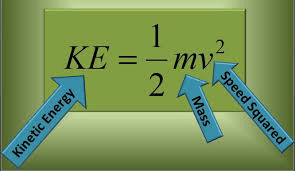
16.2 Joules
Which of the following is an example in which energy produces a force that causes motion:
A) Energy from the sun is transferred to plants for food.
B) A rock lying on the ground possess potential energy.
C) Pushing a box across the floor.
D) Holding a bunch of books while standing in line to go to class.
C) Pushing a box across the floor.
What is the main difference between Gravitational Potential Energy and Elastic Potential Energy?
A) One of them measures energy when you are outside, while the other one is used to measure energy inside a building.
B) One is used in space while the other is used on Earth.
C) Gravitational depends on the height of an object, while elastic depends on the shape.
D) One is used to measure distance and the other is used to measure density.
C) Gravitational depends on the height of an object, while elastic depends on the shape.
In the process of fusion, nuclear energy is:
A) Absorbed when a nucleus splits
B) Released when a nucleus splits
C) Released when nuclei join
D) Absorbed when nuclei switch places.
C) Released when nuclei join
An energy _______________ is the movement of energy from one object to another.
A) charge
B) transformation
C) level
D) transfer
D) Transfer
A woman is walking at a speed of .4 m/s. Her mass is 60 kg. Calculate the woman's Kinetic Energy using the formula below (Use a calculator).
K.E. = 1/2 x Mass (Speed ^ 2nd power)
4.8 Joules