Name That Energy
Energy Transformations
Will It Work?
Follow the Path
Circuit Challenge
100
What form of energy makes objects move?
Mechanical energy
100
A plugged-in lamp turns on. What transformation produces its light?
Electrical → light
100
A student has three bulbs, five wires, and a switch. What essential component is missing?
A power source, such as a battery.
100
Wire 6 is removed. How many bulbs remain lit?
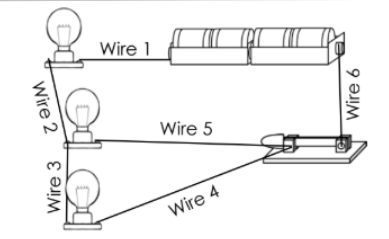
Zero. Wire 6 is part of the shared connection to the battery.
100
Wire 1 is removed. How many bulbs remain lit?
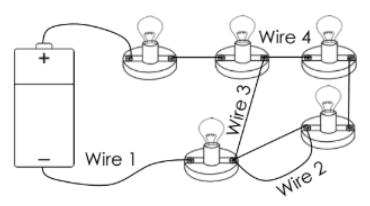
Zero. The connection back to the battery is broken for every bulb.
200
What form of energy is stored in a battery?
Chemical energy
200
An electric fan’s blades begin spinning. What transformation makes the blades move?
Electrical → mechanical
200
A student replaces part of a wire with a plastic straw. Will the bulb light? Explain.
No. Plastic is an insulator, so it interrupts the conducting path.
200
Wire 3 is removed. Which bulbs remain lit?
The top and middle bulbs. The bottom bulb loses its complete path.
200
Two bulbs are connected together on each of two branches. One bulb burns out. A student says, “Every other bulb will stay lit because there are separate branches.” Explain the mistake.
The other bulb on the same branch also goes out. Only the bulbs on the unbroken branch stay lit.
300
A toaster warms a slice of bread. What form of energy heats the bread?
Thermal energy
300
A battery-powered speaker plays music. Give the energy transformations in order.
Chemical → electrical → sound
300
Both wires from a bulb connect to the same side of the battery terminal. What must change for the bulb to light?
The connections must form a complete path through the bulb and both battery terminals.
300
Wire 5 is removed. Which bulbs remain lit? Explain why.
The top and bottom bulbs remain lit because they still have a complete path through the battery, wires 1, 2, 3, 4, and 6, and the closed switch. The middle bulb’s path is broken at Wire 5.
300
Wire 4 is removed. Which three bulbs remain lit?
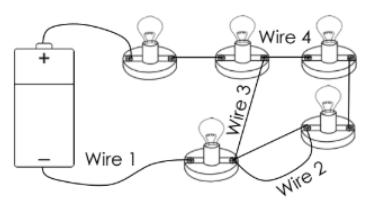
The top-left, top-middle, and bottom-left bulbs. Wire 3 keeps their path complete. The two right-hand bulbs lose their path.
400
A television produces pictures and voices. What two forms of energy do you observe?
Light and sound energy
400
Sunlight reaches a solar panel that powers a small motor. What transformations make the motor spin?
Light → electrical → mechanical
400
Three bulbs share one path through a battery. One bulb burns out and breaks that path. What happens to the other bulbs?
They go out because their only complete path is broken.
400
Wire X is removed. Which bells continue ringing, and why?
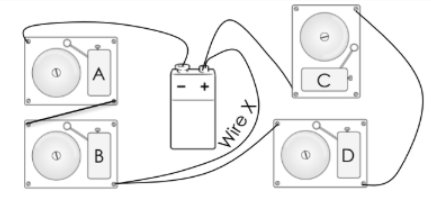
All four bells - A, B, C, and D will continue ringing because they still have a complete path connecting both battery terminals.
400
Sunlight reaches the solar panel. Which switch should be closed to charge the battery while keeping the bulb off?
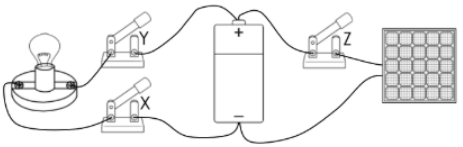
Switch Z only. Keep X and Y open.
500
A student says a flashlight creates energy. Explain what actually happens.
Energy changes forms. The flashlight transforms chemical energy into electrical energy, then light and thermal energy.
500
An electric pencil sharpener sharpens a pencil and makes noise. Identify its starting energy and two output forms.
Electrical energy transforms into mechanical and sound energy.
500
Design a circuit with three bulbs so that if any one bulb burns out, the other two stay lit. Describe how to connect them.
Put each bulb on its own branch connecting both battery terminals—a parallel circuit.
500
Which wire could you remove so that only Bells A and B continue ringing?
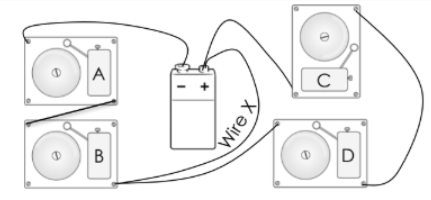
Remove the wire connecting Bell B to Bell D.
500
Switches X and Z are closed, but Y is open. Will the bulb light? Explain.
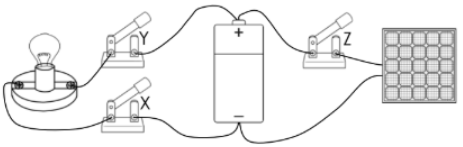
No. Switch Y breaks the bulb’s path. Closing X alone does not complete that path.