Zeros
Division and
remainder thm
remainder thm
End Behavior
Multiplicity
Mystery
100
Identify the zeros of the following polynomials:
f(x) = (x + 3)(x - 2)(x + 7)
(-3, 0)(2, 0)(-7, 0)
100
Divide the following polynomial:
(x^3+x^2-22x-40)
divide (x+2)
(x + 2)(x - 5)(x + 4)
100
Describe and sketch the end behavior of the following polynomial:
Deg:
Pos or neg:
f(x)=(4x+3)(x-1)
Deg: 2, even
Positive
x -> -oo, f(x)-> oo
x -> oo, f(x)-> oo
100
Describe the multiplicity (what type of function) of each factor:
(x-6)(x+4)^3
(x-6) - linear (straight line)
(x+4) - Cubic (s-shaped)
100
True or false: Is the polynomial in standard form? If not, put it into standard form.
x^4+3x^3+2+x+5x^5+8x^2
False
5x^5+x^4+3x^3+8x^2+x+2
200
Given the following x-intercepts, write the factored form expression:
(-5, 0)(-2, 0)(1, 0)
f(x) = (x + 5)(x + 2)(x - 1)
200
Use the remainder theorem to evaluate (x - 4):
What does the answer tell you about (x - 4)
f(x)= 2x^3-4x^2-7x-10
remainder = 26
(x - 4) is not a factor
200
What was the degree, and was the following function positive or negative:
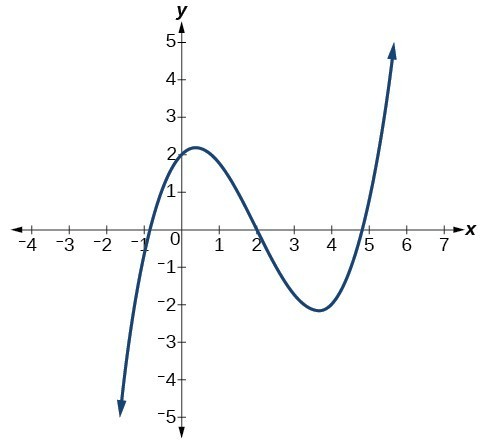
odd degree, positive
200
Determine the multiplicity of the following polynomials:
y=(x+2)^2(x-1)
x = -2
Multiplicity: Even or Odd
Behavior: Cross or Bounce
x = 1
Multiplicity: Even or Odd
Behavior: Cross or Bounce
x = -2
Even, Bounce
x = 1
Odd, Cross
200
Which form is most helpful for finding zeros/x-intercepts?
Factored form
300
Identify the zeros of the following polynomials:
f(x) = x (x - 10)(x - 9)(x + 1)
(0, 0)(10, 0)(9, 0)(-1, 0)
300
Divide the following polynomial:
(x^3+3x^2-73x-315)
divide (x-9)
(x + 7)(x + 5)(x - 9)
300
Describe and sketch the end behavior of the following polynomial:
Deg:
Pos or neg:
f(x)= -x^2(x+3)^3
Deg: 5, odd
Negative
x -> -oo, f(x)-> oo
x -> oo, f(x)-> -oo
300
Describe the multiplicity (what type of function) of each factor:
(x-4)^2(x+9)
(x-5) - quadratic (u-shaped)
(x+7) - Linear (straight line)
300
is (x+7) a factor of
x^3+2x^2-41x-42
? How do you know?
Yes since there is no remainder!
400
Given the following x-intercepts, write the factored form expression:
(3, 0)(2/3, 0)(-6, 0)(0, 0)
f(x) = x (x - 3)(x - 2/3)(x + 6)
400
Use the remainder theorem to evaluate (x - 3):
What does the answer tell you about (x - 3)
f(x)=-2x^3+8x^2-3x-9
Remainder = 0
(x - 3) is a factor because there is no remainder
400
What was the degree, and was the following function positive or negative:

Even degree, positive
400
Determine the multiplicity of the following polynomials:
y=(x+5)(x+4)^3
x = -5
Multiplicity: Even or Odd
Behavior: Cross or Bounce
x = -4
Multiplicity: Even or Odd
Behavior: Cross or Bounce
x = -5
Odd, Cross
x = -4
Odd, Cross
400
Which form is most helpful for finding y-intercepts?
Standard form
500
Identify the zeros of the following polynomials:
f(x) = 3x (2x - 1)(3x - 2)(x - 7)
(0, 0)(1/2, 0)(2/3, 0)(7, 0)
500
Divide the following polynomial:
(x^3+3x^2-49x-147)
divide (x+3)
(x + 3)(x - 7)(x + 7)
500
Describe and sketch the end behavior of the following polynomial:
Deg:
Pos or neg:
f(x)= -5x(4x+3)^3(x-1)^2
Deg: 6, even
Negative
x -> -oo, f(x)-> -oo
x -> oo, f(x)-> -oo
500
Describe the multiplicity (what type of function) of each factor:
x^3(x-5)^2(x+7)
x^3 - cubic (s-shaped)
(x - 5) - quadratic (u-shaped)
(x + 7) - linear (straight line)
500
Determine the number of zeros of the following polynomial:
5x^3+x^2+3+x^7+x
7