Socialisation and Gender
Group Social Influence
Prosocial Behaviour and Bystander Intervention
Aggression, Attraction and Relationships
Attitudes and Social Identity
Attributions, Biases and Prejudice
Culture and Community
Research and Applied Psychology
100
Discriminate between primary and secondary socialisation.
Primary socialisation occurs through close relationships, particularly with family members, and begins early in life.
Secondary socialisation occurs through wider social influences, such as schools, peers, workplaces and the media.
100
Identify the type of social influence in each situation:
- Publicly agreeing with a group while privately disagreeing
- Adopting a behaviour to be like an admired group
- Accepting a group’s beliefs as genuinely correct
- Compliance
- Identification
- Internalisation
100
Define prosocial behaviour.
Prosocial behaviour is voluntary behaviour intended to help or benefit another person or group.
100
Identify the four social or cognitive origins of attraction.
- Proximity
- Reciprocity
- Similarity
- Self-disclosure
100
Identify the three components in the tri-component model of attitudes
- Affective component: feelings or emotions
- Behavioural component: actions or behavioural intentions
- Cognitive component: beliefs or thoughts
These are sometimes remembered as the ABC components.
100
Discriminate between situational and dispositional attributions.
A situational attribution explains behaviour using external circumstances or environmental factors.
A dispositional attribution explains behaviour using internal characteristics such as personality, motives or ability.
100
Describe culture using behaviours, beliefs and values.
Culture is a shared system of behaviours, beliefs and values learned and communicated among members of a group.
Behaviours are observable actions, beliefs are ideas accepted as true, and values are principles about what is important or desirable.
100
Discriminate between implicit and explicit racism.
Explicit racism involves conscious and openly expressed prejudiced beliefs or discriminatory behaviour.
Implicit racism involves automatic or less conscious associations that may influence judgements and behaviour without deliberate awareness.
200
Define gender in a psychological context.
Gender refers to the socially and psychologically constructed roles, behaviours, identities and expectations associated with being male, female or another gender.
200
Discriminate between conformity and obedience.
Conformity involves changing behaviour or beliefs in response to real or imagined group pressure.
Obedience involves following a direct instruction from a person perceived to have legitimate authority.
200
Discriminate between the reciprocity principle and social responsibility.
The reciprocity principle is the expectation that people should help those who have previously helped them.
Social responsibility is the expectation that people should help those who need assistance, even when no direct benefit or repayment is expected.
200
Explain how proximity and reciprocity can contribute to attraction.
Proximity increases opportunities for repeated interaction, familiarity and relationship development.
Reciprocity increases attraction because people tend to like those who communicate that they like and value them.
200
Discriminate between explicit and implicit attitudes.
Explicit attitudes are conscious attitudes that a person can deliberately report.
Implicit attitudes are automatic or less conscious evaluations that may influence behaviour without deliberate awareness.
200
A driver assumes another motorist is careless after they suddenly change lanes, without considering that they may be avoiding an obstacle.
Identify and explain the attribution error.
This demonstrates the fundamental attribution error. The driver overestimates a dispositional explanation - carelessness - and underestimates a possible situational explanation - the obstacle.
200
Discriminate between individualist and collectivist cultures.
Individualist cultures tend to emphasise independence, personal goals and individual achievement.
Collectivist cultures tend to emphasise interdependence, group goals, family obligations and social harmony.
These are broad cultural tendencies and do not describe every individual within a culture.
200
Identify the four conditions that make intergroup contact most effective in reducing prejudice.
- Sustained contact
- Equality of status
- Mutual interdependence
- Superordinate goals
300
A child sees an older sibling praised for playing with a toy considered appropriate for their gender. The child begins playing with similar toys.
Explain this behaviour using social learning theory.
The child observes and models the sibling’s behaviour. Seeing the sibling receive praise provides vicarious reinforcement, increasing the likelihood that the child will imitate the behaviour.
300
Discriminate between descriptive and injunctive social norms.
Descriptive norms communicate what most people actually do.
Injunctive norms communicate what behaviours are socially approved or disapproved.
Both can influence behaviour, but drawing attention to an undesirable descriptive norm may unintentionally increase that behaviour.
300
Describe how each personal characteristic can influence prosocial behaviour:
- Empathy
- Mood
- Competence
- Altruism
- Empathy can increase helping by allowing a person to understand and share another person’s feelings.
- Positive mood often increases helping, although some negative moods may also motivate helping to reduce distress.
- People are more likely to help when they feel capable of providing effective assistance.
- Altruism involves helping primarily to benefit another person without expecting a reward.
300
Describe the principal findings of Buss et al. (1990) concerning attraction across cultures.
Across the cultures studied, men tended to place relatively greater importance on youth and physical attractiveness, while women tended to place relatively greater importance on financial prospects, ambition and status.
The strength of these preferences varied across cultures, suggesting that attraction is influenced by both biological and cultural factors.
300
A student believes environmental protection is important but regularly buys disposable products. The student feels uncomfortable and begins using reusable products.
Explain this behaviour using cognitive dissonance theory.
The inconsistency between the student’s environmental attitude and disposable-product use creates psychological discomfort called cognitive dissonance.
The student reduces the dissonance by changing their behaviour to align with their attitude and using reusable products.
300
Discriminate between self-serving bias and confirmation bias.
Self-serving bias involves attributing personal successes to internal factors while attributing failures to external factors.
Confirmation bias involves seeking, interpreting or remembering information that supports existing beliefs while overlooking contradictory information.
300
Discriminate between multiculturalism and pluralism according to the presence or absence of a dominant culture.
In multiculturalism, multiple cultural groups coexist, but a dominant culture remains present.
In pluralism, cultural groups coexist while maintaining their distinct identities without one culture being positioned as dominant.
300
Students from two rival groups must work together over several weeks to raise money for new equipment that both groups need. All students have equal responsibility.
Explain why this arrangement may reduce prejudice.
The contact is sustained rather than brief, and the groups have equal status within the activity.
The shared goal of obtaining new equipment is a superordinate goal that benefits both groups. Mutual interdependence means that neither group can succeed without cooperating with the other. These conditions encourage positive interaction and weaken negative stereotypes.
400
Explain gender-role formation according to cognitive developmental theory.
Cognitive developmental theory proposes that children actively construct their understanding of gender.
As their thinking develops, children recognise their own gender and eventually develop gender constancy - the understanding that gender generally remains stable despite changes in clothing, activities or appearance. They then seek and adopt behaviours they consider consistent with their gender identity.
400
Describe the principal findings of Asch’s 1955 conformity research.
Participants completed a simple line-comparison task after hearing confederates deliberately provide incorrect answers.
Participants conformed on approximately one-third of the critical trials, and around 75% conformed at least once. This demonstrated that group pressure can produce conformity even when the correct answer is clear.
400
Interpret the findings from a version of Latané and Darley’s 1969 smoke-filled-room experiment.
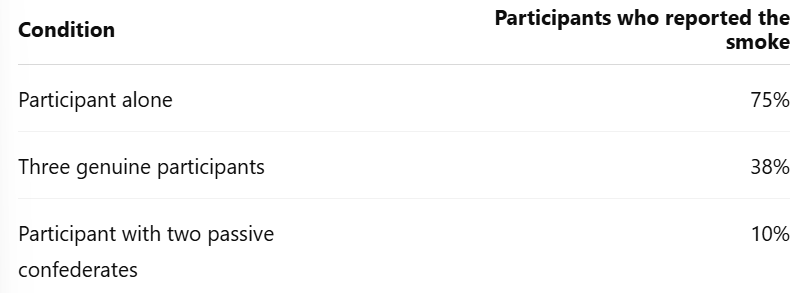
Participants were most likely to report the smoke when alone. Reporting decreased when other people were present and was lowest when the other people remained passive.
The results demonstrate the bystander effect. The presence and inactivity of others reduced the likelihood of intervention through processes such as diffusion of responsibility and social influence.
400
Arrange Rollie and Duck’s relationship-dissolution phases in the correct order and describe each phase.
Intrapsychic → Dyadic → Social → Grave-dressing → Resurrection
- Intrapsychic: one partner privately considers dissatisfaction with the relationship.
- Dyadic: the partners discuss their problems and possible dissolution.
- Social: the breakup becomes public and social networks become involved.
- Grave-dressing: each person constructs an account of why the relationship ended.
- Resurrection: the person moves forward and applies what was learned to future relationships.
400
Describe the three processes in social identity theory.
- Social categorisation: people classify themselves and others into social groups.
- Social identification: people adopt the identity, values and behaviours associated with their group.
- Social comparison: people compare their in-group with relevant out-groups, often seeking a positive group identity.
400
Contrast stereotypes, prejudice and discrimination.
- A stereotype is a generalised belief about members of a group.
- Prejudice is an attitude or evaluation, usually negative, toward a person because of their group membership.
- Discrimination is behaviour that treats people differently because of their group membership.
Stereotypes are cognitive, prejudice is primarily attitudinal and discrimination is behavioural.
400
Explain how the following elements contribute to a sense of community:
- Membership
- Influence
- Integration and fulfilment of needs
- Shared emotional connection
- Membership provides a feeling of belonging and identifies who is part of the community.
- Influence involves members feeling that they matter to the group and that the group also influences them.
- Integration and fulfilment of needs occur when community membership provides resources, support or rewards that meet members’ needs.
- Shared emotional connection develops through shared experiences, history and meaningful interactions.
400
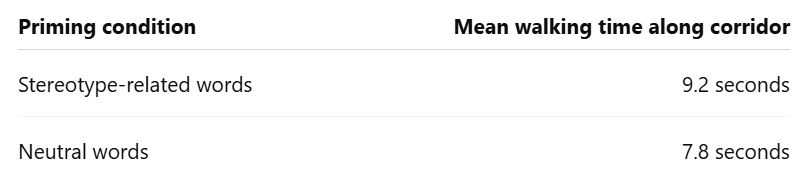
A modification of Experiment 2 from Bargh, Chen and Burrows (1996) produced the following results:
 Interpret the results.
Participants exposed to stereotype-related words took an average of 1.4 seconds longer to walk along the corridor than participants exposed to neutral words.
The result suggests that stereotype priming may have influenced behaviour outside conscious awareness. However, inferential statistics are required to determine whether the difference is statistically significant, and the data do not establish that every participant was affected.
500
Compare social learning, cognitive developmental and biological theories of gender-role formation.
- Social learning theory proposes that gender roles are learned through observation, modelling, direct reinforcement and vicarious conditioning.
- Cognitive developmental theory proposes that children actively develop their understanding of gender and adopt gender-consistent behaviours after developing gender identity and gender constancy.
- Biological theories explain gender-role formation through factors such as genes, hormones, brain development and evolutionary pressures.
Social learning emphasises environmental experience, cognitive developmental theory emphasises active thinking, and biological theories emphasise physiological and inherited influences.
500
Compare the findings of Milgram’s obedience research and Haney, Banks and Zimbardo’s prison research.
Milgram found that participants were often willing to obey an authority figure’s instructions even when they believed they were harming another person. In the original condition, 65% continued to the maximum labelled voltage of 450 volts.
Haney, Banks and Zimbardo found that participants rapidly adopted assigned prisoner and guard roles. Some guards behaved abusively, while some prisoners showed significant emotional distress. The study was terminated after six days.
Together, the studies suggest that authority, assigned roles, institutional status and situational power can strongly influence behaviour.
500
A student collapses in a crowded school courtyard. Several witnesses look at one another, but nobody immediately helps.
Explain the lack of intervention using three social or cognitive factors.
- Diffusion of responsibility: each witness assumes that someone else will help, reducing their personal sense of responsibility.
- Audience inhibition: witnesses fear embarrassment or negative evaluation if they misinterpret the situation.
- Social influence: witnesses observe the inaction of others and interpret it as evidence that the situation is not an emergency.
Cost-benefit analysis may also occur if witnesses judge that helping involves significant personal risk or cost.
500
A person who is already angry plays a violent video game containing repeated aggressive rewards. They interpret an accidental bump as deliberate and respond aggressively.
Explain this behaviour using the general aggression model.
The person’s existing anger is a personal input, while exposure to rewarded violence is a situational input.
These inputs influence the person’s internal state by increasing aggressive thoughts, negative affect and physiological arousal. The person interprets the ambiguous bump as intentional during the appraisal process and selects an aggressive response.
Across repeated episodes, aggressive scripts may become more accessible and influence future behaviour. However, media exposure is one contributing factor and does not guarantee aggression.
500
Supporters of two school houses view members of their own house as talented and cooperative but describe the opposing house as difficult and unfriendly.
Explain this behaviour using social identity theory.
The students categorise themselves and others according to school-house membership. They identify with their own house, making it part of their self-concept.
Through social comparison, they evaluate their in-group more positively than the out-group. This produces in-group favouritism and may contribute to negative stereotypes or prejudice toward the opposing house.
500
Describe four explanations for the formation of prejudice.
- Scapegoating: directing frustration or blame toward an accessible group that did not cause the problem.
- Direct experience and personal prejudice: developing prejudice from personal experiences or learned interpretations of them.
- Group prejudice: adopting prejudiced attitudes that are communicated and reinforced by an in-group.
- Prejudiced personality: personality characteristics, such as rigid or authoritarian thinking, increasing susceptibility to prejudice.
500
A newly arrived student initially feels confused by unfamiliar social expectations. Over time, they abandon their original cultural practices to adopt those of the dominant culture. However, they later feel disconnected from both cultures.
Identify and explain the three cross-cultural processes illustrated.
- Culture shock: the initial confusion, stress or discomfort caused by unfamiliar cultural expectations.
- Assimilation: abandoning aspects of the original culture and adopting the practices of the dominant culture.
- Marginalisation: feeling disconnected from both the original culture and the wider dominant culture.
500
A highly cohesive committee must make an urgent decision. The leader strongly supports one option, dissenting members remain silent and the group does not examine alternatives or risks.
Explain the decision-making process and predict two likely consequences.
The committee is demonstrating groupthink. Its high cohesiveness, directive leadership, time pressure and suppression of dissent encourage members to prioritise agreement over critical evaluation.
Likely consequences include:
- failure to consider alternative courses of action
- incomplete examination of risks
- an illusion of unanimity
- pressure on dissenting members
- overconfidence in the selected option
- a poorer-quality decision