General
Art/Science
Reformation
Texts
Hamlet
100
What is the Renaissance?
Meaning "Rebirth", a time period between the 1400s and early 1600s in which much innovation in sciences, art, architecture, and politics made a distinct impact on the world that many later historians would see this time as the point at which the dark, backward, ages of the medieval world ended and were "reborn" into a new modern age of progress.
100
DAILY DOUBLE
What is this statue of and who sculpted it?
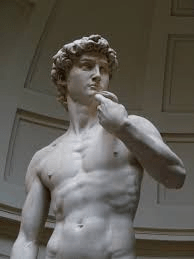
Michelangelo's statue of David, an excellent example of Renaissance humanism.
100
What is the name of the German priest and theologian who 'protested' against several of the Catholic churches practices and called for 'reform', thus starting the Protestant Reformation?
Martin Luther
100
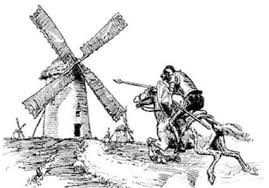
What did Don Quixote, in his mad desire for adventure, take to be wicked giants that he had to slay?
Windmills
100
What do the guards encounter on the wall?
The ghost of Hamlet's father, come to inform Halet that he was murdered by his brother, Hamlet's uncle.
200
What was 'humanism' and how did it affect the Renaissance period?
A philosophy that emphasized the study, appreciation, and inherent value of humanity, as opposed to the medieval view that held humanity as low or base in a religious or superstitious sense. Social attitudes, art, science, literature, and theology were all affected.
200
How did the invention of the printing press change the world, give at least two examples.
Bonus 50 points if you can name the inventor of the printing press.
Another 50 points if you can describe why this particular printing press was a vast improvement from previous printing methods.
The printing press allowed for the much speedier and cheaper production of materials, meaning that there was a greater demand by more people for written materials, meaning that more people gained the ability to read. Education became more available to more people and ideas spread, whether they be scientific, philosophical, or political, quicker. Literature began to be produced in the common language of people, rather than Latin, and common people started recording everyday information, like recipes in cookbooks or compositions in music books. People began to read the Bible, shifting how people related to God.
Johann Gutenberg
Movable type was the innovation that replaced copying things by hand forever.
200
For what reason did England separate from the Catholic Church and form the Anglican Church to replace it in England?
Because Henry VIII couldn't get a divorce from the Catholic Church from his first wife, Catherine of Aragon, since her powerful Spanish relatives had connections to the Pope. Thus, he broke with Rome to get the divorce, in hoping to produce a male heir for himself.
200
When Don Quixote "frees" the "princesses" he tells them that they, in keeping with the medieval rules of romance and chivalry that he has comically mistaken to be real, must give an account of themselves and Don Quixote's "deeds" to his lady. What is the name of "his lady".
Dulcinea del Toboso
Later in the book it is revealed that Don Quixote has mistaken that since chivalric knights in books always have ladies, that somehow chivalry requires that he have one too. So he picks a rather average peasant girl from his neighborhood whose real name is Aldonza Lorenzo, who is comically unaware of Don Quixote's grand affections.
200
How does the play end?
Claudius' plan to secretly poison Hamlet during his supposedly friendly fencing match with Laertes backfires, Hamlet gets stabbed with the poisoned fencing foil, but then so does Laertes and Claudius, in the confusion his mother drinks from a poisoned cup. Horatio tries to follow suit but Hamlet stops him. Fortinbras, who gets the last line in the play, arrives to get his revenge, only to find everyone already dead.
300
What three Italian cities became the biggest centers for Renaissance innovation and learning?
Florence, Venice, and Rome

300
Why did the Catholic Court of Inquisition imprison Galileo Galilei until his death in 1641?
Galileo, using math and new technologies, such as the telescope, hypothesized that the Earth revolved around the Sun, rather than vice versa, which was not in keeping with traditional Church doctrine.
300
What was the practice of 'selling indulgences'.
The idea that the Catholic Church had the power to reduce the amount of time your loved one's spent in purgatory, but would only do so if you paid them a sum of money.
300
What is the meaning behind Luther's sixth thesis?
In the Catholic Church it was believed that the Pope and other authority figures in the church had the authority and responsibility to forgive the sins of people (remember the Crusades?). Luther believed that forgiveness was offered by God alone, the Pope and other priests jobs were only to point people to humble themselves before God, not be him.
300
What does Hamlet mean by "the plays the thing in which to catch the conscience of the king"?
Hamlet is going to use the performance of a play, depicting the exact events of an evil brother killing his brother the king and marrying the queen, taking his place, to see how his uncle Claudius will act to see whether the story is true.
This also subtly shows Shakespeare making a statement that theatre is something that evokes the truth about people from them, just as it hides its actors in makeup and costumes, it reveals something about the audience.
400
For 100 points each, what is the name of the explorer who,
1. Portuguese who was first to round the tip of Africa and reach India, creating a lucrative trade route for Portugal.
2. Italian who was sponsored by the Medici bank of Spain who explored the New World.
3. Spanish explorer who was first to round the southern tip of South America.
4. An English sailor, hired by the Dutch, sailed up a North American river, hoping to find a passage to India, instead found a large bay in northern Canada.
1. Vasco da Gama
2. Amerigo Vespucci. The Americas are both named for him by a German mapmaker. Columbus was sponsored by the royalty of Spain, Ferdinand and Isabella.
3. Ferdinand Magellan. He and his party were killed by native in the Phillipines.
4. Henry Hudson, the Hudson River and Hudson Bay are named for him.
400
What are the names of Leonardo da Vinci's master techniques of blending tones into a hazy, three dimensional, realistic effect and depicting forms with contrast on light and shadow?
Sfumato and Chiaroscuro
400
During the reign of Elizabeth I, what event greatly weakened England’s Catholic enemies and saw England transforming from a non-important island nation into a great European powerhouse?
The Defeat of the Spanish Armada
400
Name one of the innovations Thomas Moore believed a perfect society would have, in Utopia.
No money is used to buy goods, public hospitals that take care of the old and sick for free, city and country dwellers take turns doing manual labor, people eat communally in dining halls where the young and old are interspersed to help the spread of wisdom, they use gold and gems to adorn toilets and children's objects to intentionally devalue them etc.
400
What is Hamlet's central moral dilemma?
Whether it is right that he avenge his father's death if it means he must murder his uncle and perhaps more importantly, his mother's new husband - making Claudius his new step-father.
The thorny relationships between father's and sons are all over this play, including: Fortinbras seeking to avenge his father by leading his armies against Poland and Denmark, Laertes fighting Hamlet for killing Polonius, his father, the skull of Yorick, who is described as a kind of father figure to Hamlet, and Ophelia going mad and committing suicide due to the death of her father.
500
According to our Matthew Gabriele article, who or what is responsible for inventing the IDEA of the Renaissance?
Renaissance era Italian writers and artists like Petrarch and Giorgio Vasari wanted to show that the art and literature of their time was inherently transcendent above the work of their ancestors, inventing terms like "Gothic" to intentionally downplay the work of medieval people. Later writers and historians in the 19th Century picked up this idea and repeated it as fact to be continued on to today.
500
How did the "Decoding da Vinci" documentary explain the Mona Lisa's enigmatic smile?
Their claim was that Leonardo da Vinci, due to his study of human anatomy and particularly the way sight works, understood how weak our peripheral vision is. According to the specialists at the Louvre, where the painting is housed, the technique of painting without lines, but only soft blending, creates an effect where Mona Lisa seems to be smiling in your blurry and indistinct peripheral vision, but when seen directly on, does not seem to smile, making her seem secretive, playful, or mystical.
500
What was the Peace of Augsburg?
An official settlement in 1555 between Catholics and Protestants within the Holy Roman Empire (modern day Germany) that allowed individual states to choose whether they would be Catholic or Lutheran.
500
In what way did our excerpt of Don Quixote show itself to use modern techniques of metafiction in it?
Metafiction is any kind of intentionally self-referential material that "breaks the fourth-wall" with the reader to indicate that the story is indeed a work of fiction in some way.
In our excerpt the narrator breaks into the story right at the height of a dramatic moment when Don Quixote is about to fight a duel, only to tell the reader that the narrator has lost the manuscript for the rest of the story, then proceeds to tell a long-winded (and somewhat comical) story, about themself, of how they found another manuscript that completed the story of Don Quixote's fight.
500
What is an example of humanism in Hamlet?
In the famous "to be or not to be" speech, among others, Shakespeare uses Hamlet to question fundamental questions about the soul and the afterlife. In previous centuries these would be questions for a priest, with well known religious answers, but here Hamlet sees death not as a transcendence to the afterlife, but a purely physical and frightening earthly reality, with much dwelling on how the body is eaten by worms and of course the famous scene in which he hold's Yorick's skull.
Short Answer: Mortality is seen in gruesome human terms, not in religious terms.