SOILED IT
OBSERVING LAND CHANGES
NATURAL RESOURCES
MORE SOIL AND RESOURCES
ALL THE THINGS
100
TRUE or FALSE: When identifying the texture of a soil, you are determining the age of the soil.
FALSE: When identifying the texture of a soil, you are determining how the soil feels.
100
TRUE or FALSE: When water freezes and expands (grows larger) within a crack it is an example of weathering.
TRUE
100
TRUE or FALSE: Animals are a nonrenewable resource.
FALSE
100
Which of the following resources is nonrenewable?
A. Air
B. Trees
C. Cows
D. Natural gas
D. NATURAL GAS
100
Correctly match the words MOVE, DROP, and BREAK to their corresponding terms DEPOSITION, WEATHERING, and EROSION.
WEATHER -- BREAK
EROSION -- MOVE
DEPOSITION -- DROP
200
A student is studying the texture of the particles in different types of soil. She is comparing soils with clay, sand, gravel, and silt in order to determine which soil has the largest particles.
Which list below has the particles listed correctly in decreasing order?
A. Sand, gravel, clay, silt
B. Gravel, sand, silt, clay
C. Sand, gravel, silt, clay
D. Gravel, sand, clay, silt
B. GRAVEL, SAND, SILT, CLAY
200
Which of the following is NOT a form of weathering?
A. Rocks rubbing against each other
B. Ice grinding the rocks
C. Plant roots growing through the rocks
D. Water moving particles from rocks downstream
D. WATER MOVING PARTICLES FROM ROCKS DOWNSTREAM
Erosion involves the movement of sediment.
Weathering is the breaking down of sediment.
200
Would a grape be considered a nonrenewable resource, a fossil resource, an alternative resource, or a renewable resource?
A RENEWABLE RESOURCE
200
TRUE or FALSE: Many of the Earth's natural resources are used up faster than they can be replaced.
TRUE: This describes the importance of conserving Earth's natural resources.
200
Water freezing in tiny holes inside a rock, breaking the rock apart as the ice expands is an examples of what process?
WEATHERING
Weathering is the breaking down of sediment.
300
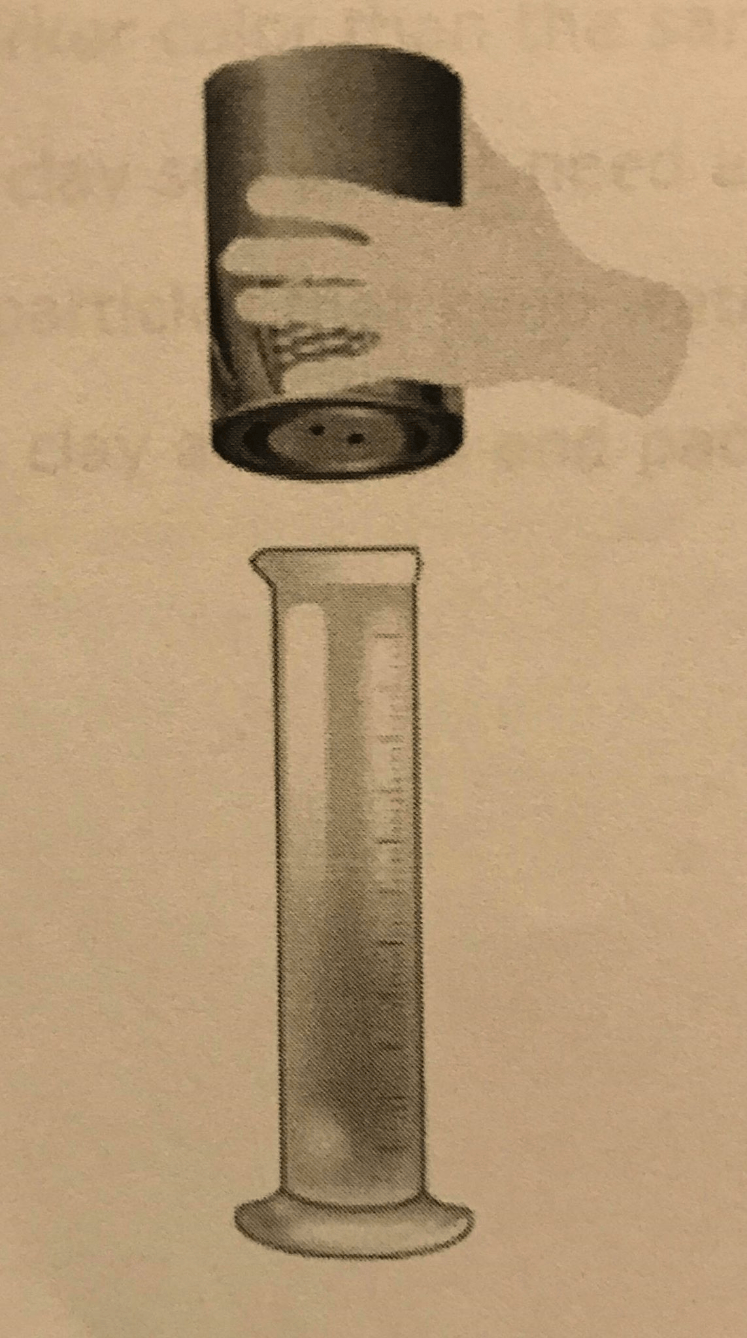
A student designs an experiment to see how the school garden soil retains water. She measures 200 grams of the soil and places it in the can with holes. She pours 50 mL of water into the can.
If the student in the above experiment expects the soil to retain most of the water, what will most likely be the results?
A. Most of the water will leak out of the can into the graduated cylinder.
B. A small amount of the water will leak out of the can into the graduated cylinder.
C. Most of the soil will leak out of the can into the graduated cylinder.
D. None of the water will leak out of the can into the graduated cylinder.
B. A SMALL AMOUNT OF THE WATER WILL LEAK OUT OF THE CAN INTO THE GRADUATED CYLINDER.
300
Most rivers form a delta at the mouth of the river where it flows into another body of water. The delta is made of silt that drops out of the water when the flow of the river decreases as it enters the other body of water.
The formation of a river delta is an example of what process?
DEPOSITION
Deposition is the dropping of sediments.
300
Which of the following statements best describes the use of renewable resources?
A. Natural gas is used to heat homes.
B. Petroleum is used in the production of paint products.
C. Plant fibers are used in the production of clothing.
D. Coal is used to generate electricity.
C. PLANT FIBERS ARE USED IN THE PRODUCTION OF CLOTHING.
Natural gas, petroleum, and coal are all nonrenewable resources.
300
WOOD, COAL, OIL, and NATURAL GAS can all be burned for heat. Which of the four comes from a renewable resource?
WOOD
300
In some areas of Texas, solid layers of rock called bedrock are beneath a thin layer of soil. Trees need to grow long, deep roots to get lots of water and hold the tree in place.
TRUE or FALSE: Trees will not grow well in areas of Texas with bedrock because the roots will not grow deep.
TRUE
400
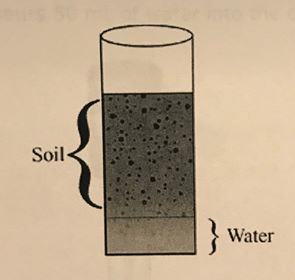
A student collected a soil sample and placed it in a clear cylinder. Next, the student added 10 mL of water to the container. The student observed that the water quickly flowed through the soil. Which of the following most likely describes the soil in the cylinder?
A. The soil sample is mostly gavel.
B. The soil sample is mostly clay.
C. The soil sample is mostly sand.
D. The soil sample is mostly humus
A. THE SOIL SAMPLE IS MOSTLY GRAVEL.
400
Which of the following describes ice changing the Earth's surface by erosion?
A. Water freezes in the cracks of a rock causing bigger cracks to form.
B. A mound of rock is left as glacier ice melts and the glacier moves.
C. Sediment frozen in the ice of a glacier moves as the glacier moves.
D. Heavy ice presses on sediment causing the formation of sedimentary rock.
C. SEDIMENT FROZEN IN THE ICE OF A GLACIER MOVES AS THE GLACIER MOVES.
Erosion involves the movement of sediments.
400
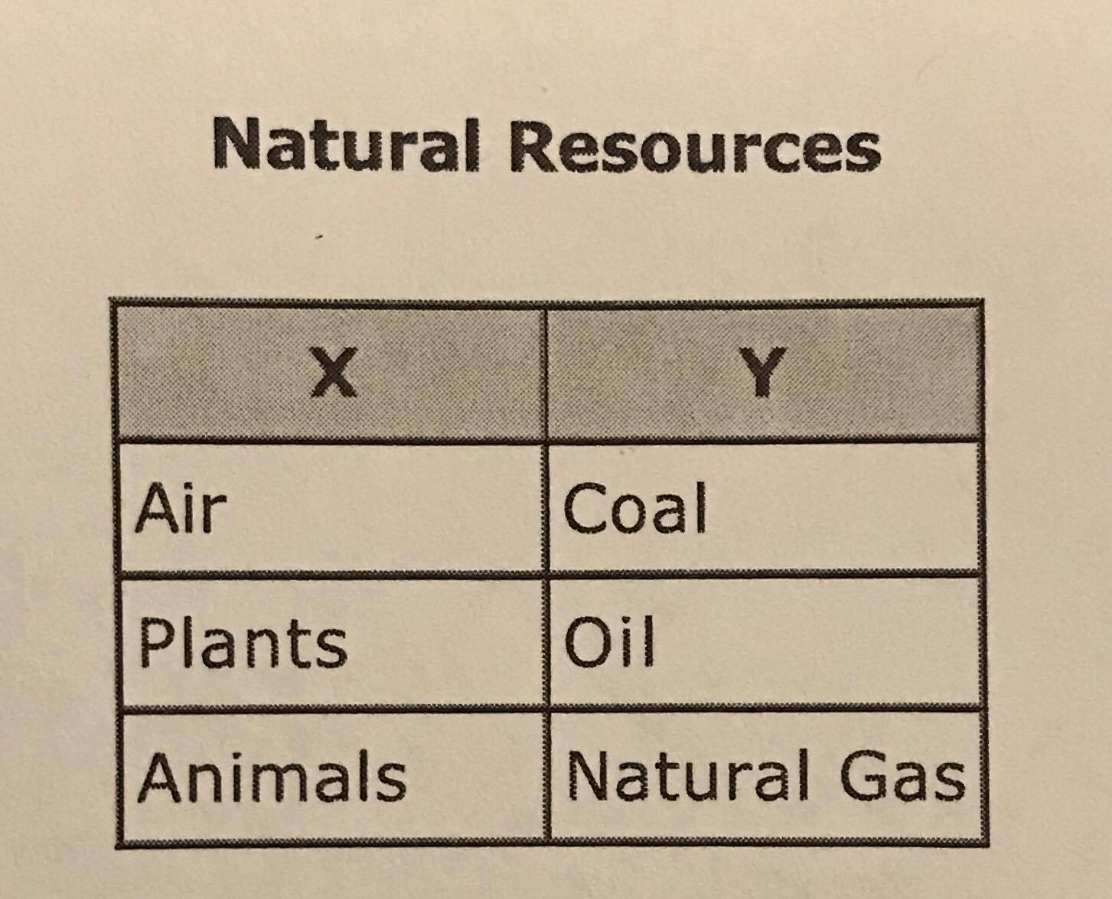
Which of the following titles best fits column X on the above table of Natural Resources?
A. Unlimited Resources
B. Renewable Resources
C. Alternative Resources
D. Nonrenewable Resources
B. RENEWABLE RESOURCES
400
What nonrenewable resource is a solid substance made from ancient trees that were buried millions of years ago and is now mined from the ground to be used as an energy source?
COAL
400
While observing soil samples, students noticed that water poured easily through sand, but it did not easily pour through the clay soil.
What caused the clay soil to retain more water than the sand?
THE SOIL PARTICLES IN CLAY ARE SMALL AND PACKED CLOSELY TOGETHER.
500
During an investigation of soil samples, funnels are placed on top of glass beakers. Each funnel is then filled with different soil samples. Then, 100 mL of water is poured into each soil sample.
The purpose of this investigation is to determine—
A. How much water is retained by each soil sample
B. The mass of each soil sample
C. The relative density of each soil sample
D. Which soil is the darkest color
A. HOW MUCH WATER IS RETAINED BY EACH SOIL SAMPLE
500
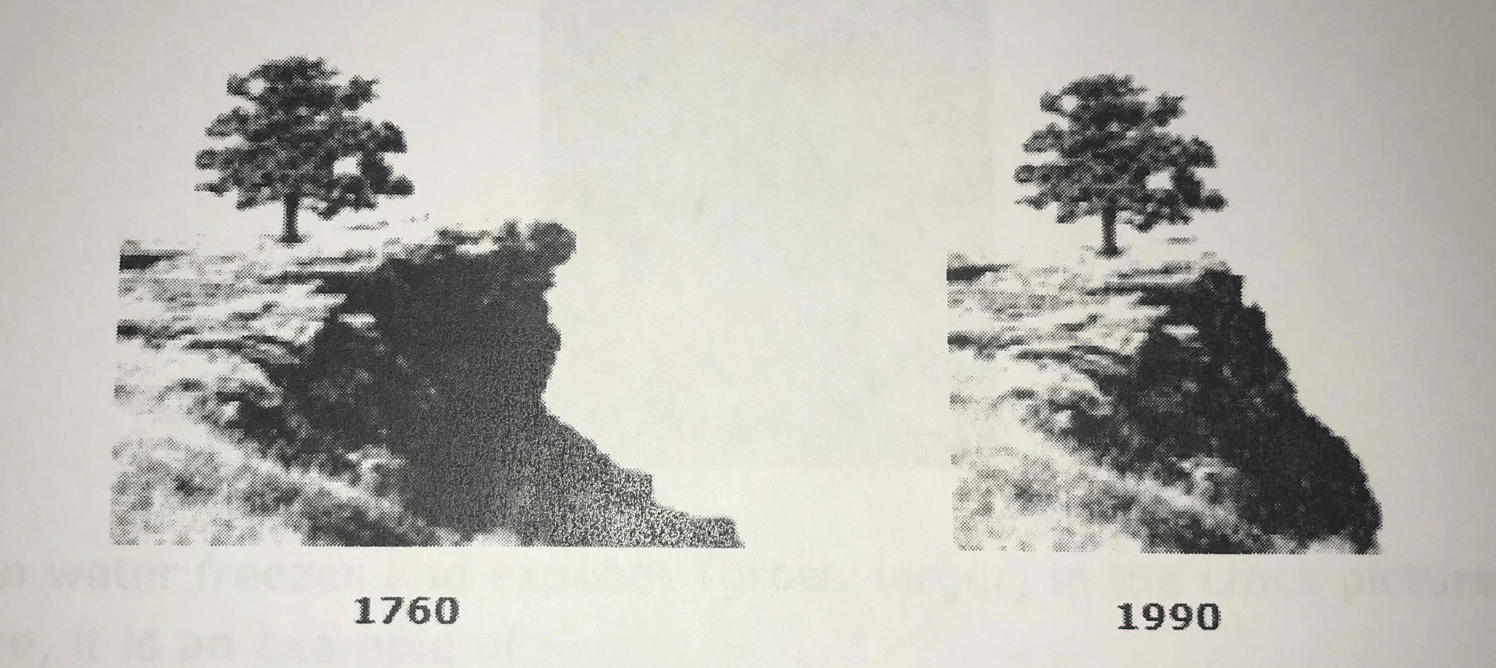
Which process changed the shape of the rock layers over time?
A. Deposition
B. Erosion
C. Evaporation
D. Faulting
B. EROSION
500
Which of the following parts of clothing is made from a nonrenewable resource?
A. A shirt made from cotton
B. Shoes made from leather
C. Plastic buttons made from oil
D. A scarf made from wood
C. PLASTIC BUTTONS MADE FROM OIL
500
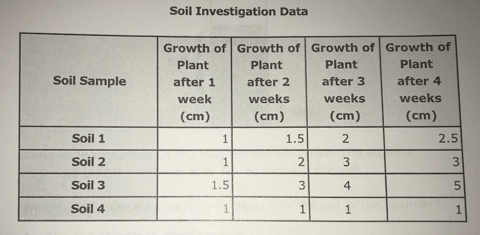
Students conducted an investigation on four different soil samples. They chose to plant black beans in the different soil types. Their data is recorded in the table above.
Based on the information provided, which soil sample is most likely the best choice for growing black beans?
SOIL 3
500
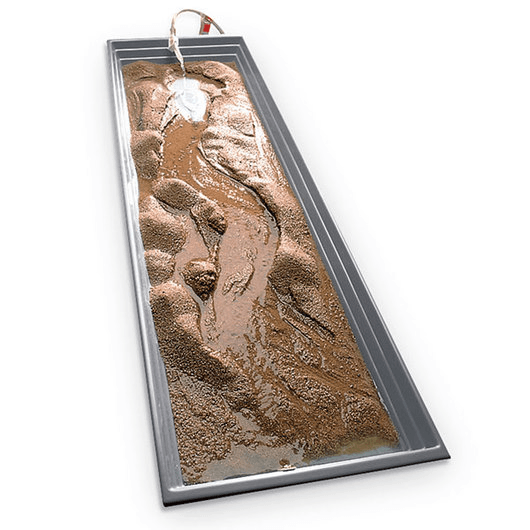
Students set up a stream table (above) to model weathering and erosion cause by water.
Based on the image, where would the most deposition occur?
A. Near the source of water
B. In the first bend of the stream
C. In the second bend of the stream
D. Near the bottom of the stream
D. NEAR THE BOTTOM OF THE STREAM