Thermal Energy
Energy Types
Energy Transformation
Nuclear, Renewable and Nonrenewable Energy
Misc.
100
Define Conduction, Convection, and Radiation
Conduction: Heat transfer through direct contact
Convection: Heat transfer in liquids/gas circulating from warm to cold
Radiation: Hate transfer through light waves
100
energy of a moving object. Energy of movement. Example: a ball beginning to roll down a hill.
Kinetic Energy
100
Which of the following scenarios represents thermal energy transfer through radiation?
a. A thermometer sitting on top of a heat lamp.
b. A person trying to unscrew a hot light bulb.
c. A child sitting in front of a space heater.
d. Swimming in the pool, and noticing that the deeper end of the pool is colder than the shallow end.
c. A child sitting in front of a space heater.
100
What does this image show?

Fission
100
THE CAMPFIRE KEEPING PATRICK AND SPONGE BOB WARM USES WHAT TYPE OF ENERGY INITIALLY?

CHEMICAL → THERMAL & LIGHT
200
Define Endothermic and Exothermic
Endothermic: Heat stored, cold, bonds made
Exothermic: Heat released, hot, bonds broken
200
Photosynthesis transforms sunlight into _____ energy.
Chemical Energy
200
a candle burning
chemical → _________
Thermal and light
200
Draw a picture of fusion
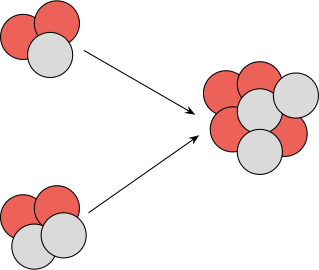
200
When does a roller coaster have kinetic energy?
When it is moving
300
A thermometer heats up when immersed in hot liquid.
Conduction
300
Answering your cell phone transforms the chemical energy in its battery into ____.
a. Electromagnetic energy
b. Radiant energy
c. Sound energy
d. All of the above
D. All of the above
300
windmill turning
Mechanical → _________
Electrical
300
Define renewable energy and Name 3 types of renewable energy
Energy that can be reused
solar, geothermal, wind, hydroelectic
300
What part of the coaster pictured above has the greatest potential energy?

The highest point because most of the energy is stored there
400
Bubbles of gas rise up from the bottom of a pot of boiling water.
Convection
400
_________energy that comes from moving electrons
Electrical
400
A gas powered car moves along a highway. (There are 3 energy types)
Chemical to thermal to mechanical
400
Sequence the steps below to correctly describe how fossil fuels form:
A. Layers of peat cover the surface of Earth
and the bottom of swamps, lakes and ocean.
B. Animals and plants die. Their decomposed
remains form peat.
C. Pressure for the weight of rock and heat
from inside Earth transform peat into fossil
fuels.
D. Layers of rock cover the peat.
B. Animals and plants die. Their decomposed
remains form peat.
400
A hot potato is sitting out on the counter. After 3 hours, you pick up the potato and notice
that it is no longer hot. Why is the potato not hot anymore?
a. the cold room made the potato cold
b. the potato is molded, and mold makes food cold
c. the heat from the potato went to the air
d. the potato is still hot
c. the heat from the potato went to the air
500
Explain why the air near the ceiling is usually warmer than air near the floor of a room.
Warm air rises while cold air falls
500
Match the following words with which type of energy they represent or store.
1. chemical A. bicycle
2. radiant B. uranium atom’s nucleus
3. thermal C. heat lamp warming a lizard
4. mechanical D. an apple
5. sound E. heat
6. nuclear F. cymbals crashing
7. electrical G. Charging a phone
1 D
2 C
3 E
4 A
5 F
6 B
7 G
500
A nuclear power plant providing the energy needed to light up your home (There are 4 energy types)
Nuclear to Thermal to Mechanical to Electrical
500
Categorize the following sources of energy
as renewable or nonrenewable:
• Biomass
• Coal
• Geothermal
• Moving Water
• Natural Gas
• Oil (Petroleum)
• Solar
• Wind
Renewable: Biomass, Geothermal, Moving Water,solar,wind
Nonrenewable: Coal,Natural Gas,Oil (Petroleum)
500
Why is it dangerous to swim in ice cold water?
a. the heat leaves your body
b. the cold water makes your blood freeze
c. the cold water causes your muscles to stop working
d. the heat from the water goes into your body
a. the heat leaves your body