Counting the Courts
I've Got the Power
Rewind and Review
Due Process
Criminal VS Civil
100
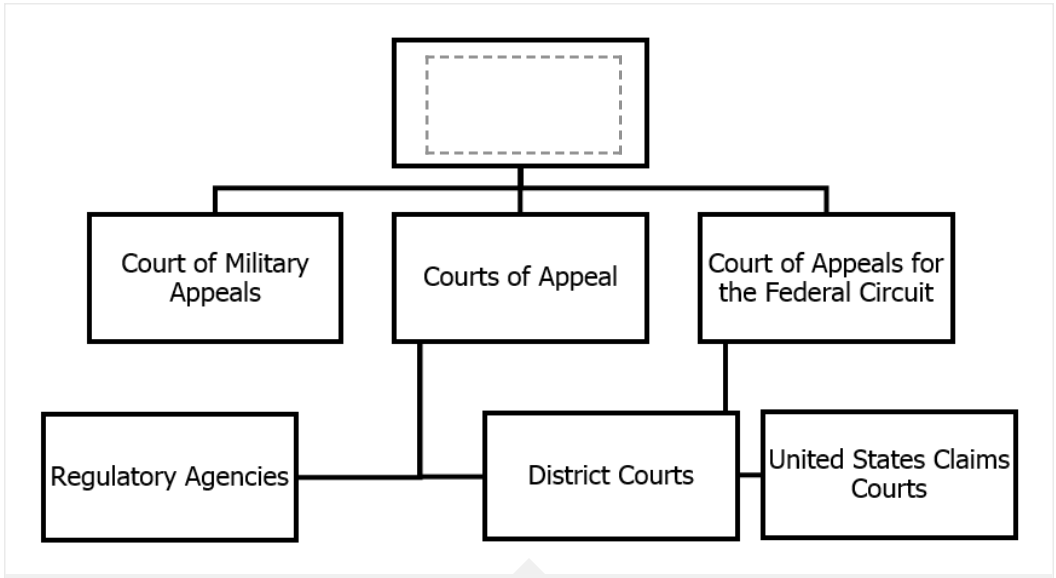 This chart shows the structure of the national court system. Which court completes the box at the very top of the federal judiciary?
What is the Supreme Court?
100
This term describes a court's legal authority to hear and decide a specific case.
What is Jurisdiction?
100
Established in 1803, this power allows the U.S. Supreme Court to declare unconstitutional laws or executive actions void.
What is Judicial Review?
100
This constitutional amendment protects citizens from being deprived of life, liberty, or property by the national government without due process.
What is the 5th Amendment?
100
While criminal cases determine guilt or innocence in breaking the law, these types of cases settle private disputes over money, contracts, or property.
What are Civil Cases?
200
This federal court operates with a panel of judges, uses no jury, and reviews decisions made by lower district trial courts.
What is the U.S. Court of Appeals?
200
Federal district courts have this specific type of authority over federal cases, meaning they are the first to hear evidence and render a verdict.
What is Original Jurisdiction?
200
Chief Justice John Marshall established the power of Judicial Review in this famous 1803 landmark Supreme Court case.
What is Marbury v. Madison?
200
This constitutional amendment extends due process protections by prohibiting state and local governments from denying equal protection.
What is the 14th Amendment?
200
In a criminal procedure, this official court event takes place where a plea is entered, an attorney is appointed, and bail is reviewed.
What is an Arraignment?
300
In the Commonwealth of Virginia, minor civil claims and misdemeanor criminal offenses are tried in this lower-level court.
What is the General District Court?
300
This term refers to an official court ruling that sets a rule or pattern for judges to follow in all future similar cases.
What is Precedent?
300
In Marbury v. Madison, Chief Justice Marshall set a major precedent by declaring part of this 1789 congressional law unconstitutional.
What is the Judiciary Act of 1789?
300
This specific type of due process focuses on HOW the government enforces laws, requiring fair steps like written notice and a public trial.
What is Procedural Due Process?
300
In a civil procedure, the defendant is officially notified that a lawsuit has been filed against them when this document is served
What is a Summons?
400
As Virginia's trial court of record, this court handles felony trials and major civil lawsuits using a judge and jury.
What is the Circuit Court?
400
This supreme court in Virginia holds final state appellate authority over all decisions made in lower state courts.
What is the Supreme Court of Virginia?
400
Judicial Review supports this constitutional principle by ensuring no federal or state law can conflict with the Constitution as the supreme law of the land.
What is Constitutional Supremacy (or the Supremacy Clause)?
400
This specific type of due process requires that the actual text and substance of a written law must be fair, clear, and constitutional.
What is Substantive Due Process?
400
To secure a guilty verdict in a criminal trial, the prosecution must meet this standard of proof beyond any reasonable doubt.
What is Proof Beyond a Reasonable Doubt?