Endo or Exo
Heating/Cooling Curves
Heat & Calorimetry
Miscellaneous
100
When heat is absorbed in a chemical reaction
What is endothermic reaction
100
At which number do the liquid and gas phase both exist?

What is 4?
100
The heat capacity of aluminum is 0.900 J/g°C. How much energy is needed to raise the temperature of a 8.50 x 10² g block of aluminum from 22.8°C to 94.6°C?
q= (850.g)(0.900J/g°C)(94.6°C-22.8°C)
q=54900 J
100
This color represents the energy pathway of a catalyzed reaction.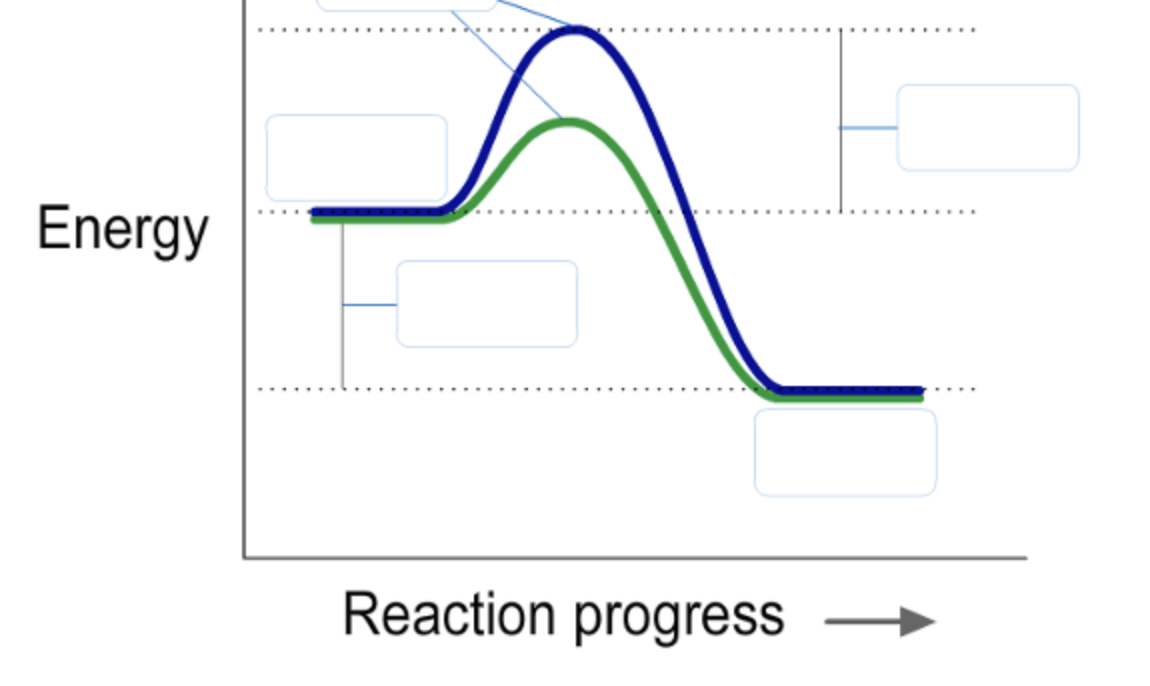
What is green?
200
heat + KClO3 --> KCl + O2
What is endothermic?
200
Calculate the heat of vaporization if this heating curve was for 6.0 g of a sample.
28 J-15 J= 13 J
13 J / 6.0g = 2.2 J/g
200
How many grams of water can be heated from 20.0°C to 75°C using 12500.0 Joules?
(specific heat of water is 4.184 J/g°C)
12500.0 = (m)(4.184 J/g°C)(75-20.0)
m= 54 g
200
This letter shows the Ea of the reaction:

What is B?
300
Does the graph represent and endothermic or exothermic reaction?

What is exothermic?
300
The amount of heat needed to warm a 8.5 g ethanol sample from -100.0 °C to the gas phase.

-100.0 °C --> 78 °C (bp) + boiling
mclT + mHv =q
(8.5g)(2.45 J/g°C)(178°C) + (8.5g)(841 J/g)=
11000 J
300
A coffee-cup calorimeter contains 150. g of water at 24.6 °C. A 110. g block of molybdenum metal is heated to 100.0°C and then placed in the water in the calorimeter. The contents of the calorimeter come to a temperature of 28.0°C. What is the specific heat capacity of the molybdenum metal if the specific heat capacity of water is assumed to be 4.184 J/g°C?
qmetal=-qwater
(110.g)(cmetal)(28.0-100.0)=-(150.g)(4.184 J/g°C)(28.0-24.6)
cmetal= 0.269 J/g°C
300
This letter shows the heat (delta H) of the reaction.
What is Letter D?
400
The image demonstrating an exothermic reaction.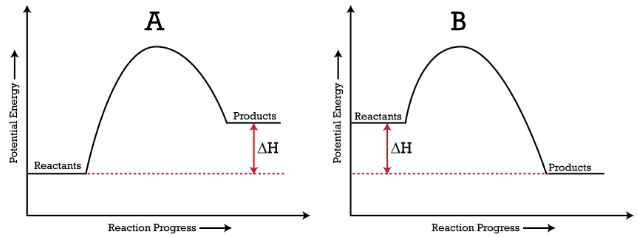
What is B: energy is being released, the products have less energy than the reactants
400
The amount of heat when 10.5 g ethanol sample cools from 0.0°C to -120.0°C
0.0°C --> -114°C + freezing + -114°C --> -120.0°C
mclT + m-Hf + mcsT =q
(10.5g)(2.45 J/g°C)(-114°C-0.0°C) + (10.5g)(-109 J/g) + (10.5g)(1.70 J/g°C)(-120.0°C- -114°C) =
-4200 J
400
A 28.4 g sample of aluminum is heated to 39.4°C, then is placed in a calorimeter containing 50.0 g of water. Temperature of water increases from 21.00°C to 23.00°C. What is the specific heat of aluminum?
qmetal=-qwater
(28.4g)(cmetal)(23.00-39.4)=-(50.0g)(4.184 J/g°C)(23.00-21.00)
cmetal= 0.898 J/g°C
400
Something that causes atoms/molecules to move quicker and thus speeds up a chemical reaction.
What is temperature/heat?
500
This letter represents a negative enthalpy (amount of heat being released).
What is D?
500
The amount of heat required when 20.5 g ethanol sample warms from -120.0°C to 120°C
-120.0°C --> -114°C + melting + -114°C --> 78°C + boiling + 78°C --> 120°C
mcsT + mHf + mclT + mHv + mcgT =q
(20.5g)(1.39 J/g°C)(-114°C- -120.0°C) + (20.5g)(109 J/g) + (20.5g)(2.45 J/g°C)(78°C - -114°C) + (20.5g)(841 J/g) + (20.5g)(1.70 J/g°C)(120.0°C-78°C) =
31000 J
500
A 2.50 g sample of zinc is heated, then placed in a calorimeter containing 65.0 g of water. Temperature of water increases from 20.00°C to 22.50°C. The specific heat of zinc is 0.390 J/g°C. What was the initial temperature of the zinc metal sample?
qmetal=-qwater
(2.50g)(0.390 J/g°C)(22.50-Ti)=-(65.0g)(4.184 J/g°C)(22.50-20.00)
Ti= 720.°C
500
A substance that increases the speed of a reaction by lowering the activation energy without being used up in the reaction.
What is a catalyst?