Name the God
P
Writing
Life After Death
Geography
100
This god of the sun is portrayed as having the head of a falcon and solar disk.
Amun-Ra
100
This social group was responsible for worshipping the gods, maintaining temples, and managing their large properties.
Priests
100
This form of writing was used in Egypt beginning in 3250 BCE. Figures or drawings were used to represent words.
Hieroglyphic Writing
100
To reach the afterlife, it was important for the body of the deceased to remain intact. This was made possible through this process which lasted 40 days.
Mummification
100
Life in ancient Egypt was made possible thanks to this river that flows North into the Mediterranean Sea.
The Nile
200
This god is the guardian of the tombs and patron of the embalmers. He has the head of a jackal.
Anubis
200
This rudimentary wooden tool was used for moving soil and planting seeds.
Plough
200
This stone made it possible to decipher ancient Egyptian writing. It was deciphered by Jean François Champollion in 1822.
Rosetta Stone
200
The deceased had to pass through this court that was made up of gods in order to make it to the after life.
Judgement of Osiris
200
These are the two natural regions in Egypt.
Upper and Lower Egypt
300
This god of the sky is represented as having the head of a falcon and a double crown.
Horus
300
This was the title taken by the Egyptian King. He was considered to be the earthly incarnation of the god of the sky.
Pharaoh
300
This type of worker was in the middle class and performed various jobs in the palace and temples writing documents and taking care of the accounts.
Scribe
300
During one's judgement after death, Anubis places the heart of the deceased on a scale. On the other side of the scale he places this item.
Feather
300
Apart from it's fertile and wet river valley, Egypt is mostly made up of this dry habitat, characterized by extremely low amounts of rainfall.
Desert
400
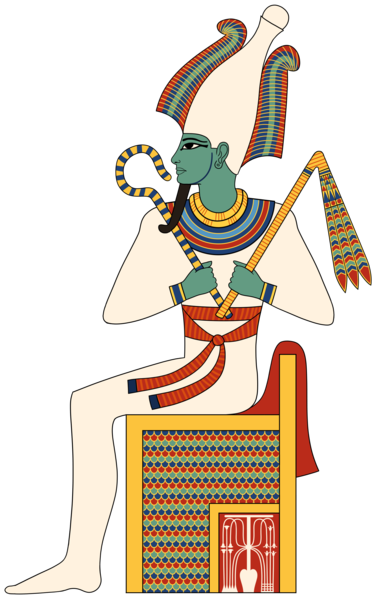
Osiris
400
These massive structures were built under the rule of the pharaohs Khufu, Khafra, and Menkaure in the large Giza plain. More than 45 remain there today.
Pyramids
400
This book was a collection of prayers and hymns designed to help deceased Egyptians through their journey in the afterlife.
Book of the Dead
400
Canopic jars were used to store these vital body parts. The lid of each jar represented the four sons of the god Horus.
Organs
400
This natural event occured every summer when rains fell and made the water levels rise. The river banks became wet and fertilized thanks to annual occurence. The Pharaoh also "ensured" that these occured every year.
Floods/Flooding
500
This is the goddess of love, happiness, and music.
Hathor
500
During this kingdom (715-31 BCE) Egypt fell into decline and was dominated by foreigners such as the Assyrians, Babylonians, and Persians.
Ptolemaic
500
These were where Pharaohs were buried. The walls were often covered in ancient Egyptian writing.
Tombs
500
Those with guilty souls would fail the journey to the afterlife and have their heart devoured by this monstruous creature.
Ammit
500
The valley or black land was known as the place of life and is where cities and farms were built. On the other hand, this place in the desert was where the Egyptians buried their dead and built their funerary temples.
Place of Death