Vectors Operations
Dot Product
Cross Product
Ramps
100
Find the magnitude of
\vec{v}=(:-2, -3, 6:)
||\vec{v}||=7
100
Two vectors and their magnitudes are shown below. Calculate \veca*\vecb , rounded to the nearest hundredth.
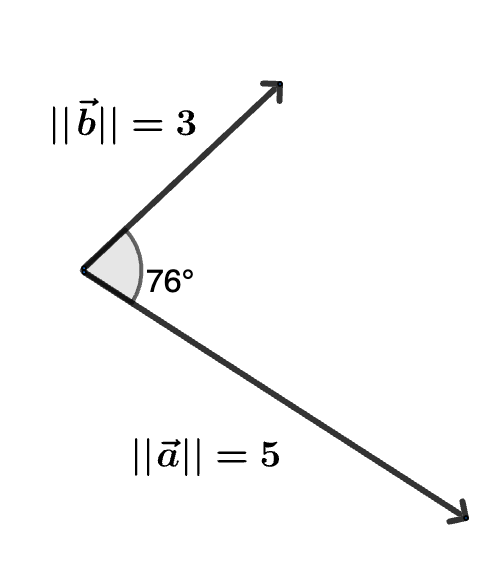
3.63
100
Determine the resultant vector of each of the following cross products:
1. \vec ixx\vecj
2. \vec jxx\veci
3. -\vec ixx\vecj
4. -\vec jxx-\veci
\veck
-\vec{k}
-\vec{k}
-\vec{k}
100
Given a 500lb box on a ramp at an incline of 10 degrees, calculate:
1. The force on the box due to gravity parallel to the ramp.
2. The force on the box due to gravity perpendicular to the ramp.
1. Parallel
500cos80^circ~~86.82
2. Perpendicular
500sin80^circ~~492.4
200
Find two vectors \veca and vecb such that veca-\vecb=(:2, 0, 5:) .
Answers vary.
200
Given \vec{a}=2\veci+3\vecj-4\veck and \vec{b}=2\veci+5\vecj-3\veck , evaluate \veca*\vecb
31
200
Determine the resultant vector of each of the following cross products:
1. \vec jxx\veck
2. \vec kxx-\veci
3. \vec jxx\vecj
4. -\vec kxx\vecj
1. \veci
2. -\vecj
3. \vec{0}
4. \veci
200
A 100lb box sits on a ramp at an incline of 23 degrees, the coefficient of friction between the box and the ramp is 0.18. Will the box slide down the ramp?
Yes, the force parallel to the ramp is about 39.1 lbs, and the maximum force friction can exert is about 16.6 lbs. Thus the net force down the ramp is 22.5 lbs and the box will slide down the ramp.
300
Given \vec{a}=2\veci+3\vecj-4\veck and \vec{b}=2\veci+5\vecj-3\veck , evaluate 2\vec{a}-\vec{b} .
2\veci+\vecj-5\veck
300
Given \vec{a}=2\veci+10\vecj-25\veck and \vec{b}=8\veci-11\vecj-16\veck , determine the angle between \veca and \vecb , rounded to the nearest whole number.
57^\circ
300
Given:
\vec{a}=(:1, -2, -3:)
\vec{b}=(:2, 0, 4:)
Find:
\vecaxx\vecb
\vec{a}xx\vec{b}=(:-8, -10, 4:)
300
A 225 lb box sits on a ramp at an incline of 14 degrees, the coefficient of friction between the box and the ramp is 0.21. How much force is required to push the box up the ramp?
Approximately 100.3 lbs.
400

2u-v
400
Decompose \veca=(:3,1:) into a sum of two vectors, one parallel to \vecb=(:5,-2:) and one that is perpendicular to \vecb=(:5,-2:) . Store values and round final answers to the nearest tenth.
Parallel:
(:2.2, -0.9:)
Perpendicular:
(:0.8, 1.9:)
400
Given:
\vec{a}=(:3, 4:)
\vec{b}=(:-2, 5:)
Find:
\vecaxx\vecb
\vec{a}xx\vec{b}=(:0, 0, 23:)
400
A car is parked on a steep hill with a 32 degree incline. What must the coefficient of friction be between the car tires and the road so that the car does not slide down the hill?
\mu =cot58^circ~~0.625