What is History?
How Does a Historian Work?
PART 1
PART 1
How Does a Historian Work?
PART 2
PART 2
100
A group of ten years is known as a ______________.
a.) century.
b.) decade.
c.) era.
d.) millennium.
b.) decade.
100
When studying history, you should
a.) base your conclusions on other historians’ opinions.
b.) take into account how people view events in present times, not past.
c.) draw conclusions based on evidence.
c.) draw conclusions based on evidence.
100
Cave paintings from prehistoric eras would be considered
a.) fossilized remains.
b.) historical data.
c.) primary sources.
d.) secondary sources.
c.) primary sources.
200
The Gregorian calendar
a.) lost one day every 128 years.
b.) is also known as the Hebrew Calendar.
c.) is still in use today.
d.) was developed by Julius Caesar.
c.) is still in use today.
200
To learn the answers to historical questions, historians
a.) look for evidence.
b.) seek out other historians with the same point of view.
c.) make guesses about what they think might have happened.
d.) interview individuals who know about significant historical periods.
a.) look for evidence.
200
What could historians conclude by studying the evidence from the cave painting?
a.) The people lived in caves.
b.) They used bows and arrows to hunt.
c.) They were fast runners.
d.) Art was their only means of communication.
b.) They used bows and arrows to hunt.
300
TRUE OR FALSE
Prehistory refers to the era of time before people developed writing.
TRUE
300
A reliable source
a.) may contain some biased information.
b.) is written from a trustworthy point of view.
c.) is usually a secondary source.
d.) must be a primary source.
b.) is written from a trustworthy point of view.
300
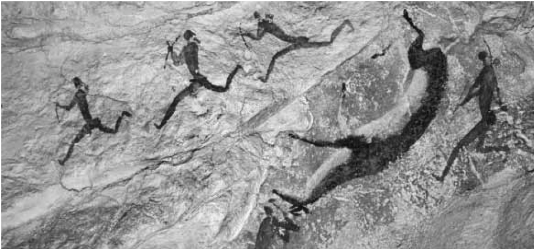
Why didn’t this cave painting include a written description of what was happening?
a.) The artist intended it to be just an artistic work.
b.) It was drawn before people learned to use written language.
c.) Because it was in a cave, it was too dark to do any extensive writing.
d.) The dyes used for the pictures were not suited to writing.
b.) It was drawn before people learned to use written language.
400
A group of 100 years is known as a(n)
a.) century.
b.) decade.
c.) era.
d.) millennium.
a.) century.
400
An example of a secondary source would be
a.) a ship’s manifest.
b.) an explorer’s journal.
c.) the biography of a pharaoh.
d.) an arrowhead found at a dig site.
c.) the biography of a pharaoh.
400
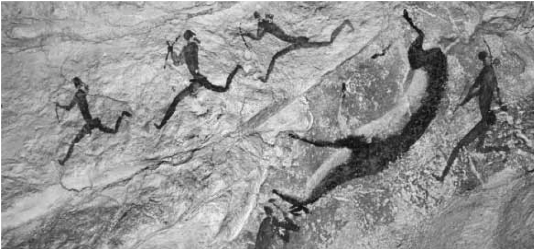 What can you infer from the cave painting?
a.) The artist was a man.
b.) Animal blood was used as paint.
c.) The people worshipped animals.
d.) Hunting was important to the people.
d.) Hunting was important to the people.
500
Historians can learn about ancient civilizations by studying items such as weapons, tools, and pottery, which are called
a.) fossils.
b.) species.
c.) treasure.
d.) artifacts.
d.) artifacts.
600
The most important fact that helped scientists connect modern humans to their ancient ancestors regarding the discovery of the skeleton “Lucy” in Africa in 1974 was that it
a.) had long arms and short legs.
b.) was only 3 1/2 feet (1.1 m) tall.
c.) was 3.2 million years old.
d.) walked upright.
c.) was 3.2 million years old.