Synthetic Division
Factoring!
Rational Root Theorem
Factor & Remainder Theorem
Potpourri
100
Complete using Synthetic division:
(x^4+2x^3-7x^2-8x+12)/(x-2)
x^3+4x^2+x-6
100
Factor
x^3+8x^2-x-8
(x+8)(x+1)(x+1)
100
State the possible rational roots of
f(x)= x^5-4x^4-12x^2-61x+12.
Possible rational zeros: ±1,2,3,4,6,12
100
Use the remainder theorem to find reminder when dividing f(x)=2x^4-5x^2+8x-7 by (x-6) .
f(6)=2453 , so the remainder would be 2453
100
Write in standard form:
(2g^4-3g+9)+(-g^3+12g)
2g^4-g^3+9g+9
200
Complete using Synthetic division:
(x^3+3x^2-x+2)/(x-1)
x^2+4x+3+(5)/(x-1)
200
Factor
12x^4+5x^2-2
(3x^2+2)(2x-1)(2x+1)
200
State the possible rational roots of
f(x)= 3x^4-10x^3-24x^2-6x+15.
Possible rational zeros: ±1,3,5,15,1/3,5/3
200
Use the factor theorem to show that (x+6) is a factor of f(x)=x^3-31x+30.
f(-6)=0 , so (x+6) is a factor.
200
Write in standard form:
(-8x^2-2x+9)(6x-2)
-48x^3+4x^2+58x-18
300
Complete using Synthetic division:
(x^3+27) / (x+3)
x^2-3x+9
300
Factor the polynomial. Use the given root to help.
f(x)=x^3+6x^2-x-30; x+3
f(x)=(x+3)(x-2)(x+5)
300
State the possible rational roots and find the actual rational roots.
f(x)= x^3-5x^2+2x+8?
Possible rational zeros: ±1,2,4,8
Actual Rational Roots: x=-1,2,4
300
List the possible rational roots. Use the factor theorem to determine which have corresponding factors.
f(x)=2x^3+-5x^2-14x+8
Possible Roots: ±1,2,4,8,1/2
f(1/2)=0, f(-2)=0, f(4)=0
factors: f(x)=(2x-1)(x+2)(x-4)
300
Complete the operation below
(x^3+5x^2-3x-1)/(x-1)
x^2+6x+3+(2)/(x-1)
400
Complete using Synthetic division:
(6x^4-2x3-12x-5)/(3x-1)
2x^3+4+(-1)/(3x-1)
400
Factor & Solve the polynomial. Use the given zero to help.
f(x)=6x^4+13x^3-4x; x=-2/3
Factored: f(x)=x(3x+2)(x+2)(2x-1)
Solutions: x=0,2,-2/3,1/2
400
State the possible rational roots and find the actual rational roots.
f(x)= 5x^4-46x^3+84x^2-50x+7
Possible rational zeros: ±1,7,1/5,7/5
Actual Rational Roots: x=1,7,1/5
400
List the possible rational roots. Use the factor theorem to determine which have corresponding factors.
f(x)=x^3+14x^2-3x+9
Possible Roots: ±1,3,9
factors: NONE - Not Factorable
400
Complete the operation below
(2x^4+7x^3+4x^2-2)/(x^2+2x+1)
2x^2+2x-4+(5x+2)/(x^2+2x+1)
500
Can you complete the following with synthetic division? Why or why not?
(3x^5+5x^4+3x^3+5x^2-6x-10)/(x^2-1)
YES! (x^2-1)=(x-1)(x+1) So complete 2 consecutive synthetic divisions, one which each linear binomial factor.
500
Factor & Solve the polynomial function.
f(x)=x^4+2x^3-5x^2-4x+6
Factored: f(x)=(x-1)(x+3)(x^2-2)
Solutions: x=1,-3,±sqrt(2)
500
State the possible rational roots and find the actual rational roots.
f(x)= 2x^4+x^3-50x^2-25x
First: f(x)= x(2x^3+x^2-50x-25)
Possible rational zeros: ±1,5,25,1/2,5/2,25/2
Actual Rational Roots: x=-1/2,±5
500
What value of k would make (x-4) a factor of x^3-3x^2+kx-12?
k=-1
500
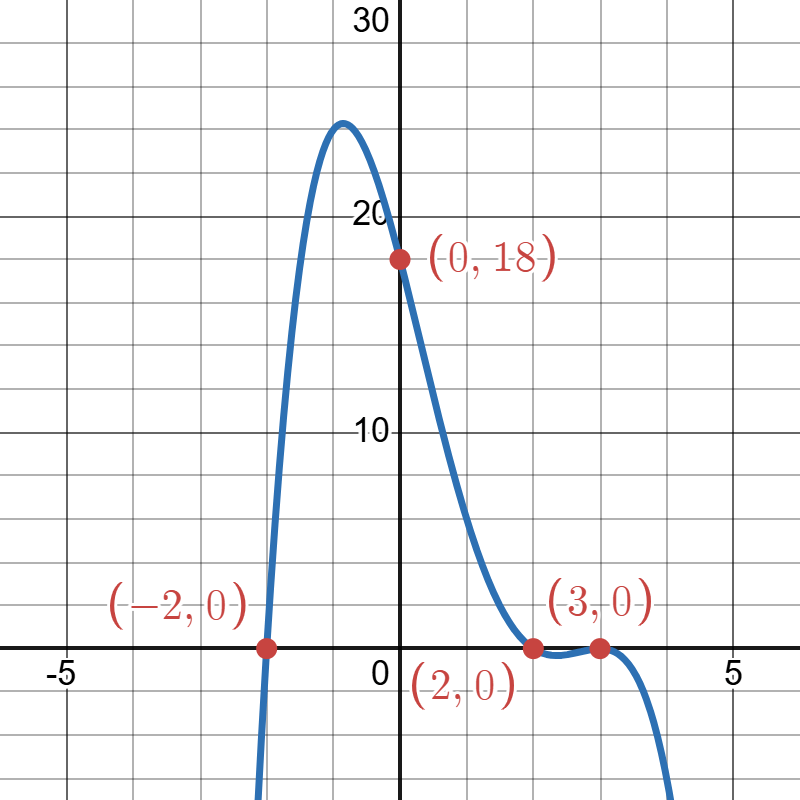
Sketch a graph of the polynomial
p(x) = -2(x-3)^2(x+2)(x+5)