Derivatives
Limits
Left & Right Riemann Sums
Reverse Power Rule
U-Sub
100
f(x)=ln(x)
1/x
100
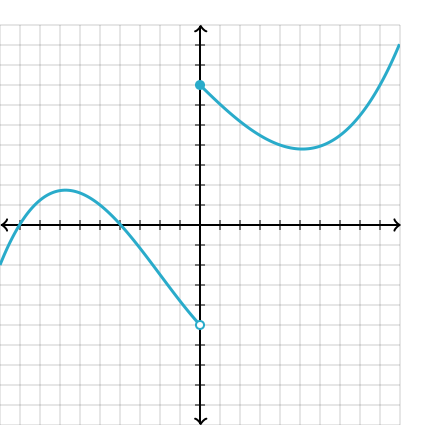
What appears to be the value of limx->0
7
100
Approximate the area between the x-axis and g(x)=2x from x=-2 to x=2 using right Riemann sum with 4 equal subdivisions.
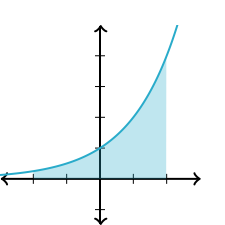
\small{1}1\small{2}2\small{\llap{-}1}-1\small{\llap{-}2}-2\small{1}1\small{2}2\small{3}3\small{4}4\small{\llap{-}1}-1g(x) = 2^xg(x)=2xyyxx
7.5 units2
100
∫ t4 dt=_____ +C
1/5t5 + C
100
∫ (18x2+3)(6x3+3x)6dx
How should you define u?
u=6x3+3x
200
Let f(x)=x5+2x3-x2
Find f'(x)
5x4+6x2-2x
200
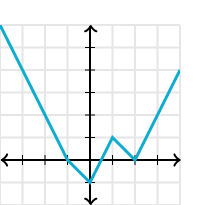
Find limx->0 (g(x)-h(x)).
-1
200
Approximate the area between h(x) and the x-axis from x=-1, x=1, using a right Riemann sum with 4 equal subdivisions.
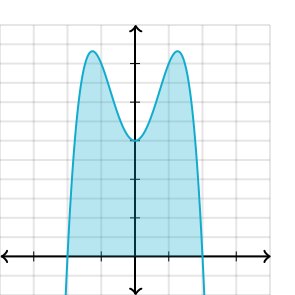
6.5
200
∫ x5 dx= ____ +C
1/6x6 + C
200
∫ sin5(x)cos(x) dx
Define u.
u=sin5(x)
300
f(x)=[−4sin(x)+9x]
Find F'
-4cos(x)+9
300
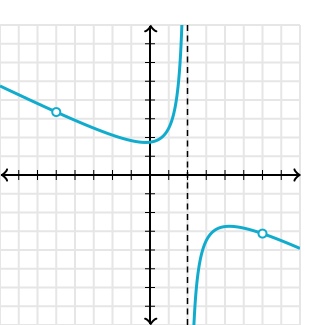
Select the x-values at which g has an infinite discontinuity.
x=2
300
Approximate the area between g(x) and the x-axis from x=2 to x=6 using a left Riemann sum with 4 equal subdivisions.
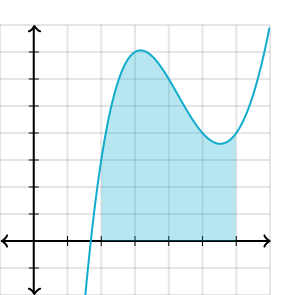
20
300
∫ x-5 dx = ____ + C
-1/4x-4 + C
300
∫01 (2x+1)ex2+x dx = ______
e2-1
400
Find the derivative of f(x)
f(x)=2x2+e2
4x
400
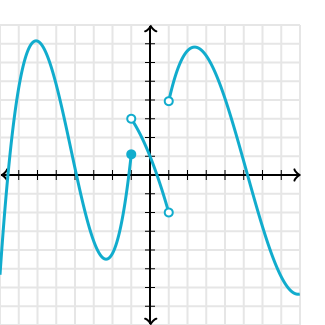
Over which intervals is g continuous?
[-6,-1]
400
Approximate the are between g(x) and the x-axis from x=0 to x=1.5 using a left Riemann sum with 3 equal subdivisions.
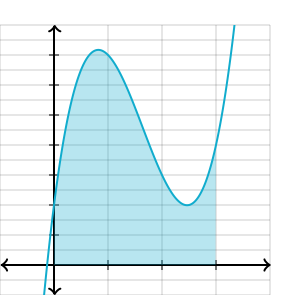
6
400
∫ x1/3 dx= ___ + C
3/4x4/3 + C
400
∫0π/6 sec(2x)tan(2x) dx = ____
1/2
500
differentiate the function f(x) = xx
exln(x)ln(x)+exln(x)
500
Which of the following functions are continuous for all real numbers?f
f(x)=tan(x)
h(x)=x3
h only
500
Approximate the area between the x-axis and h(x)=x3+2 from x=-1 to x=5 using a right Riemann sum with 3 equal subdivisions.
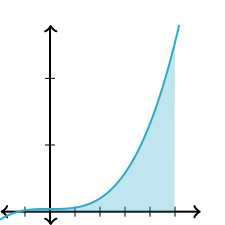
318
500
∫ x2(2x-5) dx = ____ + C
1/2x4 - 5/3x3 + C
500
∫ −sin(−x+2) dx
Define u.
u=-x+2