DNA and Proteins
Cells as the Basis of Life
Homeostasis
Evolution
Lucky Dip
100
The statement ‘All chromosomes are double stranded and linear’ is
A. always true
B. not true for eukaryotes or for prokaryotes
C. true for prokaryotes but not for eukaryotes
D. true for eukaryotes but not for prokaryotes
B. not true for eukaryotes or for prokaryotes
100
The golgi apparatus is
A. involved in packaging molecules.
B. the site of RNA synthesis.
C. involved in the later stages of respiration.
D. the site of protein synthesis.
A. involved in packaging molecules.
100
As a result of having many regulated steps in a metabolic pathway
A. fewer enzymes are required.
B. there is more heat released.
C. less regulation is needed.
D. intermediate compounds are produced.
D. intermediate compounds are produced.
100
12. A change in the mixture of species in an area over time is called
A. speciation
B. genetic variability
C. succession
D. geographic isolation
C. succession
100
How many teeth does an adult human have?
32
200
In the process of DNA profiling, which one of the following is correct?
A. Electrophoresis separates segments of DNA according to their size, with smaller fragments at the top of the gel and larger fragments at the bottom.
B. As many as 20 different DNA regions in the sample are amplified and analysed.
C. In the electrophoresis stage, overheating of the gel can be a problem because the restriction enzymes may denature.
D. An advantage of using DNA profiling is that important regions of the DNA that code for differences like eye colour can be analysed.
B. As many as 20 different DNA regions in the sample are amplified and analysed.
200
Which one of the following combinations of these structures may be found in both plant cells and animal cells?
A. cell wall, lysosome and golgi body.
B. golgi body, chloroplast and mitochondrion.
C. lysosome, golgi body and mitochondrion.
D. cell wall, lysosome and mitochondrion.
C. lysosome, golgi body and mitochondrion.
200
The nervous and endocrine systems work independently and together to regulate the internal environment of humans. One factor that is important to control in the body is the carbon dioxide concentration.
Which of the following combinations matches the:
-stimulus
-site of the receptors
-nature of the message
-the response in the regulation of carbon dioxide
A. Low pH, Brain, Along nerves, Breathe faster
B. Low CO2, Lungs, Hormonal, Breathe slower
C. High pH, Brain, Hormonal, Breathe slower
D. High CO2, Diaphragm, Along nerves, Breathe faster
A. Low pH, Brain, Along nerves, Breathe faster
200
Most of the Australian species of rodents descended from a single lineage that entered Australia around 4 million years ago. At the time when the rodents reached Australia, much of the northern parts of the country was covered by dry-country environments with no seed-eating marsupial fauna. It was an unoccupied niche to which rodents were well suited. Their arrival resulted in 49 known species as the rodents rapidly adapted to semi-arid and arid environments.
Which one of the following statements is correct?
A. This is an example of adaptive radiation because of the similar selection pressures in the environments in the north of Australia.
B. Genetic drift would have been an important factor in the colonisation of Australia by rodents.
C. This is an example of convergent evolution because of the similar selection pressures in the environments in the north of Australia.
D. Natural selection would have resulted in a change in the frequency of alleles in the original population, after it entered Australia.
D. Natural selection would have resulted in a change in the frequency of alleles in the original population, after it entered Australia.
200
What are the 4 layers of the earth?
Crust, mantle, outer core, inner core
300
Many genes code for important proteins in our bodies.
Describe the way in which eukaryotic RNA undergoes modification before being used as the template for protein synthesis.
Exons are the coding segments and introns the non-coding segments of DNA. In protein synthesis, both exons and introns are transcribed to form pre-mRNA, then the introns are removed and only exons are retained in the final mRNA that is translated into protein.
300
Explain the difference between prokaryotic and eukaryotic cells, and provide an example of each.
Prokaryotic cell - lacking a membrane-enclosed nucleus and membrane-enclosed organelles. Reproduce through binary fission. Found only in the domains Bacteria and Archaea.
Eukaryotic cell - has a membrane-enclosed nucleus and membrane-enclosed organelles. Reproduce through mitosis. Examples of organisms with these cells are protists, plants, fungi, and animals.
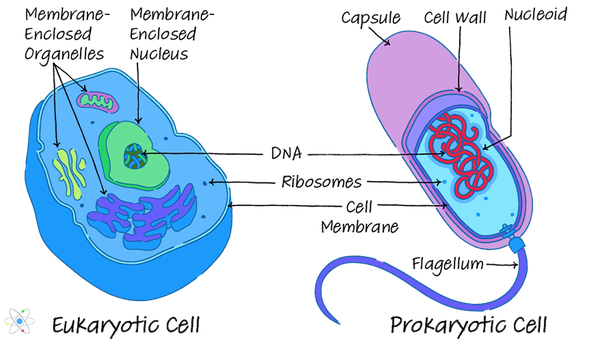
300
Name one target cell for insulin and one for glucagon. Compare the action of insulin and glucagon in blood sugar regulation.
Target cell of insulin: one of: liver, muscle, fat.
Target cell of glucagon: liver.
Insulin is secreted in response to high blood glucose levels. It causes liver cells to convert glucose to glycogen and stimulates muscle and fat cells to take up glucose from the blood. All these responses reduce the concentration of glucose in the blood.
300
Compare allopatric and sympatric speciation.
Allopatric speciation occurs when 2 populations become geographically separated from each other and eventually become so different that they cannot interbreed. In sympatric speciation, the 2 populations evolve into different species while living in the same area.
300
What are Newton's three laws?
1. an object in motion tends to stay in motion unless an external force acts upon it
2. force = mass x acceleration
3. for every action, there is an equal and opposite reaction
400
Describe the factors that determine
(i) the primary structure of proteins.
(ii) the tertiary structure of proteins.
The primary structure of a protein is the sequence of amino acids in the polypeptide chain. It is determined by the sequence of bases on the mRNA which itself is determined by the sequence of bases on the gene transcribed.
The tertiary structure of a protein is the overall three-dimensional shape of the whole polypeptide chain. It is determined by the interactions and bonding between the amino acid side chains in the polypeptide.
400
Name and describe the 4 phases of mitosis.
Prophase - The first stage of cell division in which the chromosomes become tightly coiled and are visible when viewed with a light microscope
Metaphase - The phase during mitosis in which the chromosomes become aligned in the centre of the cell, prior to being pulled apart by spindle fibres in anaphase
Anaphase - A phase during mitotic cell division, in which chromatids are separated by spindle fibres
Telophase - The final stage of cell division in which two new nuclei, and subsequently two new cells, are formed
400
Where is ADH synthesised and stored? Describe the process of it's release into the body.
Antidiuretic Hormone (ADH) is...
- synthesised in the hypothalamus
- stored in the pituitary gland
Process of ADH release:
- osmoreceptors in hypothalamus detect increase of solutes in blood
- ADH is released and transported via the blood to cell receptors on the kidney's collecting ducts
- collecting ducts become more permeable to water
- increased reabsorption of water back into blood via osmosis - reduces concentration of solutes
400
Freshwater lakes containing various species of fish are common across Africa. Sometimes sand moves around so much that a sand bar permanently isolates one area of a lake from the main body of water. This may separate a small number of fish of one species from the rest of its population remaining in the main lake.
Describe the process that over time could result in the populations from the isolated area and the main lake no longer being able to interbreed.
Describe one pre-zygotic mechanisms that could prevent interbreeding in this situation.
Speciation is when a single species evolves into 2 new species. Once the 2 populations of fish were physically separated by the sandbar, there would be no gene flow between them. The different environmental conditions in the 2 areas provided different selection pressures, resulting in the accumulation of genetic changes. Eventually, the 2 populations would become so different that they would be unable to interbreed.
An example of one of the following isolating mechanisms needs to be described in relation to the fish: temporal isolation, behavioural isolation, mechanical isolation, gamete isolation.
400
How many bones are in the human body? Where is the smallest and largest bone?
206. Smallest is in the middle ear, largest is the femur in the leg.
500
In a recent breakthrough, new blood tests are now able to detect the presence of some cancers long before symptoms appear. One such test identifies circulating tumour DNA (ctDNA) in blood using a sensitive PCR-based method to detect two genes (BCAT1/IKZF1) associated with bowel cancer.
A. Describe how the polymerase chain reaction (PCR) could be used to multiply the DNA of these two genes obtained from blood tests.
B. Discuss the economic issues related to using tests able to detect the presence of some cancers long before symptoms appear.
A. A PCR solution contains a supply of the 4 DNA nucleotides, A,T, G and C, a heat stable DNA polymerase and short primers that are complementary to the sequence of bases at either end of the length of DNA to be copied. Solution is heated to 95 degrees to separate the DNA strands, then the temperature is reduced to allow primers to join to each end of the DNA. Next, the temperature is raised to allow polymerase to synthesise two new DNA strands. Heating and cooling continues in cycles.
B. The test could save a great deal of money and reduce burden of cancer treatment in community. Early diagnosis reduces future hospitalisations of advanced cases and saves lives.
500
ATP synthase is a trans-membrane protein that catalyses ATP synthesis during cellular respiration. Part of the enzyme acts like a channel and, as positively charged protons pour from one side of the membrane to the other, ATP synthase produces molecules of ATP.
A. Describe the process in which ATP synthase forms ATP during cellular respiration.
B. Explain why ATP synthase would be found in the mitochondria of eukaryotes but the plasma membrane of prokaryotes.
C. Explain how the structure of the internal membranes of mitochondria facilitates the process of ATP production.
A. ADP + Pi + energy --> ATP
OR energy released in respiration is used to join an inorganic phosphate to ADP to form ATP.
B. In eukaryotes, the final stages of aerobic respiration occur in the mitochondria. As prokaryotes have no mitochondria, the membrane available for anchoring transmembrane proteins like ATP synthase is the plasma membrane.
C. Internal membranes of mitochondria is highly folded. This provides a large surface area for anchoring the many membrane bound enzymes, like ATP synthase, involved in aerobic respiration.
500
Alcohol has been widely used in many cultures for centuries and currently about 2 billion people across the world consume alcoholic drinks. The consumption of alcohol inhibits the secretion of antidiuretic hormone (ADH) from the pituitary gland.
By describing the role of antidiuretic hormone (ADH), discuss the effects of drinking alcohol on osmoregulation and discuss the possible benefits and/or harmful effects of chemicals that human beings use.
ADH is synthesised in the hypothalamus and stored in the pituitary gland. It is secreted in response to an increase in the concentration of solutes in the blood as detected by osmoreceptors in the hypothalamus. The ADH is transported in the blood and binds to receptors on the cells forming the walls of the collecting ducts, making the collecting ducts more permeable to water. This causes increased reabsorption of water back into the blood which reduces the concentration of blood solutes. As alcohol inhibits the secretion of ADH, its consumption will reduce reabsorption of water and cause more water to be excreted from the body, possibly leading to dehydration.
Benefits: medicines like hormone treatments for diabetes, anti-cancer chemo- and radio-therapy and antibiotics; antigens and antibodies for immunisations; antiseptics, disinfectants, preservatives; agricultural fertilisers, pesticides, herbicides.
Harmful effects: many useful chemicals are toxic in high concentrations, e.g. pesticides, herbicides, radioactive substances, medicines.
500
The Australian orange-bellied parrot is considered critically endangered, with a wild population of only 14 birds. Its diet consists of seeds and berries of small coastal grasses and shrubs.
The orange-bellied parrot is one of only three species of parrot that migrates. It breeds in a restricted area of Tasmania’s southwest, then at the start of winter, it migrates to spend the non-breeding period on the Australian mainland. This parrot was once more widespread, being found along the mainland coastline from Sydney to Adelaide, but their range has shrunk considerably with the vast impact of European settlement over the last 200 years.
Give examples of human activities that could have brought about environmental changes that have adversely affected the orange bellied parrots and discuss the size of the gene pool of the parrot and the implications this will have on its risk of extinction.
Human activities: habitat destruction caused by land clearing and wildfires would reduce the food supply and the number of nesting sites available to the parrots. Introduction of predators like foxes and cats would reduce the population of adults and hatchlings.
Size of the gene pool: the gene pool is all the alleles of all of the individuals in an interbreeding population. The small wild population of parrots will have a small gene pool with low genetic diversity. This will cause a higher risk of extinction because the population is less likely to be able to adapt to changes in their environment.
500
List the first 20 elements of the periodic table.
- Hydrogen (H)
- Helium (He)
- Lithium (Li)
- Beryllium (Be)
- Boron (B)
- Carbon (C)
- Nitrogen (N)
- Oxygen (O)
- Fluorine (F)
- Neon (Ne)
- Sodium (Na)
- Magnesium (Mg)
- Aluminum (Al)
- Silicon (Si)
- Phosphorus (P)
- Sulfur (S)
- Chlorine (Cl)
- Argon (Ar)
- Potassium (K)
- Calcium (Ca)