OTU
Forces
Classification
Cells
Skills
100
What are the four main branches of science?
Biology, chemistry, physics and geology.
100
What force pulls objects towards the centre of the Earth?
Gravity.
100
What is the most specific level of classification of living organisms?
Species
100
What are the three main principles of cell theory?
All living things are made of one or more cells.
The cell is the basic unit of structure and function in living things.
All cells come from pre-existing cells.
100
What is the purpose of an aim in a scientific investigation?
To state what the experiment is trying to find out.
200
What are the three main things scientists do to build knowledge and understanding of the world?
Observe, experiment and analyse.
200
What are the six types of simple machines?
Lever
Pulley
Wheel and axle
Inclined plane
Wedge
Screw
200
What are the seven characteristics of living things represented by MRSGREN?
Movement, Respiration, Sensitivity, Growth, Reproduction, Excretion and Nutrition.
200
Which organelle contains DNA and controls the activities of plant and animal cells?
Nucleus.
200
What is the difference between an observation and an inference?
An observation is something noticed or measured, while an inference is a possible explanation based on observations.
300
A student notices that the ground is wet, but it is not raining. They conclude that it rained earlier. Is this an observation or an inference?
An inference, because the student is using an observation to suggest a possible explanation.
300
What happens when the north pole of one magnet is brought close to the north pole of another magnet?
They repel each other.
300
What two classification levels make up an organism's scientific name? How do we write it?
Genus species.
300
Look at the diagram below. Is this a plant cell or an animal cell? Identify two features that support your answer. 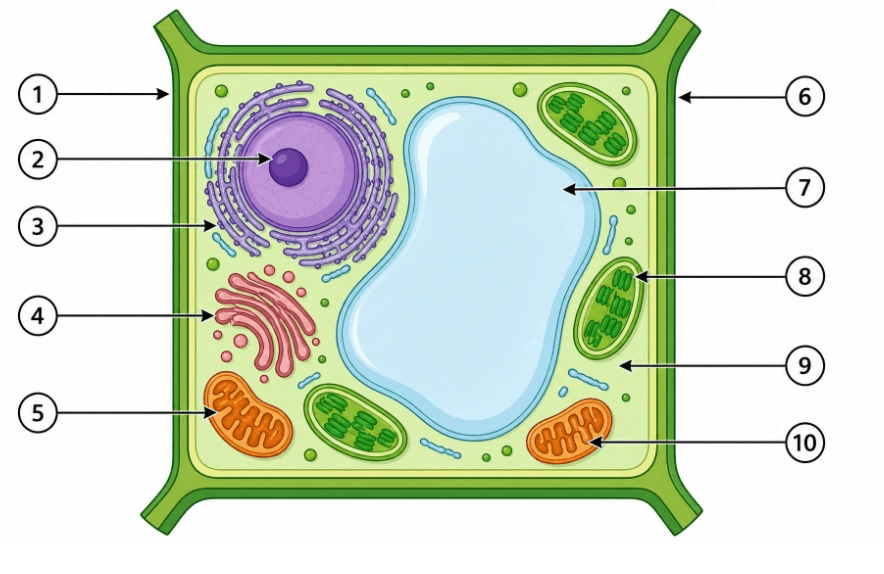
Plant cell. It has a cell wall and chloroplasts.
300
What are the three types of variables in a scientific investigation, and what does each one mean?
Independent variable: The variable that is deliberately changed.
Dependent variable: The variable that is measured or observed.
Controlled variables: The variables that are kept the same to ensure a fair test.
400
What causes day and night on Earth?
Earth's rotation on its axis.
400
What is the difference between balanced and unbalanced forces?
Balanced forces do not change an object's motion, while unbalanced forces cause a change in motion.
400
Use the dichotomous key to determine what type of leaf is pictured.
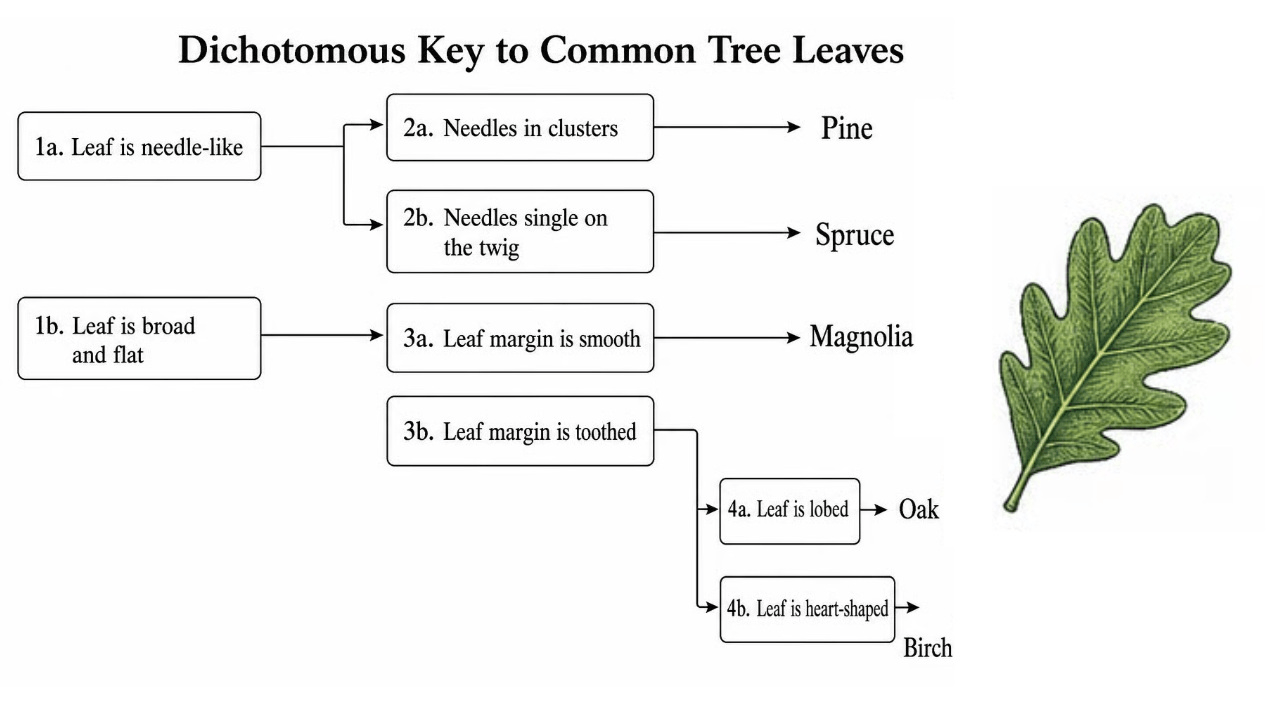
Oak
400
A microscope has a 10× eyepiece lens and a 40× objective lens. What is the total magnification?
400×.
400
Why do scientists include headings and units in results tables?
To clearly identify what was measured and the units used, making results easier to interpret.
500
Why does the Moon appear to change shape throughout the month?
As the Moon orbits Earth, we see different portions of its sunlit half.
500
How does a pulley make lifting a heavy object easier?
A pulley can change the direction of the applied force, and a system of pulleys can reduce the force needed to lift an object.
500
How do the deep root systems of some Australian plants help them survive in dry environments?
Deep roots allow plants to reach water stored further underground, helping them survive when rainfall is limited.
500
Why do muscle cells contain large numbers of mitochondria?
Muscle cells need energy for contraction, and mitochondria release energy through cellular respiration.
500
Why is it important to repeat an experiment multiple times and calculate an average of the results?
To improve the reliability of the results by reducing the impact of random errors and identifying any anomalies.
600
How have Aboriginal and Torres Strait Islander Peoples used observations of stars to predict seasonal changes?
By observing the appearance and positions of stars and constellations to identify seasonal changes, including animal behaviour and plant cycles.
600
An astronaut has a mass of 50 kg. Calculate their weight on Earth if gravity is 9.8 N/kg.
490 N
(F = mg = 50 × 9.8).
600
Explain how two adaptations of a kangaroo help it survive in its environment.
Powerful hind legs allow efficient hopping, while its large tail helps with balance and support.
600
What is the word equation for photosynthesis?
Carbon dioxide + Water → Glucose + Oxygen
Light energy is required for photosynthesis, and chlorophyll absorbs this light.
600
A student investigates the relationship between the length of a spring and the force applied to it. They collect numerical data for both variables. What type of graph should they draw to identify the relationship between the two variables?
A scatter plot with a line of best fit.
700
Why did scientists replace the geocentric model of the solar system with the heliocentric model?
New observations and evidence, including the phases of Venus and the moons of Jupiter, supported the Sun-centred model rather than an Earth-centred model.
700
A satellite is travelling through space around Earth. Explain why it stays in orbit rather than flying away in a straight line or falling directly to Earth.
Earth's gravity continuously pulls the satellite towards Earth, changing its direction, while its sideways velocity keeps it moving around Earth in orbit.
700
Two organisms belong to the same family but different genera. What does this tell us about their classification and evolutionary relationship?
They share characteristics and evolutionary ancestry, but are less closely related than organisms belonging to the same genus.
700
Explain how the structure of a root hair cell is adapted to its function.
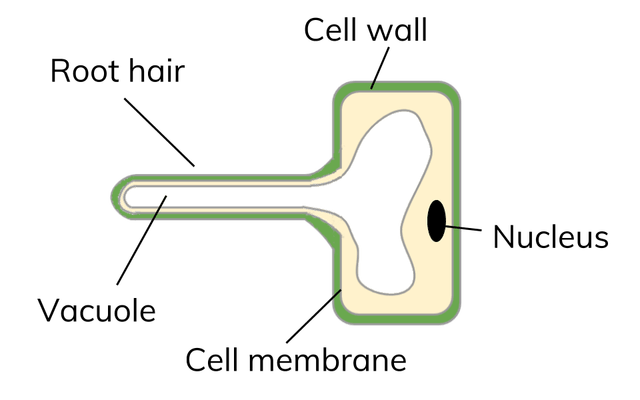
Root hair cells have a long, thin extension that increases their surface area, allowing them to absorb water and mineral ions efficiently from the soil.
700
A student tests how water temperature affects the time sugar takes to dissolve. They use different amounts of sugar, different volumes of water and only conduct each test once. Identify two problems with the investigation and explain how to improve its validity and reliability.
Validity: Keep the amount of sugar and volume of water the same.
Reliability: Repeat each test several times and calculate an average.