Med history
Potpourri 1
Potpourri 2
Biting Bugs
Other names
Don't play with your food
Potpourri 3
100
What profoundly useful drug did dentist Horace Wells discover whilst visiting a sideshow in 1844?
Nitrous Oxide
Horace had gone to see the show exhibiting nitrous oxide put on by the American showman (and former medical student) Gardner Quincy Colton. Wells noticed at the time that one of the participants injured their leg whilst jumping about under the effects of the nitrous oxide but exhibited no pain.
Nitrous oxide itself had been discovered initially in 1772 in England by Joseph Priestley, which he called dephlogisticated nitrous air. It remained a little known scientific curiosity until being properly developed by Humphry Davy in 1799. Davy was initially looking to find gaseous cures to various medical ailments. During his own self experimentation he noticed both the euphoric and analgesic effects of the gas. Davy’s intuitive comments on the potential use of nitrous oxide as a procedural medication was rapidly overlooked, and the gas went on to become a favorite of parlor parties and carnival shows. It wasn’t until Horace Wells demonstrated its analgesic benefits that it properly emerged in the context we know today.
100
A 67 year old women presents 2 weeks after a STEMI and a stent in her RCA. She’s complaining of shortness of breath but saturations are 96%. In your work up you see she had a normalise ECHO EF only down to 55%, chest X-ray is clear, troponin’s negative someone even spun the BNP and D-Dimer dice, both of which are negative. You’ve ditched your stethoscope and use your ultrasound and determine there are no B-lines. Scratching your head as to what’s causing her shortness of breath your emergency pharmacist taps you on the shoulder and says I bet it's medication-related.
What medication has this patient been put on that can cause shortness of breath?
Ticagrelor
In phase 2 studies, ticagrelor was associated with a dose-dependent incidence of dyspnoea of 10 to 20% compared with 0 – 6.4% of patients on clopidogrel. It usually occurs at rest, not related to exercise and can be intermittent or persistent.
The exact mechanism has not been proven but one hypothesis is its adenosine antagonism causes increased adenosine stimulation on the pulmonary vagal C fibres.
100
What statistical figure is shown in the Cochrane logo?

The forest plot within the logo shows one of the first meta analyses done by Cochrane. It was showing the benefit of corticosteroids given to women who are about to give birth prematurely.
100
What would a bite from Ixodes holocyclus potentially give you?
Tick Paralysis
Tick paralysis in humans is most commonly reported in children aged 1–5 years, although can occur in older children and adults; 2-7 days after tick bite.
It can present with lethargy and weakness , gait changes (often ataxia), and an ascending symmetrical paralysis. Slurred speech and depressed deep-tendon and gag reflexes are to be noted. Ophthalmoplegia and bulbar palsy can occur.
100
What is the fourth most common coagulation disorder after von Willebrand’s, Haemophilia A and B?
Haemophilia C (Factor XI deficiency)
Also known as Rosenthal syndrome. Factor XI deficiency is an autosomal recessive disease that is most commonly reported in Ashkenazi Jews
100
What fruit-related injury did Meryl Streep suffer from in 2012?
Avocado Hand
100
Where is your pain if you experience Texidor’s twinge?
Chest
The Texidor twinge, better known is precordial catch syndrome, is a benign and quite common yet underrecognized cause of chest pain in children and adolescents. The syndrome has a remarkably consistent, characteristic presentation and is therefore easily diagnosed.
Texidor’s twinge begins suddenly, without provocation, and is characteristically exacerbated by deep inspiration. It may be worsened or partially relieved by change of position. Episodes last between 30 seconds and 3 minutes, occasionally resolve after a breath or two but may rarely last up to 30 minutes.
200
Leonard Thompson received the first what?
Insulin injection
On January 11, 1922, at 14 years of age in Toronto he received his first injection but due to impurities he had an allergic reaction. James Collip worked for a further 12 days to refine the canine insulin and successfully delivered a second injection.
Thompson showed signs of improved health and went on to live 13 more years taking doses of insulin, eventually dying of pneumonia at age 27
200
What is Albers-Schonberg Disease?
Albers-Schönberg disease is the most common form of osteopetrosis.
Also known as autosomal dominant osteopetrosis type II (ADO II). Heinrich Ernst Albers-Schönberg (1865 – 1921) was a German radiologist and named the disease in 1904.
Osteopetrosis is a group of conditions characterized by increased skeletal mass due to impaired bone and cartilage resorption
200
Takuo Aoyagi died April 2020 at the age of 84. He was a Japanese engineer who invented something your nursing staff use on nearly every patient. What is this device?
The pulse oximeter
Takuo Aoyagi (1936-2020) developed the modern pulse oximeter in the 1970s and undoubtedly has helped save millions of lives. Early models were inaccurate and cumbersome. Takuo Aoyagi realised that blood flow was not uniform and developed formulas to cancel out the ‘pulsatile noise’.
200
What infectious condition gives you the seven-year itch?
Scabies.
200
Known as commotio retinae it is a common condition caused by blunt injury to the eye. What is the other name for this condition? (Named after the physician who first noted the condition and also shares the name with a famous European capital)
Berlin oedema
It is characterized by decreased vision in the injured eye a few hours after the injury. Under examination the retina appears opaque. This whitening is indicative of cell damage, which occurs in the retinal pigment epithelium and outer segment layer of photoreceptors. Damage to the outer segment often results in photoreceptor death through uncertain mechanisms.
The prognosis is excellent unless there has been choroidal rupture, haemorrhage or pigment epithelial damage.
200
Pitta bread and Camembert cause the same injury, what is it?
A molten burn, to the roof of your mouth.
Typically Camembert over the Christmas period (a baked favorite) and pitta bread as the searingly hot steam comes seeping out when you try and tear a bit off to dip in your humus
200
What organ is affected by Kounis Syndrome?
The heart (most commonly presenting as a STEMI).
Kounis syndrome, named after a Greek cardiologist Nicholas Kounis who described the phenomenon in 1991 as a histamine-induced coronary artery spasm. Hypersensitivity can be induced by exposure to drugs, food, environmental and other triggers like contrast media or unfortunately coronary stents. The most common manifestation is allergic acute coronary syndrome (referred to as ‘allergic angina’), which is most frequent in middle aged men. Three main variants exist:
- Vasospastic allergic angina.
- Allergic myocardial infarction.
- Stent thrombosis with occluding thrombus that is infiltrated by eosinophils and/or mast cells.
300
DAILY DOUBLE: Contaminants from this pub led to the discovery of what?
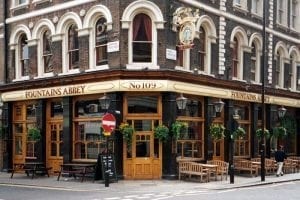
Penicillin
The Fountains Abbey in Paddington was frequented by Alexander Flemming and was across the road from his laboratory. The pub claims spores from the ale house drifted through the window onto Flemming’s culture dishes
300
What is the number one cause of acute coronary syndrome (ACS) in pregnancy?
Spontaneous coronary artery dissection (SCAD)
This is a very uncommon cause of acute coronary syndrome accounting for 0.2% to 4% of all patients who make it to angiography.
However, in pregnancy SCAD is the most common mechanism for pregnancy-related MI. Pregnancy is associated with >40% of cases called PASCAD (pregnancy associated – SCAD). Typically these women do not have any of the traditional cardiac risk factors.
300
You’re about to leave your shift when the diabetic with a leg infection reads “high” on the finger stick. You cringe, you know the lab is going to take at least 60 minutes to get a pH back. You think to yourself, there must be a non-invasive way I can quickly tell if the patient is acidotic. What maverick device can you use? (Clue marginally related to the previous question).
Capnography
Bou Chebl et al illustrated that lower pCO2 values correspond to lower pH and bicarbonate values in hyperglycemic diabetic patients. This fits with what we would expect, a patient in DKA often has a high respiratory rate compensating for the metabolic acidosis, ETCO2 is expected to be low. But how low buys you an insulin drip
- A blood sugar level greater than 550 mg/dL (30.5 mmol/L), and an EtCO2 of 35 or greater virtually guarantees that the patient is not in DKA with a sensitivity of 100 percent.
- A blood sugar level greater than 550 mg/dL (30.5 mmol/L), and an EtCO2 of ≤21 and ≤26 are 100 percent and 96 percent specific for DKA, respectively.
- A blood sugar level greater than 250 mg/dL (13.9 mmol/L), and an EtCO2 greater or less than 24.5 is both 90 percent sensitive and 90 percent specific for DKA
300
A 32yo male presents with a painful bite mark on his right thumb and bilateral below knee sweating. What has bitten your patient? (this is in Australia)
Redback spider (Latrodectus hasselti).
Bilateral below knee sweating is a unique but pathognomonic feature of redback spider envenomation. Redback envenomation is a clinical diagnosis, and is NOT life-threatening.
300
12 young females present to your emergency department all within the space of 2 weeks complaining of tingling and burning on the lateral aspect of their thighs. One girl wonders if this is the start of MS after a google doc consult as it appears to come and go lasting hours at a time. You correctly tell her that this is Bernhardt–Roth syndrome. What is this syndrome?
Meralgia paresthetica
Meralgia paresthetica is a painful mononeuropathy of the lateral femoral cutaneous nerve (LFCN) that manifests clinically as numbness, burning, itching, or pain over the anterior and lateral aspects of the thigh. Also known as the Bernhardt–Roth syndrome
It periodically enters the medical literature depending on the latest fashion trends, hip-huggers were to blame in the 2000s and recently a trend with “taille basse” – low cut jeans or selecting a size too small inflicts pressure on the LFCN.
300
Finally, you get the weekend off you’ve been waiting for, ready to dive into your brunch with the standard artisan bread. Which sourdough injury should you be wary of?
Sourdough gum, due to lacerations from the sharp edges.
300
A young girl presents one month after infection with Hand, Foot, and Mouth disease (Coxsackievirus A16) with a particular body part falling off. What is she shedding?
Her finger nails.
A rare but recognised complication of Coxsackie A16 is Onychomadesis (from the Greek Onyx for nail and madesis – ‘growing bald’). Onychomadesis is an acute, non-inflammatory, painless, proximal separation of the nail plate from the nail matrix.
400
What disease was reprieved from the death sentence in both 1986 and December 1993?
Smallpox
Two laboratories still hold stock, the United States’ Centers for Disease Control and Prevention and Russia’s State Research Center of Virology and Biotechnology VECTOR.
WHO first recommended destruction of the virus in 1986 and later set the date of destruction to be 30 December 1993. This was postponed to 30 June 1999. Due to resistance from the U.S. and Russia, in 2002 the World Health Assembly agreed to permit the temporary retention of the virus stocks for specific research purposes.
400
You decide to do some Jet Skiing. After blasting around and slapping the water at 50kph+ you hobble home with some lower back pain.
What injury have you sustained?
L1 compression fracture.
A series of cases from the island of Malta reports that these fractures are invariably located around the thoracolumbar junction and that L1 is the vertebra most commonly affected. As predicted this anomaly only occurs in the summer season.
The take-home message is to x-ray those patients who have been doing recreational water sports and present with back pain. The incidence is seasonal and all fractures occurred between May and October. The message is that anyone complaining of back pain after indulging in this sort of recreational activity needs to have their spine x-rayed.
400
How many Ramsay Hunt Syndromes are there?
There are three in total – not just herpes zoster on the tympanic membrane.
Ramsey Hunt syndrome 1 is also called Ramsay Hunt cerebellar syndrome, a rare condition secondary to cerebellar degeneration with causes myoclonic epilepsy, progressive ataxia and tremor.
Ramsay Hunt syndrome type 2 is the herpes zoster infection of the geniculate ganglion
Ramsay Hunt syndrome type 3 is an occupational induced neuropathy. It is caused by damage to the deep palmar branch of the ulnar nerve (in Guyon’s canal) causing weakness and wasting of the small muscles in the hand.
400
For what infectious disease would you perform a spatula test?
Tetanus
Most people when you shove a tongue depressor onto the posterior pharyngeal wall will gag and try to push the tongue depressor out. Those with tetanus have been shown to clamp down on the tongue depressor.
This test had a specificity of 100% and a sensitivity of 94% in a group of 400 patients with suspected tetanus.
400
What is the ACHOO reflex?
Autosomal Dominant Compelling Helio-ophthalmic Outburst reflex
ACHOO
Sneezing when looking at a bright light (colloquially the sun), it affects 18-35% of the population and its mechanism is not fully understood. Also known as the Photic sneeze reflex
400
What metabolic disorder could Hannibal Lecter NOT have had? We know this due to his favorite food.
Glucose-6-phosphate dehydrogenase deficiency; with his liking for liver with Fava beans!
400
what occupational hazard caused the women to strike in the Matchstick girls’ strike of 1888?
‘Phossy jaw’, or osteonecrosis of the jaw from exposure to white phosphorous.
In the early 19th century, white phosphorous was added to matchstick heads to make them easier to ignite. The demand for the new ‘strike-anywhere’ matches was enormous, creating a profitable international industry. It also led to a new industrial disease that lasted until roughly 1906, when the production of phosphorous matches was outlawed by the International Berne Convention.
500
DAILY DOUBLE: Who discovered a form of heart block using a tuning fork and a Sphygmogram?
Karel Frederik Wenckebach (1864 – 1940)
In 1898 Karel Wenckebach consulted a 40-year-old woman with an irregular pulse which he interrogated using a sphygmogram and tuning fork. He noted there were regular pauses every 3 to 4 beats, but the small extra pulse seen during pauses were longer, and subsequent intervals were smaller. The first interval after each pause was longer, and subsequent intervals were shorter.
500
What is scrivener’s palsy?
Writer’s cramp
A neurological condition caused by frequent handwriting. It is not a strain injury but focal dystonia.
The first epidemics of writers’ cramp were reported in the 1830s among clerks of the British Civil Service, where it was attributed to the new steel pen nib.
500
You meet a young patient who is tall and smokes complaining of bilateral pleuritic chest pain. To no one's surprise, she has bilateral pneumothoraces. You place a chest tube on the right and to your surprise both Pneumothraces resolve. On speaking to the cardiothoracic surgeon they state she must have Buffalo chest. What do they mean?
Buffalo or bison have a single pleural cavity, one of the few mammals to do so, hence they were so easy to kill with a single arrow to the chest.
If your patient has a pleuropleuro connection they will develop spontaneous bilateral pneumothoracies which will resolve if a chest drain is inserted only on one side.
500
What childhood disease manifests the Comby sign?
Measles
Named after Jules Comby, a French Paediatrician, the Comby sign is whitish patches and inflammation seen in the mouth prior to the appearance of Koplik spots
500
A patient presents with generalized weakness, in fact they can’t move any of their limbs, during the work up you get handed the following ECG. You immediately put two and two together and label the patient with ‘Impressive syndrome’. What is impressive syndrome?

Hyperkalemic periodic paralysis.
It is an autosomal dominant disorder and often occurs in horses. The index case was a stallion called… ‘Impressive’. 1 in 50 Quarter Horses suffer from the disease and they can all be traced back to this stallion.
It is characterised by muscle hyper excitability or weakness which can be exacerbated by hyperkalaemia or heat and cold. It also occurs in humans more commonly called Hyperkalaemic periodic paralysis (HYPP)
500
The Kilner sprain is a wrist injury caused by this cooking-related activity?
Jar opening wrist sprain
500
Which famous fictional character suffered from Erethism?
The Mad Hatter due to mercury exposure.
Common symptoms include irritability, low self-confidence, depression, apathy, shyness, personality changes, memory loss and delirium.
The connection between the Mad Hatter in Lewis Carroll’s Alice and Wonderland and erethism is unclear, and a mere speculation however, the character was almost certainly based on Theophilus Carter, an eccentric furniture dealer who was well known to Carroll.