Solutions & Colligative Properties
Kinetics
Equilibrium
Acids, Bases & Buffers
Thermodynamics & Electrochemistry
100
A solution is prepared by dissolving 10.0 g NaCl in enough water to make 500.0 mL of solution. What is the molarity? Assume complete dissociation.
0.342 M
100
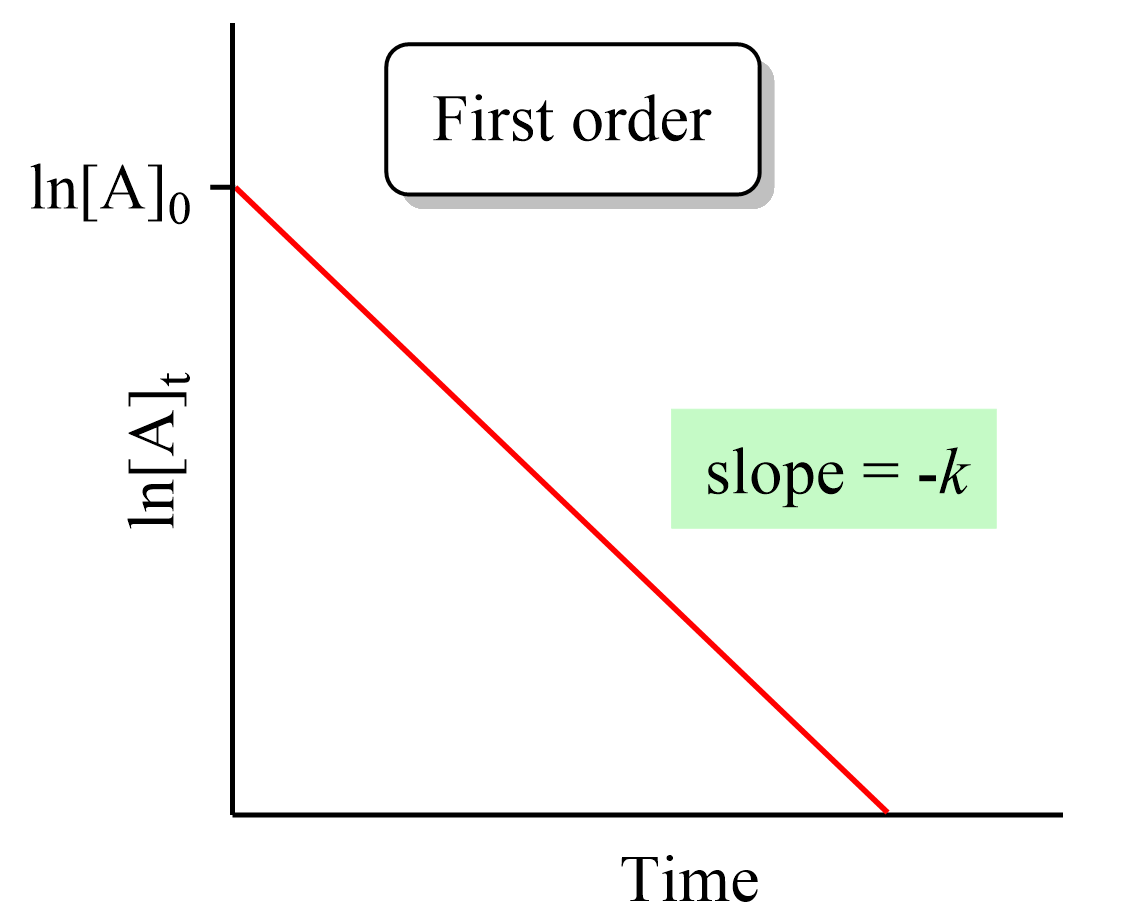
What is first order in A?
Rate ∝ [A]¹
If doubling [A] doubles rate, the reaction is first order in A.
100
For the reaction:
N₂(g) + 3H₂(g) ⇌ 2NH₃(g)
At a certain temperature, the equilibrium constant is K = 1.0 × 10⁻⁵.
Which side of the reaction is favored and why?
Left
Reasoning: At equilibrium, the mixture contains mostly reactants. K is very small → products are not favored → equilibrium lies to the left.)
100
What is [H₃O⁺] when pH = 3?
pH = −log[H₃O⁺]
[H₃O⁺] = 10⁻³ M = 1.0 × 10⁻³ M
100
ΔH < 0 and ΔS > 0
What is true about ΔG?
ΔG = ΔH − TΔS
If ΔH is negative and ΔS is positive, then −TΔS is also negative.
Both terms make ΔG negative at all temperatures.
So the process is spontaneous at all temperatures.
200
What is the mole fraction of a solvent when the mole fraction of the solute is 0.20?
0.80
200
Rate = k[A]²[B]. [A] doubles and [B] triples. By what factor does rate increase?
New rate factor = (2²)(3) = 4 × 3 = 12
Rate increases by a factor of 12.
200
For the reaction:
CO(g) + H₂O(g) ⇌ CO₂(g) + H₂(g)
At a certain moment, the reaction quotient is calculated to be greater than the equilibrium constant (Q > K).
Which direction does the reaction shift and why?
Left
(Reasoning: Too many products relative to equilibrium → system shifts left.)
200
Ka = 1.0 × 10⁻⁵
What is pKa?
pKa = −log Ka
pKa = −log(1.0 × 10⁻⁵) = 5
200
A galvanic (voltaic) cell is set up and initially produces a voltage. After running for a long time, the voltmeter reads 0.00 V and no current flows through the circuit.
What is the state of the system?
The system is at equilibrium.
300
What is the expected ΔTf for a 1.0 m NaCl solution?
A 1.0 m solution of a nonelectrolyte has ΔTf = 2(1.86°C) = 3.72°C
300
A first-order reaction has a half-life of 10 min. How long will it take to reach 1/8 of the original concentration?
1/8 = 1 → 1/2 → 1/4 → 1/8
That is 3 half-lives
3 × 10 min = 30 min
300
For the gas-phase equilibrium:
2NO₂(g) ⇌ N₂O₄(g)
This reaction occurs in a sealed container. The volume of the container is suddenly decreased, increasing the pressure.
Which direction does the equilibrium shift and why?
Right
(Reasoning: Left = 2 mol gas, right = 1 mol gas → system shifts right to reduce pressure.)
300
Given: Buffer where [HA] = [A⁻]
What is the relationship between pH and pKa?
pH = pKa
(Reasoning: Henderson–Hasselbalch: pH = pKa + log([A⁻]/[HA])
If [A⁻] = [HA], then log(1) = 0)
300
E°cell is positive
What is true about ΔG?
ΔG° = −nFE°cell
If E°cell is positive, then ΔG° is negative.
So the reaction is spontaneous under standard conditions.
400
Two solutions have equal molality: one CaCl₂, one glucose. Which has lower vapor pressure?
CaCl₂
(Reasoning: CaCl₂ dissociates into 3 ions, glucose does not dissociate.
More dissolved particles means greater vapor pressure lowering.)
400
A reaction is experimentally found to have the rate law:
rate = k[A][B]
A proposed mechanism is:
Step 1 (fast): A + A ⇌ A₂
Step 2 (slow): A₂ + B → products
Why is the proposed mechanism invalid?
This mechanism is not consistent with the observed rate law.
(Recall:
- Slow step determines the rate!!! = k[A₂][B]
- But A₂ depends on [A]² from the fast equilibrium
- Predicted rate = k[A]²[B], which does NOT match experimental rate = k[A][B])
400
For the reaction:
H₂(g) + I₂(g) ⇌ 2HI(g)
At a certain temperature, K = 100. A mixture is prepared and the reaction quotient is calculated to be Q = 0.01.
What happens to the system?
Shifts Right
(Reasoning: Q < K → not enough products → system moves right.)
400
A buffer solution is prepared using acetic acid (HA) and sodium acetate (A⁻). A small amount of strong acid (HCl) is added to the solution.
Which component of the buffer reacts with the added acid?
The acetate ion (A⁻) is consumed, forming more acetic acid (HA).
(Recall:
- Strong acid adds H⁺ to solution
- Buffer resists change by neutralizing added H⁺
- Conjugate base reacts:
A⁻ + H⁺ → HA
- Therefore:
- A⁻ decreases
- HA increases
- pH changes only slightly!)
400
What is the sign of ΔG° when K = 1.0 × 10¹⁰?
Negative (-)
(Reasoning: Large K means products are strongly favored.
Since ΔG° = −RT ln K and ln K is positive for K > 1, ΔG° is negative.)
500
Two solutions are prepared:
- Solution A: 0.50 mol solute + 4.50 mol solvent
- Solution B: 2.00 mol solute + 4.50 mol solvent
Which solution has the higher vapor pressure?
Solution A
500
Mechanism slow step: A + B → C
Experimental rate law: rate = k[A][B]
Is the mechanism valid?
Yes
(Reasoning: For an elementary slow step, the rate law should match the molecularity of that step.
Slow step includes A and B, so rate = k[A][B].)
500
For a reaction at standard conditions, the standard Gibbs free energy change (ΔG°) is negative.
What is the relationship between ΔG° and K?
The equilibrium constant for this reaction is greater than 1.
(Reasoning: ΔG° = −RT ln K
Negative ΔG° → ln K positive → K > 1 → products favored.)
500
A weak acid solution has a very small Ka value.
What does a small Ka imply about pH and ionization?
The acid ionizes very little, so the solution has a relatively higher pH compared to stronger acids.
(Reasoning:
- Small Ka → equilibrium favors reactants
- Very little H₃O⁺ produced
- Higher pH (though still acidic))
500
Electrons flow from Zn to Cu.
Determine which is the anode.
Zn
(Recall: OIL RIG → OA/RC
Oxidation occurs at the anode.
Electrons leave Zn and go to Cu, so Zn is oxidized.)