Motivation
Arousal
Confidence
Attention and Concentration
Team Dynamics and Cohesion
Sports Psychology Strategies
100
Sport psychology is a field of science that investigates how an athlete’s mental processes – such as their _______ , __________, and __________ – influence their participation and performance in sport and physical activity.
thoughts, feelings and emotions
100
Arousal is linked to our body’s ______ or ______ response, an instinctive reaction that all human beings have when they are faced with the threat of danger or harm.
fight or flight
100
Define self-efficacy.
Self-efficacy is a specific term used by sport psychologists to describe an athlete’s confidence. It refers to the belief an athlete has in their ability to perform a particular task.
100
What is 'selective attention'?
Selective Attention is where an athlete narrows their focus to the specifics of the task required of them (known as relevant cues) and block out distractions (known as irrelevant cues).
For example, during play a soccer goalkeeper will focus on relevant cues (such as the position of the ball, the speed of its approach and the location of other players on the field) and ignore irrelevant cues (such as a bird flying overhead, taunts from opponents, cheers from the crowd).
100
Correctly sequence the 4 stages of Tuckman's Stages of Group Development.
- Storming
- Performing
- Forming
- Norming
- Stage 1 – Forming
- Stage 2 – Storming
- Stage 3 – Norming
- Stage 4 – Performing
100
Name the 3 categories of sports psychology techniques.
- Ongoing psychological techniques
- Pre-performance psychological techniques
- In-performance psychological techniques
200
The name of the theory developed in 1985 by US psychologists Edward Deci and Richard Ryan.
It is a theoretical framework used to analyse human behaviour and is very useful for understanding what motivates people to participate in sport and physical activity.
Self- determination theory (SDT)
200
Optimum arousal levels for most athletes and physical activities are located where on the continuum?
Towards the middle (4, 5, 6)
200
Provide an example of where 'too much confidence' may be a barrier to performance.
- not preparing properly if thinking the opponent is 'easy'.
200
The two dimensions of Nideffer's Attentional Model are...
a. width and depth
b. depth and scope
c. direction and depth
d. width and direction
D.
200
Explain the difference between 'team dynamics' and 'team cohesion'.
- team dynamics is a term used to describe the relationships between all of the different members of a group (who are working together to achieve a common goal).
- team cohesion is used to describe the extent to which individual members of a team can work together and function as a single, unified (i.e. united) whole.
200
Name the 2 Pre-performance psychological techniques.
- pre-competition routines
- relaxation and energizer techniques.
300
The three types of motivation found on the 'motivation continuum'...
- Amotivation
- Extrinsic motivation
- Intrinsic motivation
300
Explain the difference between trait and state anxiety.
• trait anxiety – an athlete’s natural tendency (i.e. a personality trait) to perceive something as threatening or non-threatening. Those with high levels of trait anxiety will naturally perceive a situation to be more threatening than a person with low levels of trait anxiety.
• state anxiety – anxiety that is induced by a particular situation or environment. The emotional response they feel is a direct result of the event or experience they are having. The higher the pressure of the situation, the greater the state anxiety experienced. An athlete’s level of state anxiety is often related to their self-confidence.
300
The three components that make up 'confidence'.
- Self-confidence
- Self-belief
- Self-efficacy
300
Provide an example of the difference between an athlete with a broad-external focus and a broad-internal focus.
- broad–external – athletes with this focus are often referred to as ‘aware’; for example, a volleyball setter who scans the defence before setting up the play.
- broad–internal – athletes with this focus are often referred to as ‘strategic’; for example, a golfer carefully considering shot selection prior to addressing the ball.
300
Name the 3 things established in Stage 1 of Tuckman's Stages of Group Development.
- group roles
- group norms
- group goals
300
Explain why an athlete may use relaxation or energiser techniques. Provide an example of each.
Relaxation and energiser techniques are often used as a way to optimise arousal levels prior to performance. They can also contribute to better concentration, motivation and confidence.
Effective relaxation and energiser techniques include:
• meditation
• progressive muscle relaxation (PMR)
• deep breathing
• music
• visualisation.
400
An athlete exhibiting high levels of intrinsic motivation is said to be ____ -____________. An athlete exhibiting amotivation is said to be ____-____-______________.
self-determined
non-self-determined
400
Explain the difference between cognitive and somatic anxiety.
Anxiety is made up of two components:
• cognitive anxiety – the emotional and mental responses to over-arousal, such as feelings of worry and panic
• somatic anxiety – the physical responses to over-arousal, such as sweaty palms and shallow, rapid breathing (known as hyperventilation).
400
Why is 'trash-talking' so effective, particularly in sports involving physical confrontation e.g boxing?
Researchers at Florida State University found that trash-talking can improve performance by up to 46% as it helps the athlete prepare to perform psychologically, while boosting self-confidence and the belief that the opponent is weaker.
400
Provide an example of the difference between an athlete with a narrow-external focus and a narrow-internal focus.
- narrow–external – athletes with this focus are often referred to as ‘focused’; for example, a tennis player focusing on her toss as she begins to serve.
- narrow–internal – athletes with this focus often referred to as ‘systematic’; for example, a basketball player reviewing his self-talk prior to taking a free throw.
400
Explain why not every team reaches 'Stage 4' of Tuckman's Model?
It is important to note that not every team progresses to the performing stage. Many teams stop developing at the norming stage. It is also common for teams to fluctuate between the second, third and fourth stages of team development for a number of reasons, such as:
- individual team members may start working independently.
- established members may leave the team and new members may join the team.
- coaching and training staff may change, leading to changes in team goals and training expectations.
- unexpected issues arise that challenge the team unity.
400
Pre-task routines (also known as pre-performance routines) are actions performed by athletes immediately prior to performing a task within a performance.
For which type of skills are pre-task routines usually used?
Closed skills.
- free throws (basketball)
- pitch (baseball)
- penalty kick (football)
- golf swing
- kick for goal (AFL)
- conversion (rugby league/union)
500
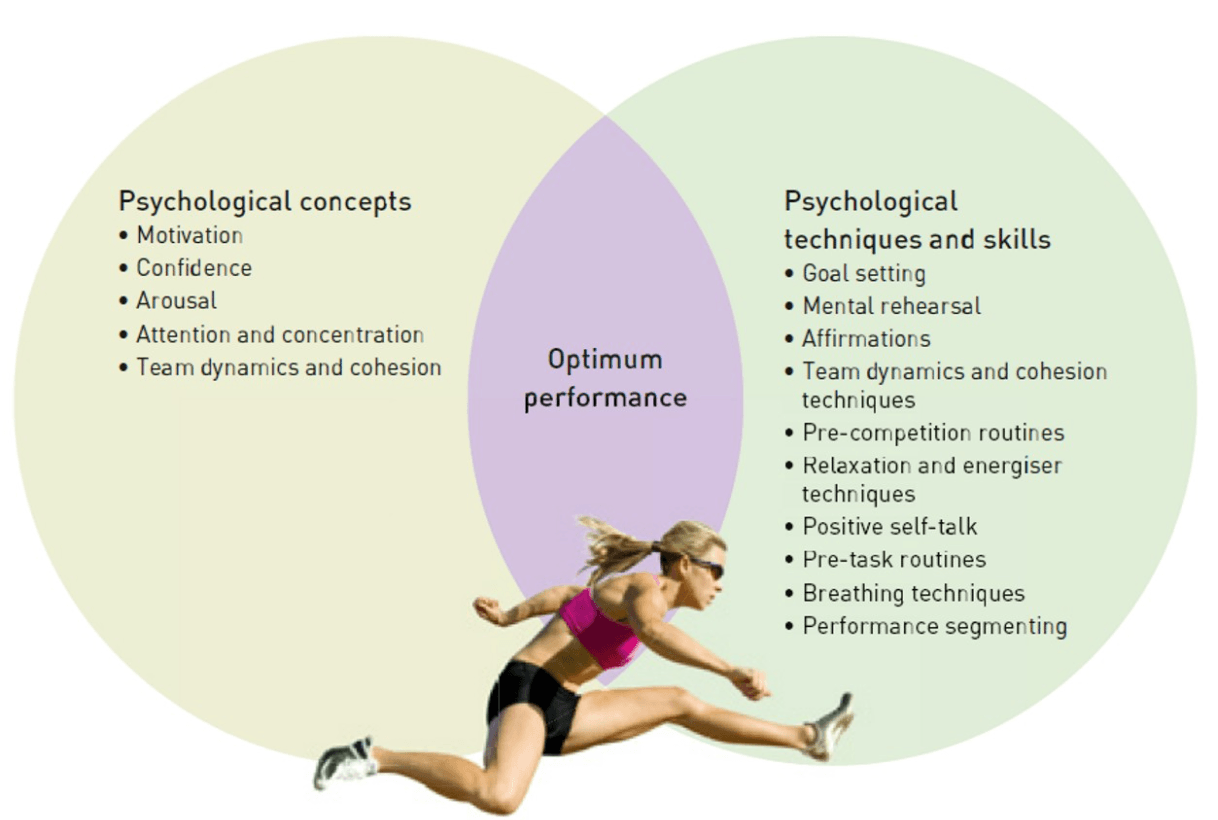
The combination of a knowledge of psychological concepts and psychological techniques and skills will facilitate __________ p_______________ from an athlete.
500
This arousal theory was originally proposed in 1908 by US psychologists Robert Yerkes and John Dodson.
It suggests that performance increases as a result of mental and physical arousal, but only up to a certain point.
Inverted U Theory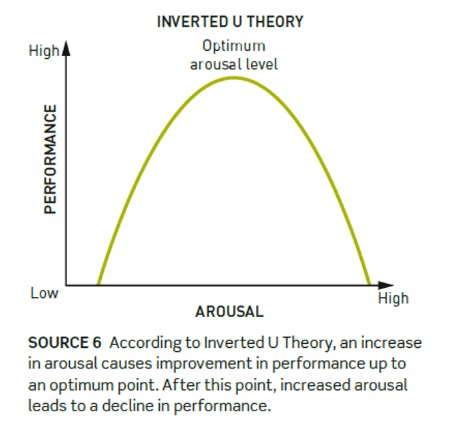
500
Self-efficacy refers to an athlete’s perception of their ability in a given task, rather than their actual ability.
Why might mismatches of self-efficacy and true capability in either direction have a negative impact on an athlete’s performance?
This distinction between self-efficacy and true capability is crucial in situations where an athlete’s level of self-efficacy in a task leads them to be over- or under-confident about their prospects.
Losing a match due to underestimating an opponent is one example of how self-efficacy can impact an athlete’s performance in this way.
500
Explain the difference between attention and concentration.
- attention is the technical term used to refer to the specific ability of an athlete to attend and respond to appropriate internal stimuli (e.g. thoughts or feelings) and external stimuli (e.g. the starter’s gun or an opponent) during training and competition.
- concentration is the everyday term used to describe how a person focuses their mental energy. Strong performances are often said to be the result of ‘good concentration’ and poor performances the product of ‘lapses of concentration’.
500
Explain what is necessary for a team to move from Stage 3 to Stage 4 of Tuckman's Stages of Group Development.
social support – the ability for team members to trust each other and actively seek each other out for assistance and support.
500
Explain why effective performance segmenting is important. In what sports/events may this be necessary? Provide an example.
A sporting event that takes place over a long period of time can be overwhelming for the players or athletes taking part in it. If an athlete performs below expectations in the early stages of an event, feelings of panic and anxiety can set in and influence the outcome of the entire event. Effective performance segmenting aims to prevent this from happening. By dividing an event up into segments, athletes can narrow their focus and fully concentrate on the demands of that smaller period of play or activity.
- marathon
- cricket innings
- triathlon