Interpreting Graphs
Circuits
Waves
Radioactivity
Motion
Heating Processes
100
The graph shows the current measured across an ohmic resistor for various applied voltages.
Interpret the graph to determine the resistance of the resistor in this graph.

Process:
1. Calculate the gradient
2. Set gradient = 1/RGradient: 0.133
Resistance: 7.5 Ohms
100
Compare ohmic and non-ohmic resistors.
Similarity:
Resistance is always the ratio of voltage across to current through the resistor.
Difference:
For ohmic resistors, the resistance is always constant, and can be calculated from the gradient of a V-I graph.
For non-ohmic resistors, the resistance is variable, and must be calculated from the ratio of voltage to current.
100
Compare water waves with electromagnetic waves.
Similarities:
Both are transverse waves.
Both have a wavelength, frequency, amplitude, period.
Both will change direction due to a change in their medium.
Both can experience reflection.
Differences:
EM waves are not mechanical, whereas water waves are.
EM waves are fluctuations in electric and magnetic fields, water waves are compressions of water molecules.
100
A carbon-14 atom decays into nitrogen-14.
Identify the type of radioactive decay that has taken place.
Beta negative decay.
100
Compare the terms "vector" and "scalar". Provide an example of each.
Similarity:
Both have magnitudeDifference:
Vectors have direction whereas scalars do not.
100
Distinguish the terms "thermal energy" and "heat"
"thermal energy" is the total kinetic energy of the particles of a system whereas heat is the TRANSFER of thermal energy between two systems.
200
Calculate the work done by the Force.
Work = area
= 100x20+100x10/2= 2500 J
200
A single resistor is connected to a power supply, the power dissipated by this circuit is P.
Explain how the power dissipated would change if a second, identical resistor was connected in parallel.
Resistance halves.
Voltage is the same, so current doubles.
P = VI, so the power dissipated doubles.
200
25 wavelengths of a wave pass a point in 5 seconds.
The wave travels with a speed of 2.4 m/s.
Calculate:
a)The frequency
b)The period
c) The wavelength
a) f = number of wavelengths that pass a point in 1 second.
= 25/5 = 5 Hz
b) T = 1/f
= 1/5
= 0.2 s
c) v = frequency x wavelength
wavelength = v/f
= 2.4/5
= 0.48 m
200
Explain the process of beta positive decay, giving a reason why it occurs.
Reason: Radioactive decay is a result of instability in the nucleus.
Beta positive decay results from an overabundance of protons. Excess protons means there will be excess electrostatic repulsion, which overcomes the strong nuclear force.
As a result, a proton is converted into a neutron, and an positron is emitted (beta positive particle), which conserves charge.
200
A basketball player jumps 76.0 cm in order to grab a basketball after a rebound.
Calculate how long it takes him to reach his maximum height.
s = 0.76 m
u = ?
v = 0
a = -9.8
t = ?
Process: find u, then find t
u2 = v2-2as
= 0 - 2 x -9.8 x0.76
= 14.986
u = 3.86 m/s
v = u + at
t = v-u/a
= -3.86/-9.8
= 0.384 s
200
Calculate the energy required to heat 3.5 kg of water from melting point to boiling point.
1463 kJ
300
The graph shows the journey of a car down a very long road.
Calculate the distance traveled during the first 30 seconds of the trip.
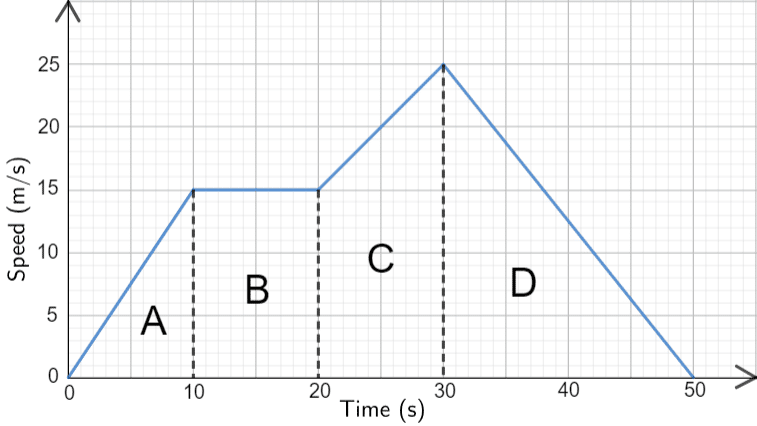
Distance = A + B + C
= 10*15/2 + 20*15 +(15+25)*10/2
= 575 m
300

Calculate the current running through the resistor R2 in this circuit.
I = V/R
= 9/45
= 0.2 A
300
Explain the formation of standing waves.
- Are formed from the superposition of two waves traveling in opposite directions.
- Interfering waves must have equal wavelength and amplitude.
- The result is a wave that does not appear to move, with nodes that oscillate in place (constructive interference), and antinodes that do not move at all (destructive interference).
300
Define the term "binding energy"
QCAA: The work that must be done against a the forces holding a nucleus together to break it down into its components.
300
A toy car of mass 1.0 kg moves left with a speed of 2 m/s. It collides head on with a toy truck of mass of 1.5 kg that was moving with a speed of 1.5 m/s to the right. If the car rebounds with a speed of 2.05 m/s to the right, determine the final velocity of the truck.
If we let right be positive.
Conservation of momentum:
mtut + mcuc = mtvt + mcvc
vt = (mtut + mcuc - mcvc)/mt
= (1.5 x 1.5 + 1 x - 2 -1 x 2.05)/1.5
= -1.2 m/s
or, 1.2 m/s to the left.
300
Explain why the temperature of ice does not increase during melting (3 marks)
1 mark - The ice is undergoing a phase change due to the addition of heat during melting
1 mark - During a phase change, the input heat is used to weaken the intermolecular bonds and increase potential energy instead of thermal energy.
1 mark - As thermal energy is not increasing, the temperature is also therefore not increasing.
400
Determine the impulse acted on the object in the graph below.
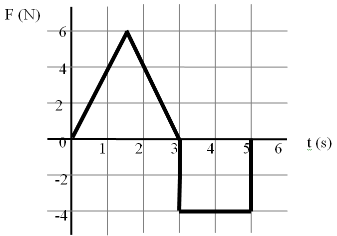
I = Positive area - negative area
Positive area:
1/2(6*3) = 9 Nm
Negative area:
4*2 = 8 Nm
I = 9 - 8
= 1 Nm
400
Calculate the power dissipated by the following circuit.
P = V2/R
Need RT.
1/Rt = 1/R1 + 1/R2 + 1/R3
= 1/90 + 1/45 + 1/180
=7/180
Rt = 180/7 = 25.7 Ohms
P = 92/25.7
= 3.15 W
400
A beam of light travelling through air strikes a glass block with nblock = 1.25
If the observed angle of refraction is 30 degrees from the normal, calculate the angle of incidence.
nisin(i) = nrsin(r)
sin(i) = (nr/ni)sin(r)
= 1.25sin(30
=0.625
i = arcsin(0.625)= 38.7 degrees
400
Calculate the binding energy of a Iodine-131 nucleus. Give your answer in MeV.
Relevant atomic masses:
Proton: 1.00727647u
Neutron: 1.008665u
Iodine-131: 130.9061246 u
Mass defect: 1.15539831u
1.91858386 x10⁻²⁷ kg
Energy: 1.72672547 x10⁻¹⁰ J
1077 MeV
400
Patricia is spinning a 2.1 kg ball attached to a 1.2 m long rope in a vertical circle. If the speed of the ball at the top of the circular path is 5.2 m/s, calculate the speed at the bottom of the path.
v bottom = 8.6 m/s.
400
Gold has a specific heat capacity of 129 kJ/kg/K.
An amount of gold is heated from 293 K to 350 K in 7.0 minutes by a 250 W heater.
Calculate how long it would take to heat half the mass of the gold to a temperature of 375 K from the same starting temperature.
GIve your answer to the nearest minute
Mass:
m = (Pt)/(c\DeltaT)
m = 14.3 kg
t = (mc\DeltaT)/P
t = 604 s = 10 minutes
500
A 0.50 kg ball starts at rest and is acted on by a non-constant force illustrated in the force-time graph below.
Determine the final kinetic energy after the force has been applied
I = change in momentum = area
= (3+8)x2/2
= 11 = m(v - u)
u = 0, therefore,
0.5v = 11
v = 11/0.5
= 22 m/s
Initial KE = 0, therefore
KE final = 1/2*0.5*22^2 = 121 J
500
Determine the current readings on ammeters A1, A2, and A3 (voltage of powerpack is 24 V)
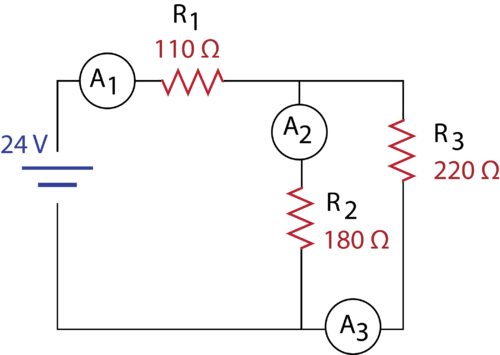
RT = 209 Ohms
A1 = 0.115 A
R2 and R3 are in a ratio of 9:11, currents will be in the same ratio.
A2 = 0.0633 A
A3 = 0.0518 A
500
Calculate the critical angle for a beam of light leaving a diamond (n = 2.54) and entering air.
sin(c) = 1/2.54
c = 23.18 degrees
500
A sample of Francium-223 initially registers an activity of 1500 Bq. If its' half life is 22 minutes, determine the activity of this sample 4 hours later.
0.78 Bq
500
A 0.63 kg ball is thrown straight up into the air with an initial speed of 14 m/s. It reaches a maximum height of 8.1 m before falling back down again. Assuming that the only forces acting on the ball are gravity and air resistance, deduce the work done on the ball by air resistance during the ascent.
Max height without air resistance:
s = (v2-u2)/2a
= -142/2x-9.8
=10 m
GPE would be = 0.63 x 9.8 x 10
= 61.74 J
Actual GPE = 0.63 x 9.8 x 8.1
= 50 J
Work done = difference in expected vs actual GPE
= 61.74 - 50
= 11.74 J
500
100 g of ice at -5 degrees celsius is mixed with 100 mL of water at 50 degrees celsius in a styrofoam cup.
Calculate the final temperature of the mixture.
0 degrees celsius