Excretion (Kidney)
Osmoregulation
Immunity
Hormones 1
Hormones 2
100
List the three forms of nitrogenous waste in order from most to least toxic.
ammonia, urea, uric acid
100
What kind of habitat would you expect a conformer to live in and why?
Conformers typically live in stable, marine habitats. This is because their cells are always iso-osmotic with the environment, so they need to live in an environment that does not change very much!
100
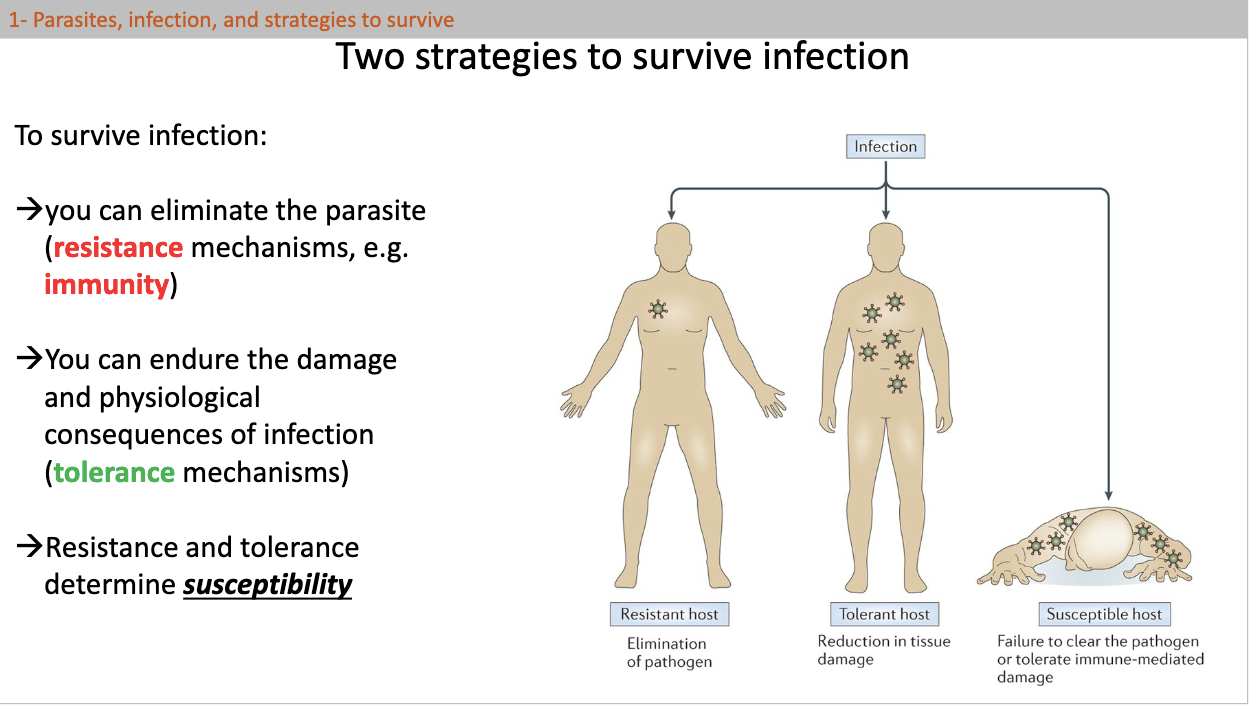
Describe the two strategies for a host to survive infection.
100
Where is the receptor located for lipophilic versus hydrophilic hormones?
lipophilic hormones have receptors in the cytosol or nucleus, hydrophilic have receptors on the outer membrane
100
What endocrine gland receives hormones from the hypothalamus and releases tropic hormones in response?
Anterior Pituitary
200
Describe the function of ADH.
- acts on cells of the late distal tubule and collecting duct to release release stored vesicles containing aquaporins
- increased numbers of aquaporin channels on the membrane provides a pathway for more water to be reabsorbed in the collecting duct
200
What are the functions of extracellular fluid?
- ensures cell function (maintains gradients to allow action potentials)
- maintains cell structure (osmolarity affects cell volume, hydrostatic pressure maintains structure)
- vehicle for nutrients and chemicals
200
What are the three lines of defense against pathogens in jawed vertebrates? What about in agnathans?
jawed vertebrates have epithelial and mucosal barrier, innate immune system, and adaptive immune system. agnathans have epithelial and mucosal barrier, innate immune system, and an adaptive-like immune system (but evolved separately)
200
how are specific cells targeted by hormones despite traveling to all cells in the body via circulation?
hormones can reach all parts of the body through circulation and could reach all cells, however only target cells (cells with receptors for that hormone) will respond to the signal
200
What is the stimulus for activation of the HPA axis?
Stress or prolonged activity
300
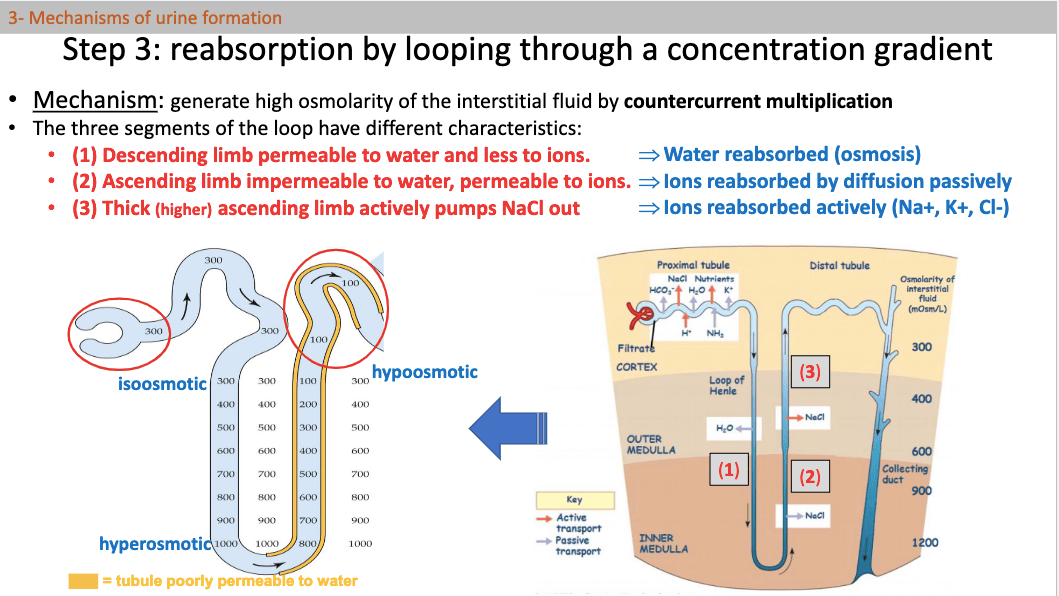
What process generates the osmotic gradient present in the extracellular fluid surrounding the Loop of Henle?
countercurrent multiplication
300
Describe the adaptations of a saltwater bass who lives in the ocean to maintain osmolarity of its body.
problems are desiccation and inward salt diffusion. The urine will be highly concentrated, releasing high amounts of salt ions and low levels of water. The gills will also actively secrete out Cl- ions (Na+ ions follow actively/passively)
300
What are the three methods the body uses to recognize infection? Which immune systems do they activate?
- tissue damage, DAMPs are recognized and the innate immune system is activated
- microbial patterns are recognized as PAMPs, innate immune system activated
- non-self epitopes are recognized, adpative immune system activated
300
If a hormone's goal is to quickly cause a change in cellular function, would it be better to alter gene expression or protein function and why?
- altered gene expression is slow regulation (requires protein synthesis)
- altered protein function is fast (recycles same proteins)
- BOTH cause altered cell behavior
300
Name 3 physiological effects of T3.
Increase basal metabolic rate, increase protein synthesis, increase growth, increase body temperature, increase fat mobilization
400
Name all places where salt can be reabsorbed or secreted in the kidney.
proximal tubule, ascending limb of loop of henle, distal tubule
400
Where/how does the body sense hypovolemia?
Baroreceptors in arteries sense decreased stretch of blood vessels. Also, kidney cells sense a decrease in renal perfusion in the kidneys.
400
How does the adaptive immune system generate a large diversity of recognition receptors?
uses somatic DNA recombination to develop many B and T cells and antibodies with many shapes and binding specificity
400
Describe the pathway of a hormone which binds a GPCR and activates Ca++ as a second messenger.
GPCR activates a G protein, alpha subunit separates and activates phospholipase C, which cleaves PIP2 into IP3 and DAG, IP3 binds receptor on ER to open calcium channels, calcium flows into cell and activates various proteins to initiate cellular responses
400
Describe how insulin and glucagon regulate blood glucose levels through two negative feedback loops.
When blood glucose is high, insulin is secreted from beta cells of the pancreas. It signals cells to transport glucose into cells and for liver cells to store glucose as glycogen. This decreases blood glucose. When blood glucose is low, glucagon is secreted from alpha cells of the pancreas. It signals breakdown of glycogen in liver cells and release of glucose into blood. This increases blood glucose.
500
Describe what mechanisms exist to prevent blood proteins from being excreted in urine.
podocytes line the endothelium of the glomerulus of the Bowman's capsule, they form a thin, porous membrane which is too small for proteins to pass through even with high pressure
500
Describe hypertonic dehydration. (how is it caused, what is the osmolarity of blood compared to cells, what are the sensors, how do you treat it?)
Hypertonic dehydration is caused by a loss of fluid without a loss of salt (ex. sweating, not drinking water). The blood is hypo-osmotic to the cells (causes cells to shrivel, intracellular thirst). It is sensed by osmoreceptors in the hypothalamus and saliva production decrease in the mouth. Treatment is to drink water.
500
How does the RNA interference (RNAi) system function as an antiviral system in bacteria?
The virus replicates in the host cell, creating dsRNA. The DICER enzyme cleaves this into small fragments created siRNA homologous to the virus. The RISC enzyme then binds the siRNA and scans the cell for homologous RNA, which it will cleave or otherwise silence.
500
How does auxin lead to phototropism in plants?
Auxin is distributed away from light, stimulates proton pumps in plasma membrane to pump protons from cytoplasm into cell wall, low pH activates expansin enzymes which loosen cellulose, cells swell and elongate so plant bends toward the light
500
Describe the pathway of the Growth Hormone axis, including all glands and hormones and their effects.
Hypothalamus secretes GHRH, anterior pituitary releases GH, GH travels to liver and other tissues and causes IGF-1 release, which acts on muscle and bone to increase growth (cartilage formation, skeletal growth, increased protein synthesis, cell growth and proliferation). GH also acts directly to increase fat breakdown and release, and on carbohydrate metabolism to increase blood glucose