What is force?
Effects of forces
Newton's Laws of Motion
Friction
Circular Motion
100
If you push against a wall with all your strength and it doesn't move an inch, are you applying a force?
Yes — force doesn't require motion to exist.
100
Name two possible effects a force can have on an object besides making it move.
Changing its shape, or changing its direction (also: starting/stopping motion, changing speed).
100
Which of Newton's three laws explains why passengers jerk forward when a bus suddenly stops?
The First Law (inertia) — your body wants to keep moving even though the bus stopped.
100
Is friction always a bad thing that engineers try to eliminate? Give one everyday example where we actually need it.
No — we need friction to walk, for car tires to grip the road, for brakes to work, etc.
100
A car drives in a perfect circle at constant speed. Is its velocity also constant?
No — velocity includes direction, and direction keeps changing, so there IS acceleration even though speed doesn't change.
200
Force is often described as a "push or pull," but what quality of an object does force change even if the object doesn't visibly move or speed up?
Its shape (deformation) — force can change shape, direction, or speed, not just cause motion.
200
A ball rolling across a rough floor eventually stops on its own, even though nothing visibly "pushed" it to stop. What force did this?
Friction — an unseen force that acted to slow and stop it.
200
A rocket in the vacuum of space can still accelerate forward by shooting gas out the back — with nothing to push against. Which law explains this, and how?
The Third Law — the rocket pushes gas backward, and the gas pushes the rocket forward (action-reaction pair).
200
If friction between your shoes and the ground vanished completely, could you still walk forward? Why or why not?
No — walking requires pushing backward against the ground so friction pushes you forward; no friction means no grip.
200
What is the name of the force that constantly pulls an object toward the center of a circular path, keeping it from flying off straight?
Centripetal force.
300
A tug-of-war has two teams pulling with exactly equal force, and the rope doesn't move. Does that mean no force is acting?
No — two forces ARE acting, they just cancel out (net force = zero), which is different from "no force at all."
300
Two ice skaters of different weights push off each other. Who flies backward faster — the heavier or the lighter one, and why?
The lighter one — same push force on both, but lighter mass means greater acceleration (F = ma).
300
A small car and a massive truck crash head-on. By Newton's Third Law, the force each exerts on the other is equal and opposite. So why does the car get far more damaged?
Equal force, but the car has much less mass, so it undergoes much greater acceleration/deceleration (Second Law: a = F/m) — more damage.
300
Two balls of very different mass are dropped from the same height in a vacuum and land at the same time. Drop them from a plane in real air instead, and the heavier one lands first. What changed?
Air resistance (a form of friction) slows the lighter object proportionally more relative to its weight — gravity itself didn't change.
300
A stone tied to a string is whirled in a circle, and the string suddenly snaps. Does the stone fly straight outward away from the center, or does it fly off in a straight line tangent to the circle?
Tangent to the circle — once the centripetal force is removed, Newton's First Law takes over.
400
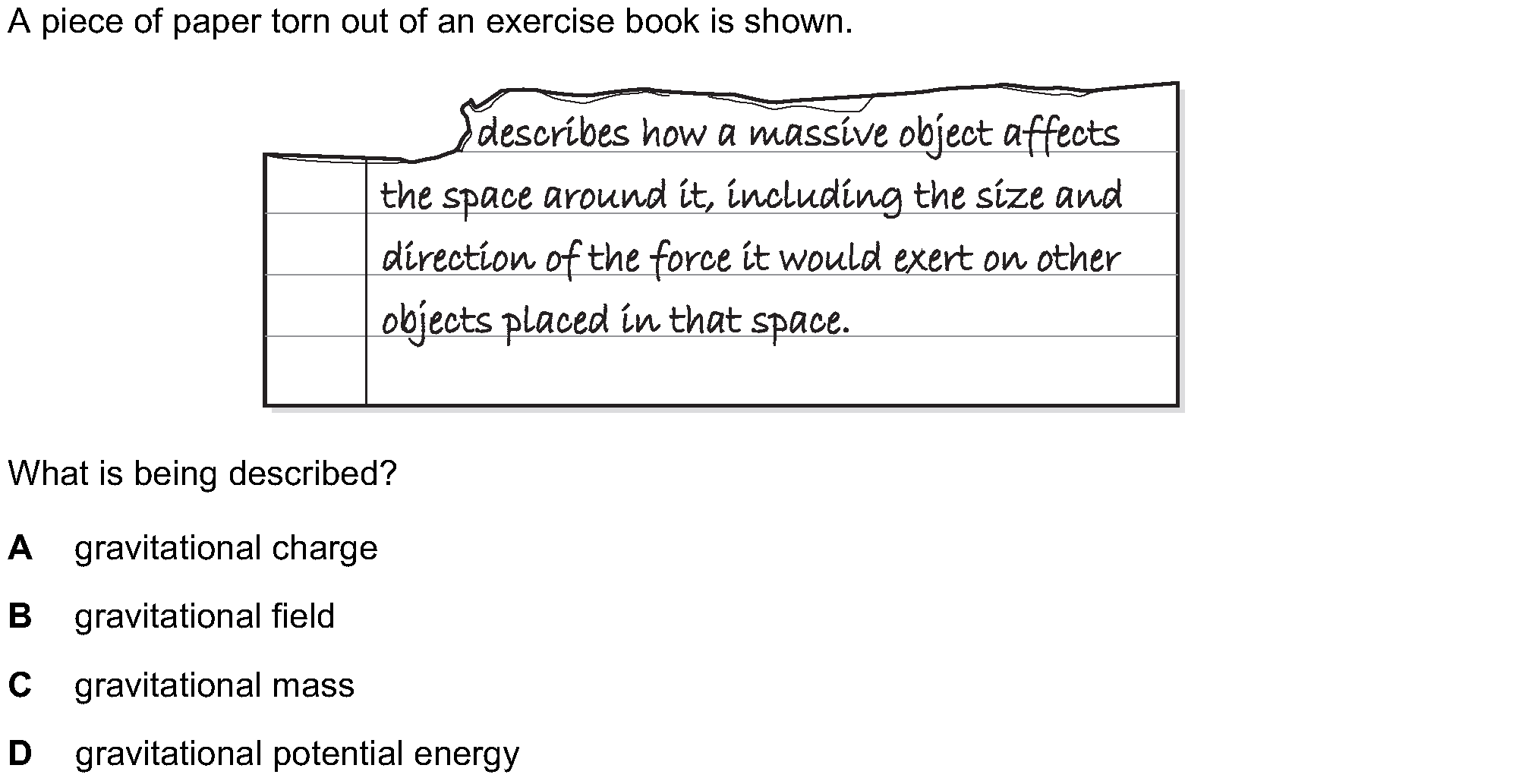
Option B
400
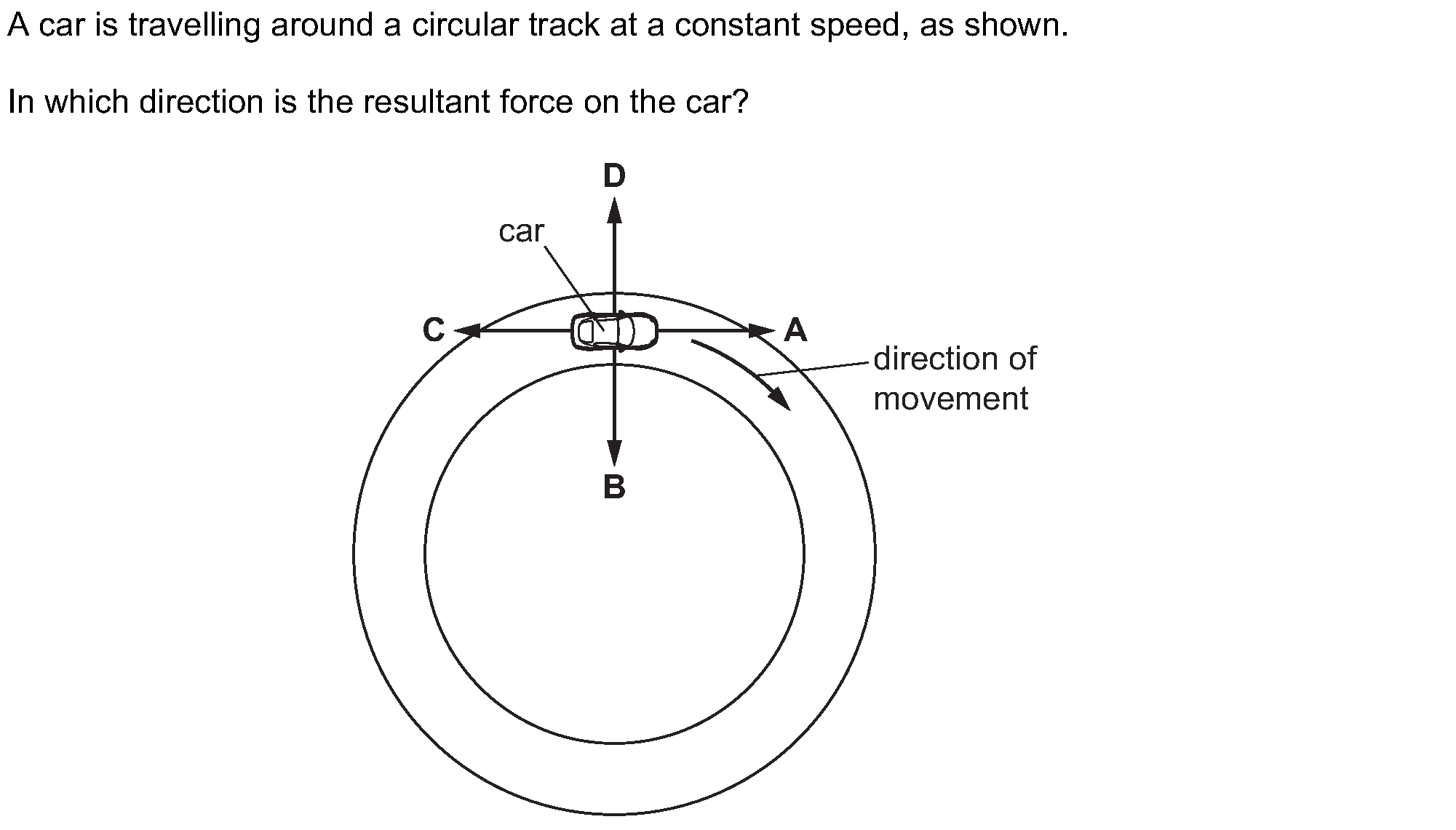
Option B