Salt Solutions
Buffers
Titrations
Acid-Base Indicators
Solubility
Entropy
100
Pick the substance whose aqueous solution is acidic.
(a) NaNO3
(b) NH4NO3
(c) NaF
(d) KClO4
(b) NH4NO3
100
At which point on this curve is a buffered solution obtained?
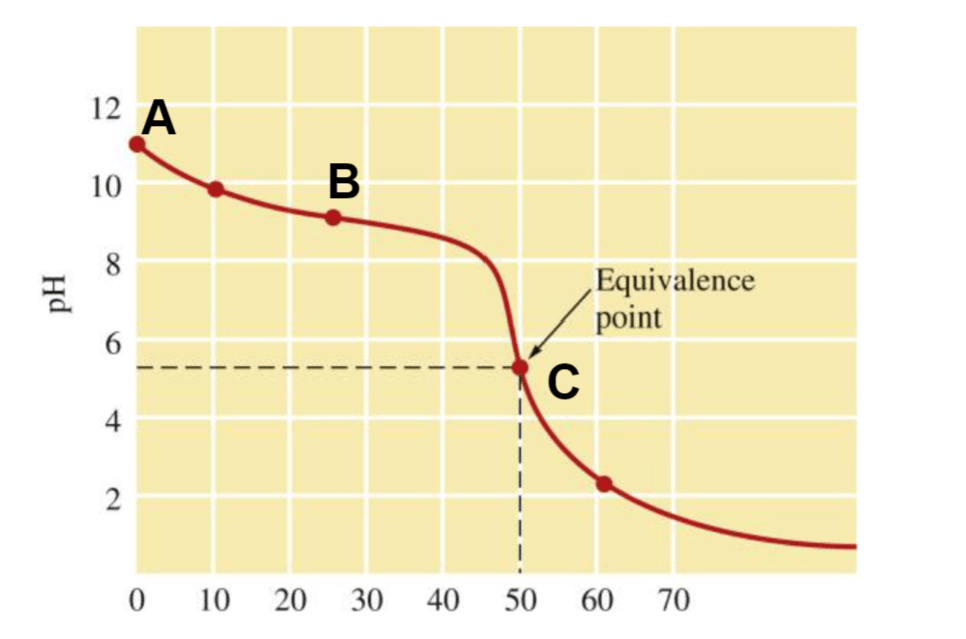
B
100
The pH curve for a certain titration is shown in the graph below. The
initial sample (that is being titrated) contains a
(a) weak acid
(b) strong acid
(c) weak base
(d) strong base

c) weak base
100
What does the pKa of an acid-base indicator tell you?
the point at which the concentration of H+ will signal a color change
100
The solubility product for AgCl(s) is about 1 × 10⁻¹⁰. The concentration of a saturated solution of AgCl is about
(a) 10-20 M
(b) 10-10 M
(c) 10-5 M
(d) 10-2.5 M
c) 10-5 M
100
What is the SI unit for entropy?
Joules (J)
200
Pick the substance whose aqueous solution is basic.
(a) KNO2
(b) NH4Cl
(c) BaCl2
(d) KCl
(a) KNO2
200
Which of the following buffered solutions has the highest buffer
capacity?
(a) 0.1 M HNO2(aq) + 0.1 M NaNO2(aq)
(b) 0.16 M HNO2(aq) + 0.04 M NaNO2(aq)
(c) 0.01 M HNO2(aq) + 0.01 M NaNO2(aq)
(d) 0.016 M HNO2(aq) + 0.004 M NaNO2(aq)
(a) 0.1 M HNO2(aq) + 0.1 M NaNO2(aq)
200
Arsenic acid H3AsO4 is a triprotic acid with pKa1=2.2, pKa2=7.0, and pKa3=11.5.
What is the pH value of a 1.00 M solution of Na2HAsO4?
pH = 9.25
200
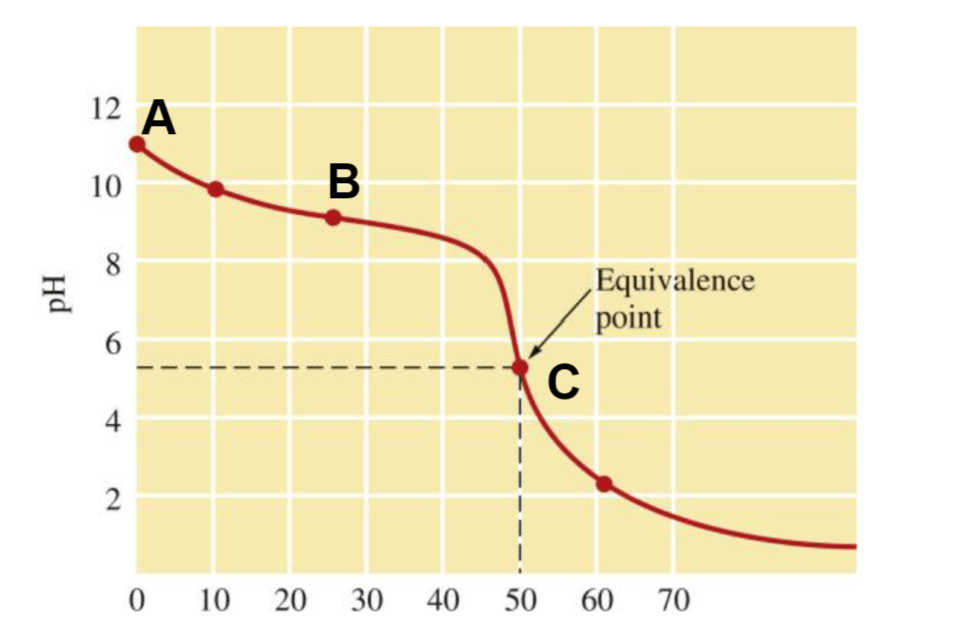
Which indicator would be the best choice for finding the equivalence
point of this titration?
(a) metacresol purple, 𝑝𝐾a= 1.5
(b) bromocresol green, 𝑝𝐾a= 4.9
(c) bromothymol blue, 𝑝𝐾a= 7.3
(d) phenolphthalein, 𝑝𝐾a= 9.5
bromocresol green
200
Write out the ion-product expression for
a) iron(III) oxide
b) silver dichromate
a) Ksp= [Fe3+]2[O2-]3
b) Ksp= [Ag+]2[Cr2O72-]
200
How do you calculate entropy on a microscopic level?
What does each constant represent?
S=kBlnW
S -> entropy
kB-> Boltzmann constant
W-> number of microstates
300
A microbiologist is preparing a medium on which to culture E. coli bacteria. She buffers the medium at pH 7.00 to minimize the effect of acid-producing fermentation. What volumes of equimolar aqueous solutions of K2HPO4 and KH2PO4 must she combine to make 135. mL of the pH 7.00 buffer?
Ka1= 7.2 x 10⁻³ , Ka2=6.3×10⁻⁸ , Ka3= 4.2×10⁻¹³
82.8 mL of H2PO4- and 52.2 mL of HPO42-
300
Malonic acid HOOCCH2COOH is a weak diprotic acid with 𝐾a1=1.4 × 10⁻³ and 𝐾a2= 2.0 × 10⁻⁶. A 40.0 mL sample of 0.200 M malonic acid is
titrated with 0.100 M NaOH. Calculate the pH values at the following points on
the pH curve:
a. after 40.0 mL (total) of NaOH(aq) was added
b. after 160.0 mL (total) of NaOH(aq) was added
a) pH = 2.85
b) pH = 9.15
300
Calculate the solubilty of SrCO3 in
a) pure water
b) 0.13 M Sr(NO3)2
a) S= 2.3 x 10⁻⁵ M
b) S= 4.2 x 10⁻⁹ M
300
What is the macroscopic definition of entropy?
ΔS= qrev/T
400
As an FDA physiologist, you need 0.700 L of formic acid– formate buffer with a pH of 3.74. (a) What is the required buffercomponent concentration ratio? (b) How do you prepare this solution from stock solutions of 1.0 M HCOOH and 1.0 M NaOH? (c) What is the final concentration of HCOOH in this solution?
Ka of HCOOH = 1.8 x 10⁻⁴
a) buffer component concentration ratio is 0.99
b) 0.468 L of 1 M HCOOH and 0.232 L of 1 M NaOH
c) 0.34 M HCOOH
400
Find the pH of the equivalence point(s) and the volume (mL) of 0.0372 M NaOH needed to reach the point(s) in titration of 28.9 mL of 0.0850 M H2SO3.
Ka1= 1.4 x 10⁻²
Ka2= 6.5 x 10⁻⁸
pH of equ. point 1: 4.52
vol NaOH needed: 66.0 mL
pH of equ. point 2: 9.685
vol NaOH needed: 132 mL
400
The solubility of KCl is 3.7 M at 20°C. Two beakers each contain 100. mL of saturated KCl solution: 100. mL of 6.0 M HCl is added to the first beaker and 100. mL of 12 M HCl is added to the second.
(a) Find the ion-product constant for KCl at 20°C.
(b) What mass, if any, of KCl will precipitate from each beaker?
a) Ksp= 14
b) 1 g KCl
400
Predict the sign of ΔS° for
(a) CaCO3(s) + 2HCl(aq) ⟶ CaCl2(aq) + H2O(l) + CO2(g)
(b) 2NO(g) + O2(g) ⟶ 2NO2(g)
(c) 2KClO3(s) ⟶ 2KCl(s) + 3O2(g)
a) positive
b) negative
c) positive