Unit 1: The Living World-Ecosystems
Unit 2: The Living World-Biodiversity
Unit 3: Populations
Unit 4: Earth Systems and Resources
Unit 5: Land and Water Use
100
This specific term describes a symbiotic relationship where one species benefits and the other is unaffected.
Commensalism
100
A scientist is comparing two forests. Forest A has 10 species with 10 individuals each, while Forest B has 10 species but one species makes up 90% of the population. Forest A has higher species ________.
Evenness
100
This reproductive strategy is characterized by species that have many offspring, provide little to no parental care, and often have short lifespans.
r-selected species
100
Most of the Earth's weather occurs in the __________, which is the lowest layer of the atmosphere and contains the majority of its water vapor.
Troposphere
100
The tendency of a shared, limited resource to become depleted because people act from self-interest for short-term gain is known as the ___________.
Tragedy of the Commons
200
Which of the following biomes has the lowest Net Primary Productivity (NPP) per unit area?
A) Tropical Rainforest
B) Estuaries
C) Open Ocean
D) Swamps and Marshes
C) Open Ocean
200
Which of the following is an example of a supporting ecosystem service?
A) Coastal mangroves protecting a town from storm surges.
B) The water cycle and nutrient cycling within an ecosystem.
C) Commercial fishing in the North Atlantic.
D) Ecotourism in the Galápagos Islands.
B) The water cycle and nutrient cycling
200
In a population showing logistic growth, the population size levels off when it reaches this maximum number of individuals the environment can support.
Carrying capacity
200
At a divergent plate boundary in the ocean, which of the following is most likely to form?
A) A deep-sea trench
B) A mid-ocean ridge
C) A volcanic island arc
D) A fold mountain range
B) A mid-ocean ridge
200
Which of the following irrigation methods is generally considered the most efficient in terms of reducing water loss due to evaporation?
A) Flood irrigation B) Furrow irrigation
C) Spray irrigation D) Drip irrigation
D) Drip irrigation
300
A scientist measures the Gross Primary Productivity (GPP) of a wetland as 15,000 kcal/m2/yr. If the producers use 8,000 kcal/m2/yr for their own cellular respiration, calculate the Net Primary Productivity (NPP).
A) 23,000 kcal/m2/yr B) 7,000 kcal/m2/yr
C) 8,000 kcal/m2/yr D) 1.87 kcal/m2/yr
B) 7,000 kcal/m2/yr
300
According to the Theory of Island Biogeography, which of the following islands would most likely exhibit the highest species richness?
A) A small island located 500 miles from the mainland.
B) A large island located 500 miles from the mainland.
C) A small island located 50 miles from the mainland.
D) A large island located 50 miles from the mainland.
D) A large island located 50 miles from the mainland
300
Total Fertility Rate (TFR) is influenced by several societal factors. What is the primary factor that historically leads to a significant decrease in a country's TFR?
Education/Employment of women
300
This phenomenon, caused by the Earth’s rotation, deflects moving air to the right in the Northern Hemisphere and to the left in the Southern Hemisphere.
Coriolis Effect
300
This type of industrial agriculture, which became prominent during the Green Revolution, involves growing only a single species of crop on a large scale.
Monoculture (or Monocropping)
400
Use the diagram below. The process of atmospheric nitrogen being converted into a form usable by plants at the root nodules of legumes is known as what?

Nitrogen Fixation
400
A catastrophic forest fire clears an area of all vegetation but leaves the soil intact. This is followed by the growth of grasses, then shrubs, and finally trees. This process is known as:
A) Primary succession B) Secondary succession
C) Island Biogeography D) Competitive Exclusion
B) Secondary succession
400
According to the rule of 70, if a country has a constant population growth rate of 2%, how many years will it take for the population to double?
35 years
400
Based on the Soil Texture Triangle below, what is the classification of a soil sample that is 20% Silt, 70% Clay, and 10% Sand?
Clay
400
In a "Clear-cutting" logging operation, the most immediate and significant environmental impact to the local stream ecosystem is an increase in ___________.
Sedimentation (or Turbidity/Water temperature)
500
Use the diagram below. Identify the ecological process demonstrated when different bird species forage in distinct vertical zones of the same tree to avoid competition.
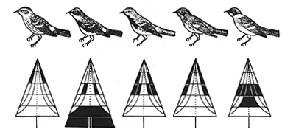
Resource Partitioning
500
This specific term describes a species that has a significant effect on its ecosystem relative to its abundance. If removed, the ecosystem may collapse.
Keystone species
500
Based on the Survivorship Curve graph below, identify the type that is most representative of a species like a giant sea turtle.

Type III
500
Identify the specific name of the global circulation cells located between 0o and 30o latitude that drive the trade winds.
Hadley Cell
500
Observe the mining diagram below. Identify the specific surface mining technique shown where the overburden is removed in long, parallel rows to expose the mineral seam.
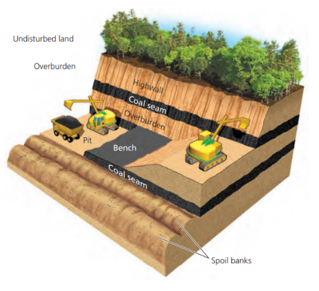
Strip mining
1000
Use the 10% Rule of Energy Transfer on the pyramid below. If the Primary Producers (Level 1) contain 1,200,000 Joules of energy, calculate the exact amount of energy available to the Tertiary Consumer (Level 4).

1,200 Joules
1000
Identify the specific type of Ecosystem Service being performed by the wetland in the diagram below as it filters pollutants from the water.
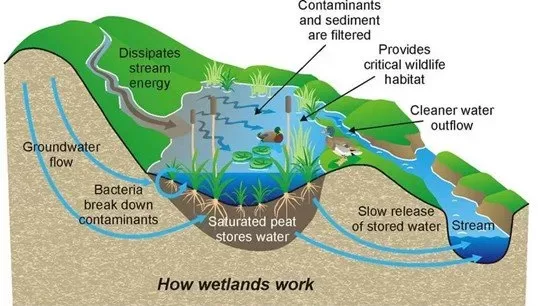
Regulating service
1000
A country has a Crude Birth Rate (CBR) of 38 and a Crude Death Rate (CDR) of 12. If this country maintains its current Growth Rate (r), calculate how many years it will take for the population to quadruple in size.
56 years
1000
During an El Niño-Southern Oscillation (ENSO) event, explain the specific shift in water temperature and precipitation patterns that occurs along the coast of South America (Peru/Ecuador).
Warmer water and increased rainfall (or flooding)
1000
A coastal "dead zone" has been identified at the mouth of a river.
Identify the specific agricultural practice most likely responsible for this.
Propose a structural (not chemical) solution that can be implemented on-site at the farm to mitigate this runoff.
1. Application of synthetic fertilizers (or Manure lagoons)
2. Riparian buffers (or Contour plowing/Cover crops, etc.).