Small Bowel Anatomy 1
Small Bowel Anatomy 2
Anti-diarrheals
Celiac Treatment
Dietary
100
What are the different portions of the small intestine and what is their correct order (proximal to distal)?
Duodenum, Jejunum, Ileum
100
What structure is show below as a lumen inside the villi.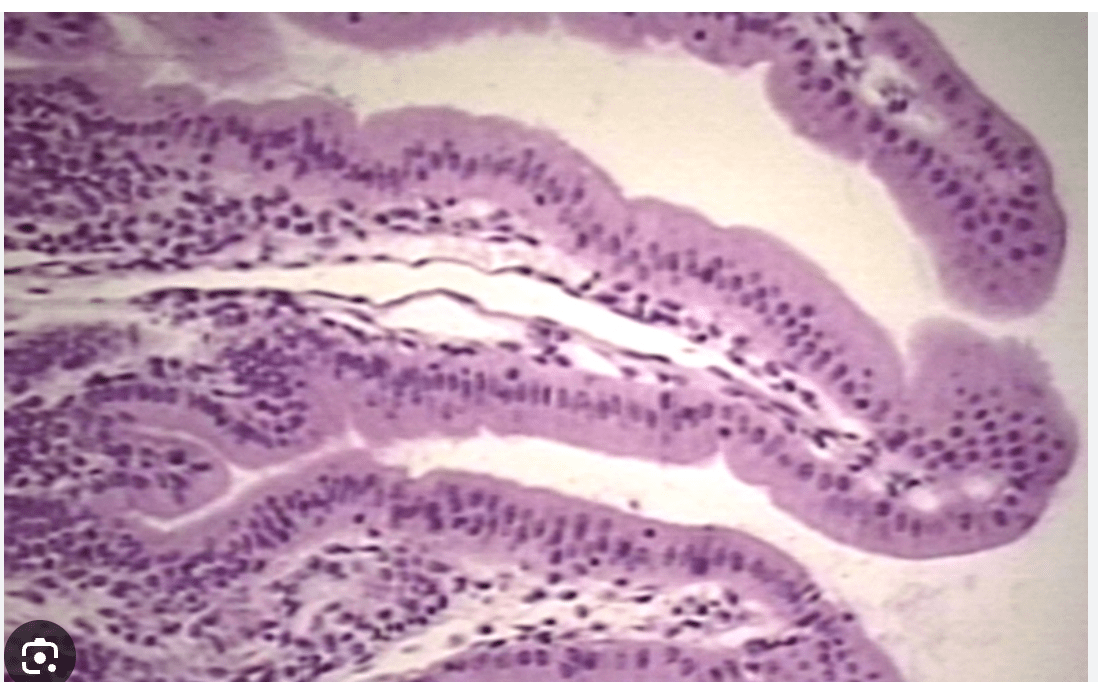
Lacteal.
Lymphatic capillaries located in the center of each intestinal villus within the small intestine.
Absorbs dietary lipids (fats) and fat-soluble vitamins (as chylomicrons).
100
This anti-diarrheal agent is typically given in combination with atropine and crosses the BBB making it potentially addictive.
What is diphenoxylate (Lomotil) - mu opioid receptor agonist
Loperamide does not cross the BBB and therefore does not have the same risk profile in terms of addiction.100
If celiac related inflammation is severe this medication(s) can be used to reduce inflammation.
What is glucocorticoids.
100
What grains are recommended as part of the BRAT diet.
Rice, quinoa, corn.
200
What is the shortest and widest portion of the small intestine?
What is the duodenum
200
What is the blood supply for the Jejunum?
The Superior Mesenteric Artery (SMA) and its branches supply the jejunum.
The SMA provides 10 to 20 jejunal–ileal branches that course through the mesentery to supply the jejunum and parts of the ileum.
200
What symptoms can a patient develop following chronic use of Bismuth subsalicylate?
Salicylate acid: Can cause tinnitus (ringing in the ears), dizziness, headache, vomiting, and metabolic acidosis.
Bismuth: Chronic, high dose ingestion can cause encephalopathy due to bismuth toxicity.
A common benign side effect is blackening of the tongue and dark stools due to the formation of bismuth sulfide in the body.
200
What treatments are used to correct the anemias caused by Celiac Disease?
B12 injection
Folic acid supplementation (usually oral)
Iron supplementation (usually oral)
200
What key macronutrients are lacking in the BRAT diet, limiting it long term use?
Protein and Fats.
Long term use can lead to malnutrition.
300
The terminal ileum is the primary site of absorption for what two substances?
Vitamin B12
Bile Salts
300
The organized lymphoid follicles circled below are only found in what portion of the small intestine?
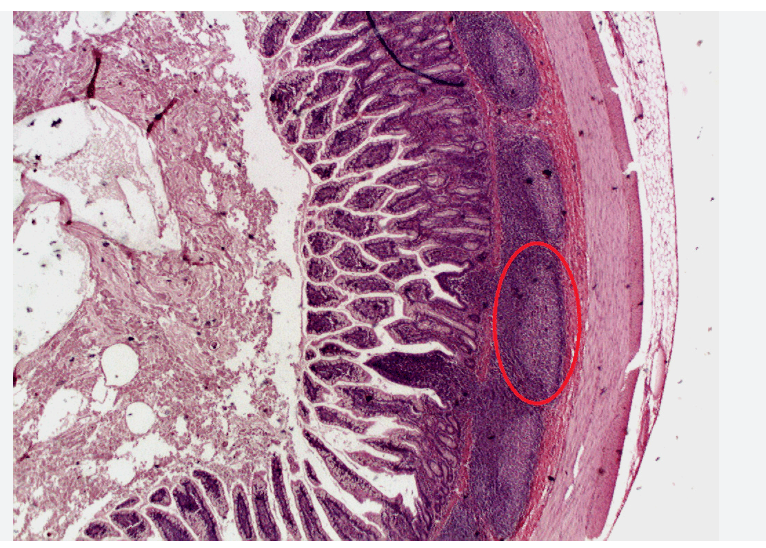
Ileum.
The image shows Peyer's Patches. These lymphoid nodules contain B and T cells and are covered by a specialized follicle-associated epithelium containing M cells, which transport antigens from the gut lumen to immune cells.
Initiates adaptive immune responses in the gut.
300
What anti-diarrheal agent should be used in a patient who has complains of having nausea, fever, and diarrhea for the past week?
Generally none! Anti-diarrheal's should be avoided if infection is suspected.
Absolute contraindication for Loperamide.
Bismuth subsalicylate could be considered due to the antibacterial properties of bismuth.
300
Long-term untreated or poorly treated celiac disease increases risk of this malignancy.
Enteropathy-associated T-cell lymphoma (EATL)
Rare but aggressive form of non-Hodgkin lymphoma.
Arises from intraepithelial T lymphocytes of the small intestine.
300
In terms of fiber content the BRAT diet is classified as a ______ diet.
Low Residue Diet
400
The glandular tissue in this image primarily secretes _____.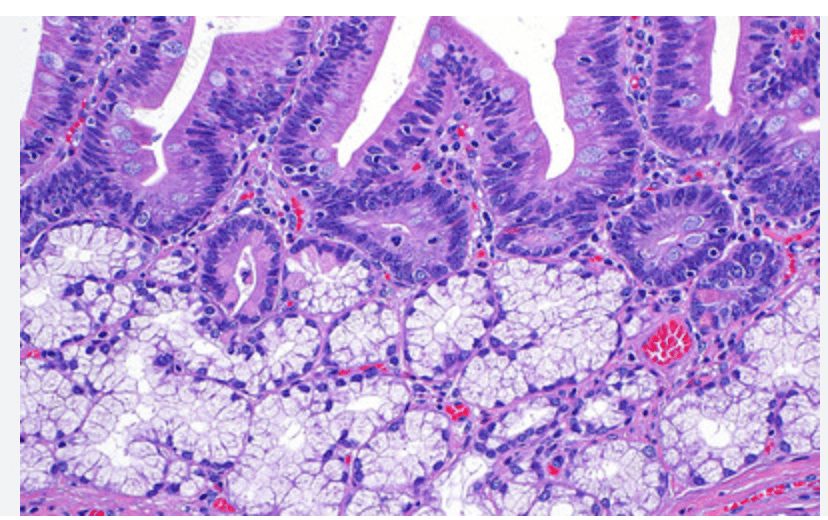
Brunner's Glands - Secrete alkaline (HCO3- rich) mucous. Found extensively in the duodenum.
400
What parts of the duodenum are intraparitoneal and what parts are retroparitoneal?
The first part (superior/D1) of the duodenum is intraperitoneal
The second (descending/D2), third (horizontal/D3), and fourth (ascending/D4) parts are retroperitoneal.
400
This agent can be used in patients with secretory diarrhea secondary to carcinoid syndrome, VIPoma, and chemotherapy induced diarrhea.
Octreotide (somatostatin analogue)
Inhibits secretion of gastrin, VIP, serotonin.
Slows gastric motility by reducing smooth muscle contractility (secondary to decreased intracellular cAMP).
Slowed motility increases absorption of water and electrolytes.
400
How long does it take for full intestinal healing to occur (denoted by recovery of the villi) in patients with celiac disease?
3-6 months for children.
Up to 2 years in adults.
400
What is the primary mechanism by which the BRAT diet decreases diarrhea?
Stool bulking/binding of excess water (via soluble fibers such as pectin) and decreased intestinal stimulation/motility.
500
A duodenal biopsy is shown below.
Left: Healthy Tissue Right: Pathologic Tissue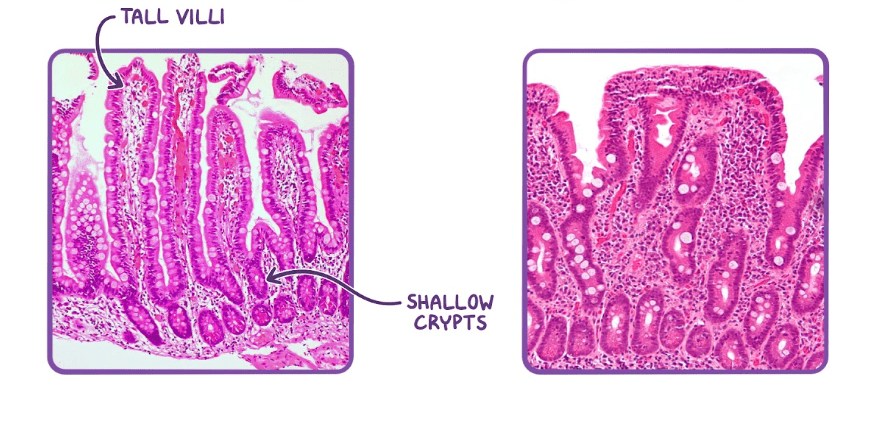
What histologic changes are shown in pathologic specimen. What disease is most likely based on these findings?
Blunting of villi (atrophy)
Crypt hyperplasia
Increased Intraepithelial Lymphocytes (IELs).
The combination of these findings as well as the fact that this specimen comes from the duodenum suggests Celiac Disease.
500
Where do the duodenum and jejunum meet? (Quadrant and Vertebral Level +/-2)
The duodenum and jejunum meet at the duodenojejunal flexure/junction.
Located in the upper left quadrant of the abdomen, roughly at the level of the L2 vertebra.
500
Opioid receptor agonists (Loperamide and Diphenoxylate) decrease diarrhea by altering these two forms of gastric motility.
Decreases propulsive peristalsis.
Increases segmentation (mixing contractions).
500
In patients whose Celiac symptoms are not controlled by dietary elimination or with corticosteroids (Refractory Celiac Disease) this immunosuppressive agent can allievate symptoms and prevent further damage to the small intestine.
Azathioprine (think this one is most common).
Cyclosporine and TNF-a inhibitors such as Infliximab can also be used but are much less common.
500
As the BRAT diet continues to lose favor with major medical societies what recommendations are being made instead for pediatric populations?
Early resumption of a normal, age-appropriate diet as soon as rehydration is achieved.
The BRAT diet is nutritionally restrictive. It is low in protein, fat, and energy density, which can be counterproductive during an acute illness.