Orbital Blocks on PT
Subshells, Principal Energy Levels, Orbitals
Period#, Orbital Block, and Outermost Subshell
Electron Configuration & NGC
Periodic Table
100
Which color are the Subshells in the p Block?
Purple
100
What is the %probability of finding an Electron inside an Atomic Orbital?
90%
100
Identify for Phosphorus:
1. Period# (P#)
2. Orbital Block (OB)
3. Outermost Subshell (OSS)
1. P# = 3
2. OB = p Block
3. OSS = 3p
100
What does the Electron Configuration represent?
The Electron Configuration represents the address for an Atom's Electrons.
100
Where are Metals and Nonmetals located on the Periodic Table?
Metals are located on the left. Nonmetals are located on the right.
200
Which color are the Subshells in the d Block?
Blue
200
Put these structures in order from smallest to largest: Principal Energy Shell (PES), Orbital, Subshell.
1. Orbital
2. Subshell
3. PES
200
Identify for Rhenium.
1. Period# (P#)
2. Orbital Block (OB)
3. Outermost Subshell (OSS)
1. P# = 6
2. OB = d Block
3. OSS = 6 - 1 = 5d
200
When writing the Electron Configuration for any Element, which Element must you ALWAYS begin with?
Hydrogen
200
Where are Metalloids located on the Periodic Table?
Metalloids are located on the Right Side of the Periodic Table along the Staircase. They separate Metals and Nonmetals.
300
Where is the f Block located on the Periodic Table?
Bottom
300
Where is Principal Energy Shell (PES) 4 located in relation to the Nucleus and how much Energy does it contain?
PES 4 is located furthest away from the Nucleus and has the most Energy.
300
Why must you determine the Outermost Subshell (OSS) prior to writing the Electron Configuration of an Element?
You must determine the OSS in order to know where the Electron Configuration ends.
300
Write the Noble Gas Configuration (NGC) for Niobium.
[Kr] 5s^2 4d^3
300
For the Element Silver, determine the following:
A). Group#
B). Period#
C). Metal, Nonmetal, or Metalloid
D). Family Name
A). 11
B). 5
C). Metal
D). Transition Metals
400
How do you determine the number of a Subshell in the s Block?
#Subshell = Period#
400
Name the Subshells in Principal Energy Shell (PES) 2.
2s, 2p
400
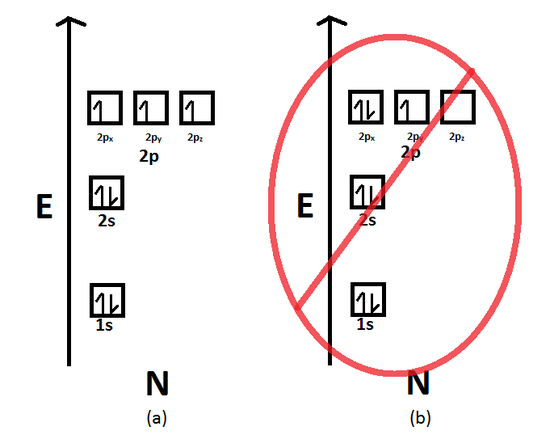
Which Principle is being broken here?
Hund's Rule
400
Write the Noble Gas Configuration (NGC) for Polonium.
[Xe] 6s^2 4f^14 5d^10 6p^4
400
For the Element Lead, determine:
A). A Group#
B). Period#
C). #Valence Electrons
D). Metal, Nonmetal, or Metalloid
E). Family Name
A). 4A
B). 6
C). 4
D). Metal
E). Tetrels
500
How do you determine the number of a Subshell in the f Block?
#Subshell in f Block = Period# - 2
500
How many Orbitals does each d Subshell contain?
5 Orbitals
500
Explain the Aufbau Principle (AP).
AP states that Electrons must enter the Orbitals in the lowest Principal Energy Shells first. This prevents Electron-Electron repulsion, resulting in lower Energy, and a more stable Atom.
500
Write the Electron Configuration for Flerovium.
1s^2 2s^2 2p^6 3s^2 3p^6 4s^2 3d^10 4p^6 5s^2 4d^10 5p^6 6s^2 4f^14 5d^10 6p^6 7s^2 5f^14 6d^10 7p^2
500
Name the Family Name each of these 3 Elements belongs to.
1. Gold
2. Silicon
3. Bismuth
1. Transition Metals
2. Tetrels
3. Pnictogens