Category 1
Category 2
100
Why do random errors have an expected mean of zero?
Positive and negative errors balance out on average when the model correctly captures the true relationship: E[ε | X] = 0.
100
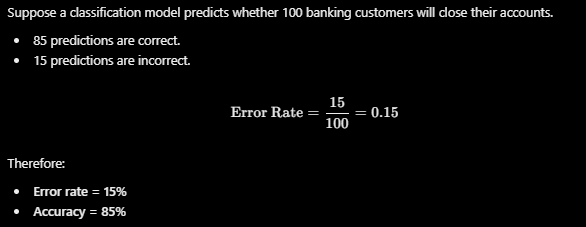
What is the error rate in classification problems?
In classification problems, the error rate measures the proportion of observations that a model incorrectly classifies
200
What is the difference between inference and predicition in statistical learning?
Inference: Understanding the relationship between variables and how they influence an outcome. Focuses on why something happens.
Prediction: Using variables to accurately estimate an unknown or future outcome. Focuses on what will happen.
300
What is a parametric method?
A parametric method is a statistical approach that assumes a specific mathematical form for the relationship between variables and then estimates its parameters using data.
Two steps:
Assume a functional form: Decide what shape the relationship follows (e.g., linear).
Estimate the parameters: Use observed data to determine the coefficients that best fit the relationship.
400
What is least squares linear regression?
Least squares linear regression is a statistical method used to find the straight line that best fits a set of observed data points.
It works by finding the line that minimizes the sum of squared errors between actual and predicted values.
500
What is non-parametric methods?
A non-parametric method is a statistical learning approach that does not assume a specific functional form (such as a straight line) for the relationship between variables. Instead, it allows the data to determine the shape of the relationship.
Requires more data: Flexible relationships can be harder to estimate accurately with small datasets.
600
What is the goal of cluster analysis?
The goal of cluster analysis cluster analysis is to ascertain, on the basis of x_1 , ..., x_n , whether the observations fall into relatively distinct groups
700
What is a regression problem in statistical learning?
Predicting a quantitative (numerical) response, such as income or house prices.
800
What is a classification problem in statistical learning?
Predicting a qualitative (categorical) response, such as customer churn (yes/no).
900
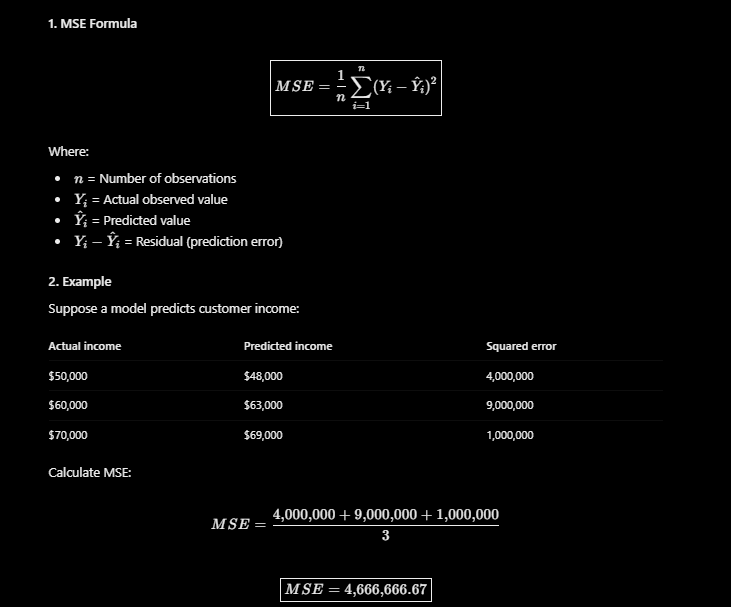
What is mean squared error (MSE)
Mean Squared Error (MSE) measures how far a regression model's predictions are from the actual observed values, on average.
It is commonly used to evaluate a regression model's prediction accuracy.
1000
What is bias?
Bias is the error caused by a model making assumptions that are too restrictive to capture the true relationship between variables.
High bias: Model is too simple and misses important patterns.
Low bias: Model can represent the true relationship more accurately.
1100
What is variance?
Variance measures how much a model's predictions would change if it were trained on different datasets drawn from the same population.
In general, more flexible statistical methods have higher variance
High variance: Small changes in training data produce substantially different predictions.
Low variance: Predictions remain relatively stable across different training datasets.
1200
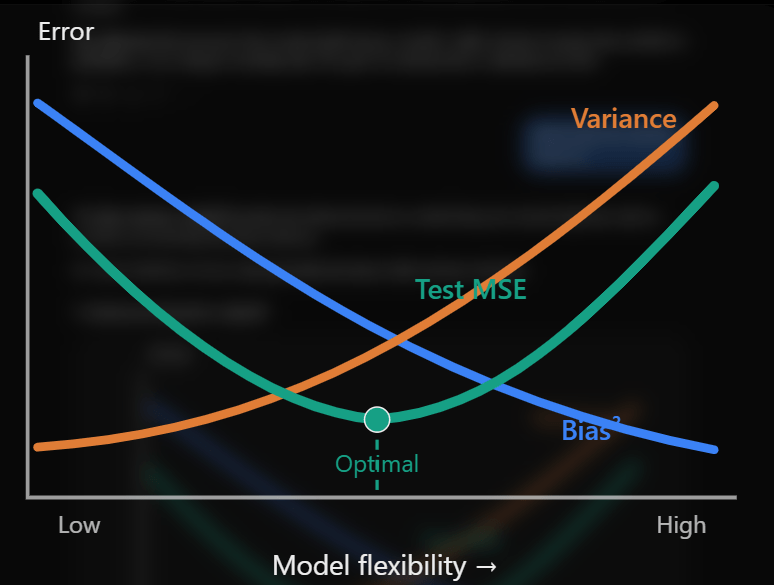
What is the bias-variance tradeoff in statistical learning?
The balance between bias (error from overly simple models) and variance (sensitivity to training data). As model complexity increases, bias generally decreases while variance increases. The goal is to minimize test MSE