Vocabulary
More Vocabulary
Hard
Harder
Hardest
100
The amount of heat needed to raise the temperature of 1 g of a substance by 1 degree Celsius
What is specific heat?
100
What is the heat of formation for a free element?
O kJ/mol
100
2NO2(g) → N2O4(l)
describes the dimerization of nitrogen dioxide. If the values of ΔHfo(298 K) of NO2(g) and N2O4(l) are +33 and –20 kJ mol–1
86 kJ
100

exothermic, released
100
Write a balanced chemical equation for the formation of CaCO3 (s) from the elements in their standard states.
Ca(s) + C(s) +3/2 O2 (g) --> CaCO3 (s)
The product side must have a coefficient of 1. Oxygen is diatomic. It is ok to have a fraction coefficient for oxygen so the coefficient of calcium carbonate remains 1.
200
What is the heat needed to convert a substance from a liquid to a gas?
Heat of vaporization
200
Exothermic or endothermic?
Combustion of a hydrocarbon
exothermic
200
1500 J of energy is released when 20g of a solid is cooled from 76 C to 25 C. What is the specific heat?
1.47 J/goC
200

63 kJ released or -63 kJ
200
Qreaction + Qsolution = ?
0
300
Enthalpy value is negative
Exothermic
300
Melting ice --- endothermic or exothermic?
endothermic
300
4000 Cal= ____cal
4,000,000 cal
300
How much heat is needed to melt 15g of ice at 0oC? The heat of fusion for water is 333 J/g
4995 J
15gx 333J /g=4995J
300
C10H8 (s) + 12 O2 (g) --> 10CO2 (g) + 4 H2O (l) delta H= -5156.1 kJ/mol
If the heat of formation of carbon dioxide is -393.509 kJ/mol and the heat of formation of water is -285.83 kJ/mol, what is the heat of formation of C10H8?
77.7 kJ/mol
-5156.1 = [(-393.509 x 10)+ (-285.83 x 4)]-[C10H8 + 12(0)]
400
This is the device used to keep heat from a reaction from escaping to the atmosphere.
Calorimeter
400
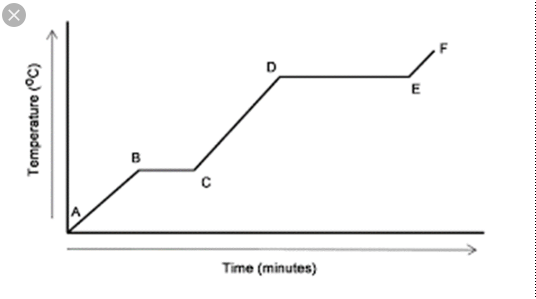
BC represents
melting
400
100g of water is warmed from 5 C to 95 C. How much heat is absorbed?
37620 J
400
How much heat is released when 10g of steam at 101 Celsius is cooled to water at 83 Celsius?
The specific heat of steam is 2.09 J/goC.
The specific heat of water is 4.18 J/goC
The heat of fusion of water is 333 J/g
The heat of vaporization of water is 2256 J/g
-23291.5 J
steam at 101 to steam at 100
Q=2.09 x 10 x -1 = -20.9 J
steam at 100 to water at 100
-2256 x 10=-22560J
water at 100 to water at 83
Q= 4.18 x 10x -17 = -710.6 J
400
Given the following equations and Ho values, determine the heat of reaction (kJ) at 298 K for the reaction:
B2H6(g) + 6 Cl2(g) -->2 BCl3(g) + 6 HCl(g)
BCl3(g) + 3 H2O(l) --> H3BO3(g) + 3 HCl(g) Ho/kJ = -112.5
B2H6(g) + 6 H2O(l) 2 H3BO3(s) + 6 H2(g) Ho/kJ = -493.4
1/2 H2(g) + 1/2 Cl2(g) --> HCl(g) Ho/kJ = -92.3
-1376
Keep 2nd reaction
Multiply 3rd reaction by 12
Reverse 1st reaction and multiply by 2.
500
The amount of heat needed to raise the temperature of 1 mole of a substance by 1 degree Celsius.
Molar heat capacity
500
When ice melts, it ionizes into H+ and OH-. Why is this false?
The attraction between water molecules is weakened when ice melts. The bonds between the H and O are not broken.
500
100.0 g of water was placed in a simple, constant-pressure calorimeter. The temperature of the water was recorded as 295.0 K. A 20.0 g copper block was heated to 353.0 K and then dropped into the water in the calorimeter. What was the final temperature of the water if the specific heat capacities of water and copper are 4.18 and 0.385 J K–1 g–1, respectively
About 296 K
500
A 13.8g piece of zinc was heated to 98.8C in boiling water and then dropped into a beaker containing 45g of water at 25C. When the water and metal came to thermal equilibrium, the temperature was 27.1 C What is the specific heat of zinc?
About 0.4J/gC
Zinc is losing energy, water is gaining energy
-(c) (13.8)(27.1-98.8) = (4.18)(45)(27.1-25)
500
You mix 2.00g NaOH with 100 mL of HCl. The temperature of the HCl before mixing was 22.5 Celsius. After mixing, the temperature rose to 25.2 Celsius. Calculate the enthalpy change per mole of NaOH. Assume that the density of HCl is 1.00g/mL and that its specific heat is 4.18 J/gC.
-23023.44 J/mol
Find the moles of NaOH.
2g NaOH x 1 mole NaOH/ 40 g NaOH = 0.05 moles NaOH
Calculate Qsolution
Q= (4.18 J/gC) x (100g+2g) x (25.2C-22.5C)=1151.172 J
Find Q reaction. -1151.172
Divide by moles -1151.172/.05 = -23023.44 J/mol