We Are Done!
Near the End!
I'm Beat!
100
This area is where you should hear S1 and S2 equally
What is Erb's point
100
This is where you hear heart sounds the strongest
What is mitral area
100
This is why you cannot shock a patient in asystole
Because there is no underlying electrical activity - Must do CPR and epi and find the cause (H's and T's)
200
Things to look for with high pressure vent alarms
What are:
1. Suctioning
2. Kinking
3. Coughing
4. Biting
200
Things to look for with low pressure vent alarms
What is disconnections
200
This is another term you might hear for neuromuscular blocker
What is a paralytic
300
If the cuff does not have enough volume in it, the patient can ___; if the cuff is overinflated this can cause ___
aspirate; tracheal damage and erode vessels
300
This type of electrical therapy speeds things up (i.e., heart block or symptomatic bradycardia)
What is pacing
300
This is the normal volume for tidal volume; too much volume causes ___
What is 2-8 mL/kg; volutrauma
400
These are the 3 types of electrical therapy
What are:
1. Pacing
2. Cardioversion
3. Defibrillation
400
This type of electrical therapy is used when patient is "dead" and is an unsynchronized shock
What is defibrillation
400
This is used to assess arterial flow to the extremities
What is capillary refill
500
If your rhythm is fast, your CO, filling time will ___
What is decrease
500
This type of electrical therapy slows down a fast HR; it is a small shock that is matched to the underlying rhythm
What is cardioversion
500
Identify the site highlighted in red
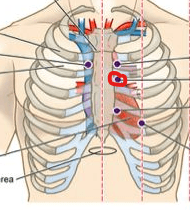
What is Erb's point (where you hear S1/S2 equally)