Sharing the Road
Emergency Scenarios
Street Markings
Turning
Signs
100
Do not use your horn
a. When you want the driver in front of you to move out of the way
b. To honk at a blind person
c. In any of the above situations
c. In any of the above situations
Explanation: Do not honk at pedestrians, bicyclists, or motorcyclists unless it is necessary to avoid an accident [HANDBOOK: Horn, Headlights, and Emergency Signals; Safe Driving Practices]
100
If you are having vehicle trouble and you need to stop, what is the first thing you should do?
a. Lift the hood to signal an emergency
b. Pull off the road and away from traffic
c. Stop your vehicle over a hill or just around a curve for visibility
b. Pull off the road and away from traffic
Explanation: If your vehicle breaks down on the road, make sure that other drivers can see it. Pull off the road, away from all traffic if possible. Turn on your emergency flashers. Lift the hood to signal the emergency and place emergency flares or triangles 200-300 feet behind the vehicle. [HANDBOOK: Use your emergency signals, safe driving practices]
100
A _______ indicates the outer edge of a roadway, and it may be crossed only by traffic moving to or from the shoulder.
a. Broken white line
b. Solid white line
c. Solid yellow line
b. solid white line
Explanation: The right edges of many roadways are marked with a solid white line. This line indicates the outer edge of the roadway, and it may be crossed only by traffic moving to or from the shoulder. The left edge is marked with a yellow line.
100
You can make a left turn on a red light
a. Only from a two-way street onto another two-way street
b. Only from a one-way street onto a two-way street
c. Only from a one-way street onto another one-way street
c. Only from a one-way street onto another one-way street
Explanation: Left turns at a red light can only be made from a one-way street onto a left-moving one-way street, and only if there is no sign to prohibit the turn. Yield to pedestrians, bicyclists, and other vehicles moving on their green light. (Note: The laws on left turns at a red light may be different in some other states). [HANDBOOK: Left Turns; Turns.]
100
What does this sign mean?
a. You have reached a train station
b. you have reached an abandoned railroad track
c. you have reached a railroad crossing
d. A railroad track parallel to the roadway is ahead
c. Railroad flashing light signals and crossbuck signs are found at most public crossings. These signs must be treated the same way as a YIELD sign.
200
You are driving slowly on a two-lane road. If there are at least ____ vehicles behind you that are unable to pass you, you must pull over and allow them to pass.
a. 5
b. 3
c. 4
a. 5
Explanation: Vehicles proceeding at a speed less than the flow of traffic and moving on a two-lane roadway where passing is unsafe, must turn off the roadway when safe if a line fo five or mor vehicles forms behind them. [HANDBOOK: Slow-moving Vehicles; Sharing the Road]
200
You should cut your speed in half when the road is
a. Icy
b. Wet
c. Packed with snow
c. Packed with snow
Explanation: You should cut your speed in half when the road is packed with snow. You should also reduce your speed on wet or icy roads, but by different amounts. [HANDBOOK: Driving in Rain or Snow; Special Driving Situations]
200
Which of the following are used as left-edge lines on divided highways?
a. Single solid white lines
b. Double solid white lines
c. Single solid yellow lines
c. Single solid yellow lines
Explanation: Single solid yellow lines are used as left-edge lines on divided highways.
200
When turning right into a two-way street, start in the right-hand lane and enter into
a. Any available lane
b. The far left lane
c. The lane nearest to the right edge of the road
c. The lane nearest to the right edge of the road
Explanation: When turning into a two-way street, begin and end the turn in the lane nearest to the right edge of the road. Watch for pedestrians, motorcyclists, and cyclists between your vehicle and the curb. [HANDBOOK: Examples of Right and Left Turns; Turns]
200
What does this sign mean?
a. you are not allowed to enter
b. you are going in the wrong direction
c. the road ahead is closed
d. an abandoned road is ahead
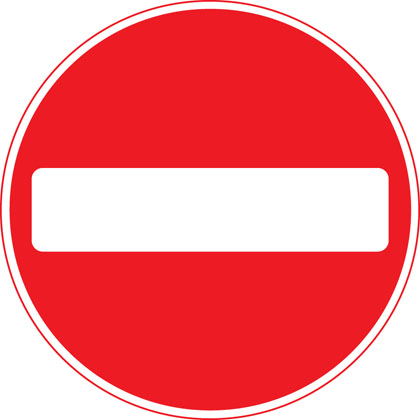
a. You are note allowed to enter
Explanation: This sign indicates that you cannot enter the roadway on which the sign is posted
300
Flashing yellow lights on a school bus require other drivers to
a. Pass quickly
b. Slow their vehicles and pass with caution
c. Slow their vehicles and prepare to stop
c. Slow their vehicles and prepare to stop
Explanation: A variety of vehicles can flash yellow lights. However, some school buses flash yellow lights when preparing to stop to let children on or off the bus. These lights warn you to slow down and prepare to stop. When the school bus flashes red lights, you must stop and remain stopped until the children have left and the red lights stop flashing. [HANDBOOK: Around Children; Reduced Speeds; Speed Limits; Laws and Rules of the Road]
300
At 55 mph, under good conditions, your vehicle will travel about ____ feet in the time that it takes you to react to an object in your path and bring your vehicle to a complete stop.
a. 200
b. 400
c. 300
b. 400
Explanation: At 55 mph, under good conditions, your vehicle will travel about 400 feet in the time that it takes you to react to an object in your path and bring your vehicle to a complete stop. A football field is 360 ft long. In poor driving conditions it may take even longer to stop your vehicle. [HANDBOOK: How well can you stop?; Visual search]
300
On one-way roads, yellow lines are used as
a. Center lines
b. Left edge lines
c. Right-edge lines
b. Left edge lines
Explanation: Yellow lines are also used as left-edge lines on one-way roadways.
300
When approaching an intersection to make a right turn, you must stay ____and make the turn close to the right curb.
a. As close to the left as possible
b. On the shoulder
c. As close to the right as possible
c. As close to the right as possible
Explanation: When approaching an intersection to make a right turn, stay as close to the right as possible. Make the turn close to the right curb. [HANDBOOK: Right Turns; Turns]
300
This sign indicates that
a. u-turns are not allowed
b. the road ahead is closed permanently
c. parking is allowed only for people with disabilities
d. parking is not allowed

d. parking is not allowed
Explanation: A red slash inside a red circle means "no." This regulatory sign is a No Parking sign. Parking at this sign is not allowed.
400
Flag persons are often located on highways and in work zones
a. To stop, slow, or guide the traffic in work zones
b. To report accidents to the police department and insurance companies
c. To slow vehicles to a lower speed limit posted ahead
a. To stop, slow, or guide the traffic in work zones
Explanation: Flag persons (flaggers) are often provided on highways and in work zones to stop, slow, or guide traffic safely through the areas. Flag persons where orange vests, shirts, or jackets and use red flags or STOP/SLOW paddles to direct traffic through the areas.
400
Use _____ steering when correcting a skid.
a. One-hand
b. Hand-by-hand
c. Hand-over-hand
c. Hand-over-hand
Explanation: Use hand-over-hand steering when steering movements are critical, such as in recovery from a skid. [HANDBOOK: Steering; Safe Driving Practices]
400
Which of the following statements about lane markings is true?
a. A solid white line between lanes of traffic means that you should stay in your lane unless a special situation requires you to change lanes
b. A double solid line between opposing lanes of traffic means that vehicles on either side can pass
c. A broken yellow line between opposing lanes of traffic means that you cannot cross the line.
a. A solid white line between lanes of traffic means that you should stay in your lane unless a special situation requires you to change lanes
Explanation: A solid white line between lanes of traffic means that you should stay in your lane unless a special situation requires you to change lanes [Line colors; Lane control; Handbook]
400
A driver in front of you is signaling with his or her hand and arm pointing upward. This driver wants to

a. Stop
b. Turn left
c. Turn right
c. Turn right
Explanation: You may use your vehicle’s signal lights or hand signals. If the signal lights are not working or if bright sunlight makes them hard to see, use hand signals. A driver in front of you who signals with his or her hand and arm pointing upward is about to turn right. [HANDBOOK: Signaling; safe driving practices]
400
What does this sing mean?
a. there is a roundabout ahead; prepare to yield to traffic
b. U-turns are allowed here; slow down
c. There is a one-way road ahead; proceed with caution
d. There is a traffic merging area ahead; stop before merging
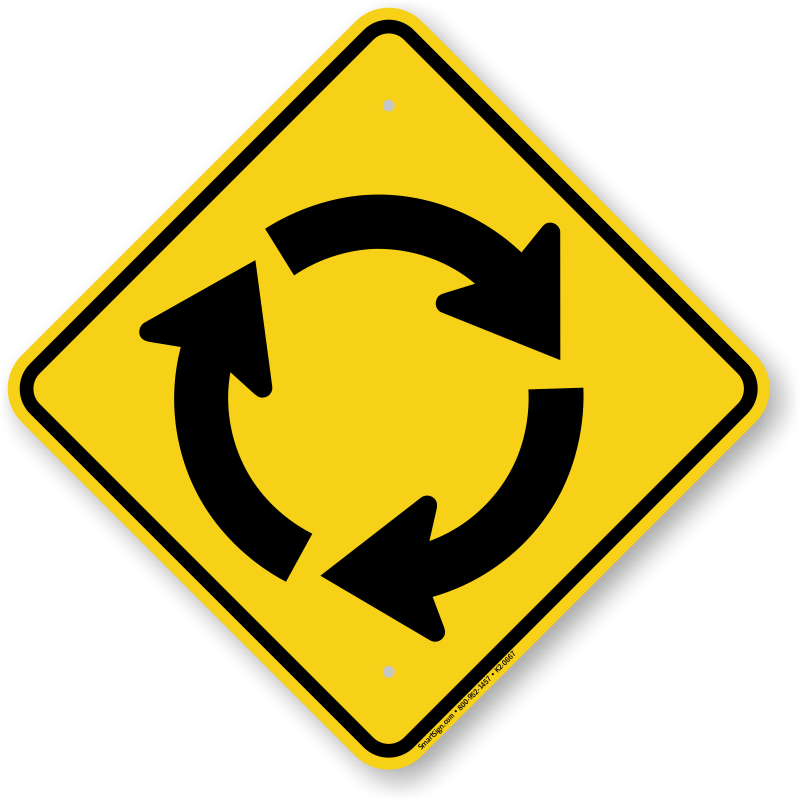
a. There is a roundabout ahead; prepare to yield to traffic
Explanation: This sign indicates a roundabout ahead. A roundabout is a circular intersection in which traffic circulates counterclockwise around a central island. Slow down and prepare to yield to traffic in the roundabout.
500
Car drivers should never drive alongside a motorcycle in the same lane because
a. Motorcycles need the full width of the lane
b. Motorcycles do not have signal lights
c. Motorcyclists may misguide the car driver
a. Motorcycles need the full width of the lane
Explanation: Motorcyclists need a full lane width, just like other vehicles. Car drivers should never drive alongside a motorcycle in the same lane even if the lane is wide and the motor cyclist is riding to one side. [HANDBOOK: Motorcycles; Sharing the Road]
500
If you are in an intersection when you hear the siren of an emergency vehicle, you should
a. Continue through the intersection, then move to the right and stop.
b. Continue through the intersection, then move to the left and stop
c. Move to the right and stop in the intersection.
a. Continue through the intersection, then move to the right and stop.
Explanation: Never block an intersection, even if an emergency vehicle is approaching. If you are in an intersection when you see or hear an emergency vehicle, continue through the intersection. Then move to the right as soon as you can and stop. [HANDBOOK: Emergency Vehicles; Sharing the Road]
500
A ________ indicates the outer edge of a roadway, and it may be crossed only by traffic moving to or from the shoulder.
a. Solid white line
b. Solid yellow line
c. Broken white line
a. Solid white line
Explanation: The right edges of many roadways are marked with a solid white line. This line indicates the outer edge of the roadway, and it may be crossed only by traffic moving to or from the shoulder. The left edge is marked with a yellow line. [HANDBOOK: Line color; lane control]
500
In which of the following places is a U-turn permitted?
a. Across a double yellow line
b. On a one-way street
c. On a railroad crossing
a. Across a double yellow line
U-turns are permitted across double yellow lines when it is safe to do so. They are not permitted on one-way streets or at railroad crossings. [HANDBOOK: Line colors; lane control]
500
What does this sign mean?
a. the road is closed ahead
b. the rails of a narrow bridge are ahead
c. a Y-intersection is ahead
d. This roadway ends at a T-intersection

d. this roadway ends at a T-intersection
Explanation: This sign warns that you are approaching a T-intersection from the terminating roadway. At the T-intersection, you must turn either left or right after yielding the right-of-way to through traffic if necessary.