Cell chemistry
Macromolecules
Protein conformation
Membranes
Enzymes
100
The reason(s) NaCl dissolves readily in water.
What is H2O molecule spheres and dipoles surrounding oppositely charged ions?
100
3 main categories of macromolecules (1 characteristic about each).
What is carbohydrates, lipids, proteins, and nucleic acids?
carbohydrates- store energy and support (insects, plants)
lipids- hydrophobic and formed from long hydrocarbons
proteins- made of amino acids which drive the primary, secondary, tertiary and quaternary structure
nucleic acids- adenine, cytosine, guanine, thymine, uracil - directionality
100
Describe the primary, secondary, tertiary and quaternary structures.
what is...
primary-linear amino acid structure
secondary-folding of primary structure into a-helix and beta pleated sheets through hydrogen bonding.
tertiary-folding of secondary structure via non-covalent interactions, disulfide bonding, and hydrophobic forces
quaternary-multiple subunits (different polypeptide domains conforming together
100
name a molecule that would NOT readily cross the lipid bilayer of an intact cell membrane by simple diffusion.
What is glucose (ions, amino acids, DNA)?
typically charged/large molecules cannot readily diffuse through the cell membrane.
100
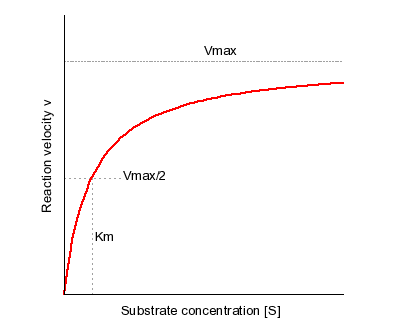
This term is described as the substrate concentration at which the catalyzed reaction is at 1/2 Vmax.
What is Km?
200
3 fundamental properties of carbon
What is... 4 valence electrons, forms single-double-triple bonds, forms a diverse set of branched-linear-ringed structures.
200
This macromolecule cannot polymerize.
What are lipids?
200
Difference between denaturation and degradation.
what is...
degradation=nonreversible breakdown into smaller parts (I.e., amino acids)
denaturation=reversible unfolding of the protein
200
A word that would describe the composition of lipids in terms of the inner/outer layer of the lipid bilayer.
What is asymmetrical?
200
How enzymes speed up reactions.
What is lowering of the activation energy at the transition state for the course of the reaction?
The enzyme stabilizes the substrates and brings them in closer proximity to each other finally releasing the desirable products.
300
Intermolecular forces guide these interactions (also name them from strongest to weakest).
What is non-covalent INTERACTIONS?
1. ionic
2. H-bonding
3. dipole
4. induced dipole
5. hydrophobic
300
four main categories for amino acids
What is uncharged hydrophilic, Hydrophobic, basic, and acidic?
300
3 things that can affect a proteins structure.
what is salinity, pH, and temperature?
300
list four functions of membranes.
what is cell-cell communication, boundary determination, compartmentalization, and regulation of transport?
300
This determines the shape of the active site.
What is folding of the protein sequence?
400
This reaction removes monomers from polymers (explain).
What is hydrolysis?

400
3 structural polysaccharides.
what is cellulose, chitin, and peptidoglycan?
400
This amino acid is known as the "helix breaker," explain why.
What is proline?
glycine can also be a helix breaker!
BUT, regardless, they both disrupt the natural structure of the alpha helix. Proline is cyclic. Both of these amino acids are commonly found at turns/loops in the secondary-tertiary amino acid sequence.
400
name a molecule that is generally found in approximately equal amounts on the inner and outer portions of the lipid bilayer.
What is cholesterol?
400
3 classes of enzymes (what do they do?)
What is...
oxioreductase-oxidation-reduction
Transferases-group transfer reactions
Hydrolases-hydrolysis reactions
Lyases-break and form double bonds through the removal of functional groups.
Isomerases-transfer functional groups within a molecule
Ligases-condensation reactions coupled with cleavage of ATP
500
Describe how a peptide bond is formed. (what other macromolecules go through this process?)
Peptide bonds are formed through a dehydration reaction. The nucleophile (N) attacks the electrophile (C=O) forming an amine group. The peptide bond is stabilized by resonance.
glycosidic bonding, nucleic acid
500
bonding and directionality of nucleic acid polymerization.
What is phosphodiester bonding?
5' -> 3'
500
list four functional classes of proteins.
What is regulatory proteins, structural proteins, motility proteins, and enzymes?
500
What are 4 characteristics of fatty acids?
what is...
1. typically 16-18 carbons long
2. huge energy source
3 & 4. saturated and unsaturated (straight/rigid vs bent/fluid)
500
3 types of enzyme inhibition (describe 2 of them).
What is...
Competitive-binds to active site (raises Km, and Vmax is unchanged)
non-competitive-binds outside of the active site (lowers Vmax, and Km is unchanged)
uncompetitive-binds to the enzyme-substrate complex (lowers Vmax and Km)