Triangles
Circles, Angles, and Radians
Simple Trig
Inverse Trig and Trig Identities
Graphing
100
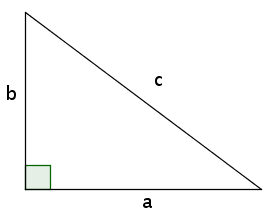
In triangle abc, side "a" is equal to 8.9 in. Side "b" is equal to 6.7 in. Identify the the length of the missing side. (Round to the nearest hundredth)
What is 11.14 in?
(SLO: Use the Pythagorean Theorem to determine the side lengths of a right triangle.)
100
Convert degrees to radians and radians to degrees:
261° = ?
-50° = ?
π/5 Radians = ?
-2π/6 Radians = ?
What is 29π/20 radians, -5π/18 radians, 36°, -60°?
(SLO: Convert an angle from degree measure to radian measure and vice versa.)
100
Given that a triangle contains a right angle, determine the exact trigonometric ratios for any of the other acute angles.
What is:
sin(x) = opposite/hypotenuse
cos(x) = adjacent/hypotenuse
tan(x) = opposite/adjacent
csc(x) = hypotenuse/opposite
sec(x) = hypotenuse/adjacent
cot(x) = adjacent/opposite
(SLO: List the exact trigonometric ratios for the acute angles of any right triangle.)
100
Determine the exact values for the following inverse trigonometric functions:
sin-1(-√3/2) = ?
cos-1(-1/2) = ?
arctan(-1/√3) = ?
What is -π/3, 2π/3, and -π/6?
(SLO: Determine the exact value of expressions with inverse trigonometric functions at special angles.)
100
Given y = 9sin(4x+7)-15
Determine the amplitude, phase shift, period, and vertical shift.
What is:
Amplitude=9
Phase shift=-7/4
Period=π/2
Vertical shift=-15
(SLO: Given the equation of a sine/cosine function:
Determine the amplitude, phase shift, period, and vertical shift of the function.)
200
In triangle abc, side "a" is equal to 7 in. Side "c" is equal to 14.8 in. Identify the the length of the missing side and determine the area of triangle abc. (Round to the nearest hundredth)
What is 13.04 in and 45.64 in2?
(SLO: Determine the area of a right triangle.)
200
sec x > 0, sin x < 0
Identify the quadrant in which the angle lies in.
What is Quadrant 4?
(SLO: Determine the quadrant in which an angle lies according to the information given.)
200
The unit circle contains 16 separate "special angles." Determine the trigonometric functions for all of these angles.
What is:
0/360°: sin=0, cos=1, tan=0, csc=undef, sec=1, cot=undef
30°: sin=1/2, cos=√3/2, tan=1/√3 or √3/3, csc=2, sec=2/√3 or 2√3/3, cot=√3
45°: sin=√2/2, cos=√2/2, tan=1, csc=√2, sec=√2, cot=1
60°: sin=√3/2, cos=1/2, tan=√3, csc=2/√3 or 2√3/3, sec=2, cot=1/√3 or √3/3
90°: sin=1, cos=0, tan=undef, csc=1, sec=undef, cot=0
120°: sin=√3/2, cos=-1/2, tan=-√3, csc=2/√3 or 2√3/3, sec=-2, cot=-1/√3 or -√3/3
135°: sin=√2/2, cos=-√2/2, tan=-1, csc=√2, sec=-√2, cot=-1
150°: sin=1/2, cos=-√3/2, tan=-1/√3 or -√3/3, csc=2, sec=-2/√3 or -2√3/3, cot=-√3
180°: sin=0, cos=-1, tan=0, csc=undef, sec=-1, cot=undef
210°: sin=-1/2, cos=-√3/2, tan=1/√3 or √3/3, csc=-2, sec=-2/√3 or -2√3/3, cot=√3
225°: sin=-√2/2, cos=-√2/2, tan=1, csc=-√2, sec=-√2, cot=1
240°: sin=-√3/2, cos=-1/2, tan=√3, csc=-2/√3 or -2√3/3, sec=-2, cot=1/√3 or √3/3
270°: sin=-1, cos=0, tan=undef, csc=-1, sec=undef, cot=0
300°: sin=-√3/2, cos=1/2, tan=-√3, csc=-2/√3 or -2√3/3, sec=2, cot=-1/√3 or -√3/3
315°: sin=-√2/2, cos=√2/2, tan=-1, csc=-√2, sec=√2, cot=-1
330°: sin=-1/2, cos=√3/2, tan=-1/√3 or -√3/3, csc=-2, sec=2/√3 or 2√3/3, cot=-√3
200
Determine the exact values of the following expressions:
tan(sin-1(2/5)) = ?
sec(cot-1(7/4)) = ?
cos(csc-1(13/12)) = ?
What is 2/√21 or 2√21/21, √65/7, and 5/13?
(SLO: Determine the exact value of expressions with compositions of trigonometric and inverse trigonometric functions at any angle.)
200
Given y=-3cos(x-5)+1
Graph one complete cycle.
What is:
https://www.desmos.com/calculator/aybuxbpwzq
(SLO: Given the equation of a sine/cosine function:
Sketch one complete cycle of the function.)
300
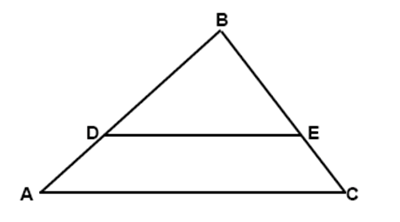
AC = 16
DE = 5
DB = 4
AD = ?
(Round to the nearest hundredth)
What is 8.8?
(SLO: Apply properties of similar triangles to determine their side lengths.)
300
Determine two positive and two negative coterminal angles for 67°.
What is 427°, 787°, -293°, and -653°?
(SLO: Determine coterminal angles for a given angle.)
300
Determine the exact value of all 6 trigonometric functions for the angle 210°.
What is:
sin(210) = -1/2
cos(210) = -√3/2
tan(210) = 1/√3
csc(210) = -2
sec(210) = -2/√3 or -2√3/3
cot(210) = √3
(SLO: Determine the exact value of a trigonometric function given a special angle.)
300
Tom was hiking in the woods when he notices a massive tree. He determines that the distance between him and the tree is 11.1 ft. and the height of the tree is 41.2 ft. If Tom looks to the top of the tree, determine this angle of elevation given that the measurement of Tom's eyes to the ground is 5.8 ft.
(Round to the nearest whole percent)
What is 73°?
(SLO: Solve application problems involving inverse trigonometric functions.)
300
Given y=4sin(π/4x)-6.3
During one complete cycle, determine the minimum, maximum, and average value.
What is:
Minimum = (6, -10.3)
Maximum = (2, -2.3)
Average value = (4, -6.3), (8, -6.3)
(SLO: Given the equation of a sine/cosine function:
List the points where the function reaches its maximum, minimum, and average value within one complete cycle.)
400

Determine the type of triangle.
What is a scalene triangle?
(SLO: Classify a triangle according to its angle measures and side lengths.)
400
Determine the arc length and sector area of a circle that has an angle of 137° and a radius of 7.8 in. (Round to the nearest hundredth)
What is 18.65 in (arc length) and 72.74 in2 (sector area)?
(SLO: Determine the arc length or sector area of a circle given a radius and angle measure.)
400
Given:
cos(theta)=8/17, theta is located in quadrant 4
Determine the other trigonometric functions.
What is:
sin(theta) = -15/17
cos(theta) = 8/17
tan(theta) = -15/8
csc(theta) = -17/15
sec(theta) = 17/8
cot(theta) = -8/15
(SLO: Determine the exact value of a trigonometric function given the value of another trigonometric function at the same angle and sufficient information to determine the location of the angle.)
400
Given: (sec(x)•sin(x)) + (sec(x) ÷ csc(x))
Simplify the expression.
What is 2tan(x)?
(SLO: Use basic trigonometric identities to simplify trigonometric expressions.)
400
https://www.desmos.com/calculator/dmfl1rrx1z
Given the graph above, determine the amplitude, period, phase shift, and vertical shift. Then, create an acceptable cosine function.
What is:
Amplitude = 1/2
Period = 6
Phase shift = Right 3/2
Vertical shift = 4
y=1/2cos(π/3x-π/2)+4 or y=-1/2cos(π/3x+π/2)+4
(SLO: Given the graph of a sine/cosine function, determine the amplitude, phase shift, period and vertical shift of the function and use these to write the equation of the function.0
500
Determine the side length values of any 30°, 60°, 90° triangle and any 45°, 45°, 90° triangle.
What is (x, x√3, 2x) and (x, x, x√2)?
(SLO: Classify a triangle according to its angle measures and side lengths.)
500
A certain sector of a circle has an area of 57.26 in2 and contains an angle of 92°. Determine the radius of this circle. (Round to the nearest hundredth)
What is 8.45 in?
(SLO: Determine the radius of a circle given an angle measure and arc length or sector area.)
500

In the image above, the United Kingdom's flag contains many right triangles. The highlighted triangle on the flag corresponds to the diagram next to it. If angle "A" equals 35° and side "a" equals 7 in, determine the value of the missing sides (Round to the nearest whole number). Then, identify all 6 trigonometric functions for angle "A."
What is:
Side "b" = 10 in., Side "c" = 12 in.
Sin(A) = 7/12
Cos(A) = 10/12 = 5/6
Tan(A) = 7/10
Csc(A) = 12/7
Sec(A) = 12/10 = 6/5
Cot(A) = 10/7
(SLO: Solve application problems involving right triangles.)
500
Verify the following trigonometric identity:
sec(x)/(csc2(x)•tan2(x)) = cos(x)
What is:
(1/cos(x)) / (1/sin2(x) • sin2(x)/cos2(x))
(1/cos(x)) / (sin2(x)/sin2(x)cos2(x))
(1/cos(x)) / (1/cos2(x))
(1/cos(x)) • (cos2(x)/1)
= cos(x)
cos(x) = cos(x)
(SLO: Verify trigonometric identities by rewriting the identity in terms of sine and cosine.)
500
Given:
Amplitude = 2
Period = 3
Phase shift = Right 5
Vertical shift = -1
Create a Sine function and a hand written graph to match with the information. Use these resources to determine at least three key points.
What is:
y=2sin(2π/3x-10π/3)-1
https://www.desmos.com/calculator/pqjdvfl8wy
Main points: (-.25, 1), (.25, 0), (1.25, -3), (2.25, 0), (2.75, 1)
(SLO: Given a set of periodic data, model the function by hand and use this model to calculate and interpret predicted values for the problem.)