Theorems
USUB
SICYO
Volume of Discs and
Washers
Washers
Inverse Derivatives
100
The Theorem that you must state the equation is differentiable...
MVT
100
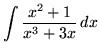
What is U?
 .
.
u = x3+3x
100
What are the 5 steps to SICYO?
1. Separate
2. Integrate
3. Solve for C
4. Solve for Y
5. Options
100
When the line is being rotated horizontally is it a dx or dy problem?
dx
100
What is the derivative of y= sin-1(u)
dy/dx= (1/√(1-u2)) ⋅ (dy/dx)
200
This theorem has to do with the average rate of change and derivatives
MVT
200
What is U?
∫ ecos(t)sin(t)dt
u= cos(t)
200
When do you need to use the options step?
Absolute Value & Square Root
200
Find the volume of the solid generated by revolving the region bounded by the lines and curves about the x-axis. y=x2, y=0, x=2
20.106
200
g is the inverse of f. If f(4) = 5, f'(4)= (2/3) and f'(5) = 3, find g'(5).
g'(5)= (3/2)
300
For this Theorem you must state endpoints.
IVT
300
Solve.
∫x2(x3+ 5)9dx
(1/30)(x3+ 5)10+C
300
Solve for Y
dy/dx = x/y
y= -√x2+12
300
The region bounded by the curves y= (1/√x), y=x2 for x=1 to x=2 is rotated around the x-axis. What is the volume of the generated solid?
((31/5) -ln2)π
300
h is the inverse of f. The function f(x)=x5+3x-2 passes through the point (1,2). Find h'(2).
h'(2)=1/8
400
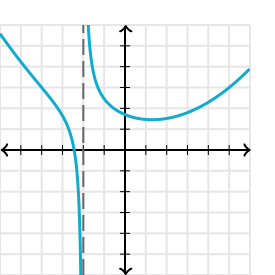
Does the Intermediate Value Theorem apply to F over the interval [1,3]?
Yes
400
Solve.
∫ex/(1+e2x) dx
tan-1(ex)+C
400
Solve for Y
dy/dx = 4x3y2
y(2)=1
y= 1/(-x4+17)
400
Find the volume of the solid obtained by rotating the region under the curve y=2x2 about the x-axis between x=1 and x=2
(124π)/5
400
f(3)= 7, f'(3)= 4, f'(7) =2
Find d/dx [f-1(7)]
d/dx [f-1(7)]= 1/4
500
Given the function f(x) = x² + 1. Can it be said that the function exists for all values in the interval [1,5]?
According to the intermediate value theorem, the function exists at all values in the interval [1,5].
500
Solve.
∫ sec2(5x+ 1) × 5 dx
tan(5x+ 1) +C
500
Solve for Y
dy/dx =(3x2+4x−4)/(2y−4)
y(1)=3
y=2+√(x3+2x2−4x+2)
500
Calculator.
Find the volume of the solid by revolving the region in the first quadrant bounded by the curves y=cos(x) and y=sin(x) about the x-axis.
1.571
500
Find g'(3) if g(x) = f -1(x)
f(x)= x3-5
g'(3)= (1/12)