Theme & Central Idea
Fiction
Vocab
Author's Purpose and Text Evidence
EOG Stuff & Vocab
100
Fill in the blanks below with "theme" and "central idea":
_______ is USUALLY found in fiction, while
_______ is USUALLY found in nonfiction.
THEME - fiction
CENTRAL IDEA - nonfiction
100
Which of the following is NOT an element of fiction?
Character, plot, conflict, claim, point of view, setting, style, theme
Claim
100
The dicitonary definition of the word: 1. _________
The emotions associated to the word:2. _________
1. denotation
2. connotation
100
What are the THREE types of author's purpose?
1. To inform or teach
2. To entertain
3. To persuade or convince
100
The End-of-Grade (EOG) Reading Test is given to all public school students in Grade 3 through Grade __.
8
200
A _______ is more general and usually can be applied to real life, not just the text or story. It's your "take-away"or lesson about life.
THEME
200
This image is an example of a ___________.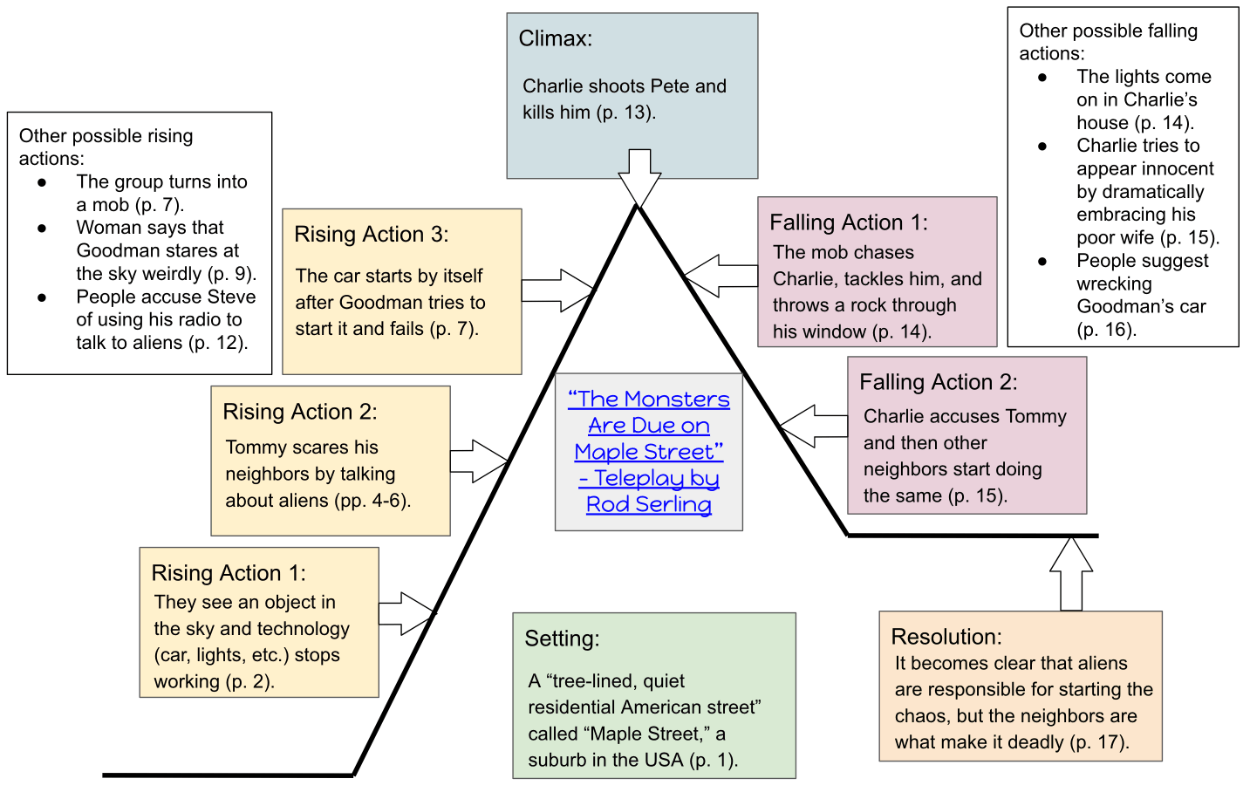
Plot
200
The WAY a character talks. Could include speech patterns, word choice..etc. HOW they talk. Could reveal where they live or their level of education even.
dialect
200
Using evidence supports the author's ____________.
Claim
200
True or False?
The EOG includes "field test items," which are questions that will not be included as part of students’ final scores but will be used for developing items for future test forms.
True
300
Which of the sentences below shows the theme and which shows the central idea or "The Lion King"?
1. _______ - A young lion cub rises up to defeat his evil uncle and reclaim the kingdom.
2. _______ - Everyone has to eventually leave childhood behind to face adult responsibilities.
1. Central Idea
2. Theme
300
A(n) 1. ________ character is one who DOES NOT HAVE have any significant change in character, personality or perspective throughout a story,
while a(n) 2. _______ character DOES have a significant change in character, personality or perspective throughout a story.
1. Static
2. Dynamic
300
The author's choice of words or his ____________ is part of his style.
diction
300
Read the short passage below. What is the author's most important purpose for writing the selection?
A wave is any movement that carries energy. Some waves carry energy through water. Others carry energy through gases, like air, or solid materials. If you drop a rock into a pool of water, a wave, or ripple of energy, skims across the pool's surface. In the same way, an underwater earthquake can release energy into ocean water. Then it carries a giant wave, or tsunami, across the surface until it hits land. If you hear a clap of thunder, sound waves (or vibrations) have carried the crashing BOOM to your ears. Sound waves speed through the air at about 1,100 feet (335 meters) per second. Light also travels through the air in waves. They travel at more than 186,000 miles (300 million meters) per second. So the light waves from a flash of lightning reach your eyes before that clap of thunder reaches your ears! Electrons travel in waves, too. They move back and forth in a solid wire, sending waves of electricity so you can turn on a light during the storm!
To inform readers about different kinds of waves
300
When the author gives small clues or hints as to future events that will arise in the plot.
forshadowing
400
Julia’s report card reflected poor grades. She felt she would get in trouble, so she hid her report card from her parents. When her parents discovered what her grades were, they grounded her for trying to hide the truth.
What is the theme of this paragraph?
The truth always comes out in the end.
400
The terms "Round" and "Flat" describe a character's complexity, layers, or personality, while the terms "static" and "dynamic" describe a character's __________________________________.
Change or Development throughout the story.
400
Conversation between two or more characters is called __________.
dialogue
400
Which of the following examples of text evidence best supports the claim that ALIENS exist?
A. "We saw the lights in the sky and knew right away that the mission was underway."
B. "He looked and moved unlike anything we had ever seen before. His body covered in fabric that almost seemed 'other-worldly'."
C. "I knew it was a bad idea to go along to this unexplored region of the moon. God know's what we might find there."
B. "He looked and moved unlike anything we had ever seen before. His body covered in fabric that almost seemed 'other-worldly'."
400
An interruption in the events of the story in order to provide the reader a reference to events that happened in the character's past.
flashback
500
True or false?
The "central idea" is the same as the "topic" of the text.
FALSE
The topic is one word like "spiders", "kindness", "honesty", "solar systems".
The central idea is explained in a full sentence.
500
A monkey put his hand into the jar of cookies. He grasped as many as he could possibly hold, but when he tried to pull his hand, he was prevented from doing so by the neck of the cookie jar. Unwilling to lose the cookies, and yet unable to withdraw his hand, he burst into tears and cried bitterly.
What is the theme?
If you are greedy, you. might get nothing.
500
The attitude toward the author's subject is called ______.
How would you describe it based on this passage:
The treadmill began to whir, and I gripped its handlebars as the belt started moving me backwards. All I could do now was run -- or begrudgingly barrel forward -- toward an outdated screen that showed me the terrain I was supposed to be running on. It was made of red squares stacked up, one on top of another: the higher stacks were supposed to be steep hills, and the lower ones, valleys. I tried to picture them as burning coals to see if that would make me speed up or at least feel like this exercise was somehow connected to nature -- even one of its cruel parts.
TONE
Negative. Disgruntled, etc.
500
A twist or unexpected ending to the story.
situational irony