Vocab
Math
Concepts
Diagrams
Stoich
Honors
100
TRIPLE POINTS: 300
I dissolve chocolate syrup in milk to create chocolate milk? Identify the solvent, solute, and solution.
Solvent: Milk
Solute: Chocolate Syrup
Solution: Chocolate Milk
100
A sample of 12.2 moles of Fr2S is used to make 5.9 L of Fr2S solution. Calculate the molarity. Round to the nearest 0.01 and include the correct unit and substance formula.
2.07 M Fr2S
100
Which of these would not have an impact on how FAST something dissolves
a) changing the temp
b) changing how long you stir
c) crushing the solute
d) adding different amounts of solute
d) adding different amounts of solute
100
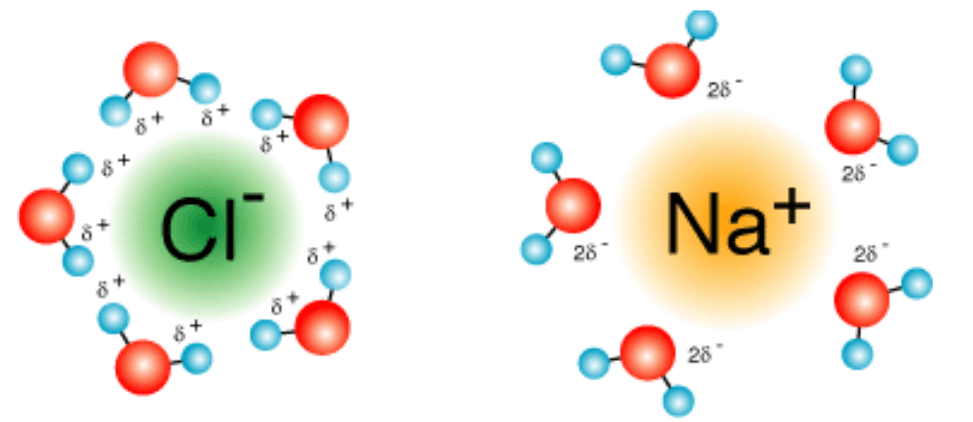
Explain why the water molecules surround the chlorine ion and sodium ion differently?
Opposite charges attract. Because chlorine has a negative charge, the positive side of the polar water molecules face chlorine because negative and positive attract. Because sodium has a positive charge, the negative side of the polar water molecules are attracted.
100
A candle is lit and the reaction below proceeds.
Wax + oxygen -> Carbon dioxide + water
1. If the candle is closed what would be the limiting reactant?
2. If the candle is allowed to fully melt and becomes empty, what would be the limiting reactant?
1. Oxygen
2. Wax
100
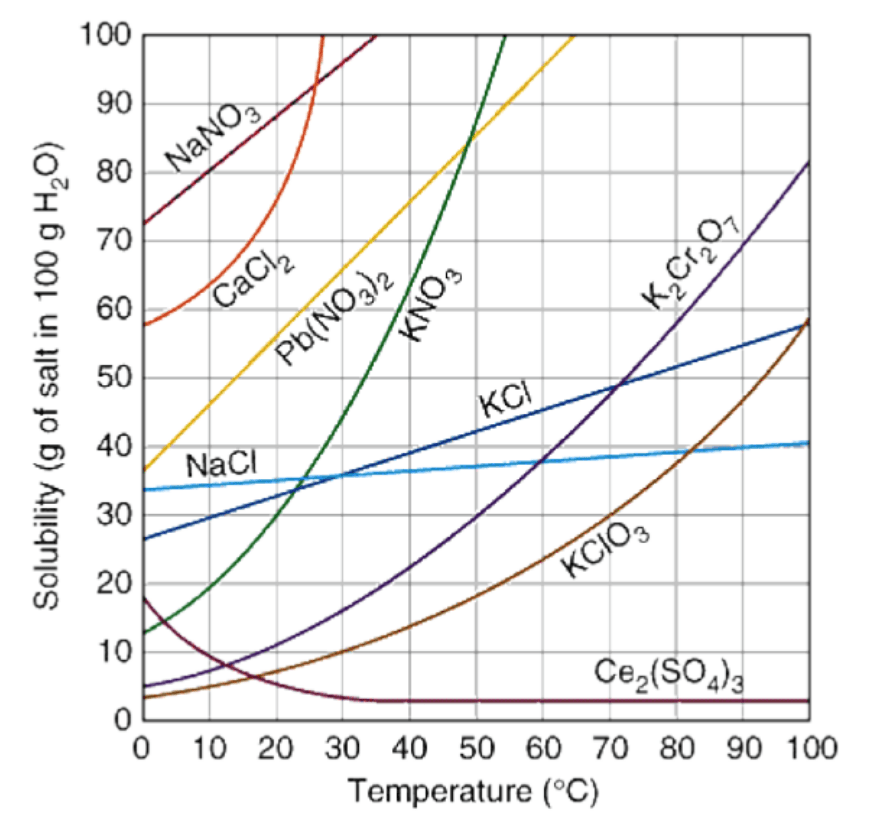
How much precipitate will be formed when a saturated solution containing 70 g of KCl is cooled to 60 degrees?
25 g
At 60 degrees, only 45 g can be dissolved usually. If 70 g are dissolved than 15 g will precipitate out of the solution (70-45).
200
A solution with high molarity (lots of solute, little water) can be described as ______________.
A solution with low molarity (little solute, more watered down) can be described as _______________.
concentrated, dilute.
200
Calculate how many moles of sodium acetate, whose formula is NaC2H3O2, you would need to make 2.5 L of a 0.65 M solution. Round to the nearest 0.01 and include the unit and substance formula.
1.63 mol NaC2H3O2
200
Which of these would have the highest boiling point?
a) 4 M CH4
b) 4 M BeF2
c) 4 M NaCl
d) 4 M AlCl3
e) Pure Water
d) 4 M AlCl3
More solute = more boiling point elevation
The one with the highest mass will make the boiling point elevate the most
200

Which substance on the graph is likely a gas?
Ce2(SO4)3
Gasses decrease in solubility as temp increases
200
4 Fe + 3 O2 ->2 Fe2O3
If you have 7.5 mols of iron and react it with excess oxygen to make iron oxide. How many mols of oxygen were used in this reaction?
5.63 mol O2
mol to mol = 1 step (mole to mole ratio from balanced reaction)
200
What is the molarity of a solution made from 80 grams of BeF2 whole volume is 700 mL? Include the unit and substance formula. Round to the nearest 0.01
2.43 M BeF2
300
Sand cannot be dissolved in solvent water. That means it is...
a) Soluble
b) Insoluble
c) Miscible
d) Immiscible
B: Insoluble = cannot dissolve
300
What volume in liters of H2O would you need to make a 3.5 molar solution if you have 6.2 moles of solute? Round to the nearest 0.01 and include the unit and substance.
1.77 L H2O
300
Which of these would have the greatest effect on freezing point?
a) 1 mol LiF
b) 2 mol AgCl3
c) 3 mol LiF
d) 3 mol AgCl3
d) 3 mol AgCl3
Look for highest molarity first, then pick highest mass
(More solute = more freezing point depression)
300
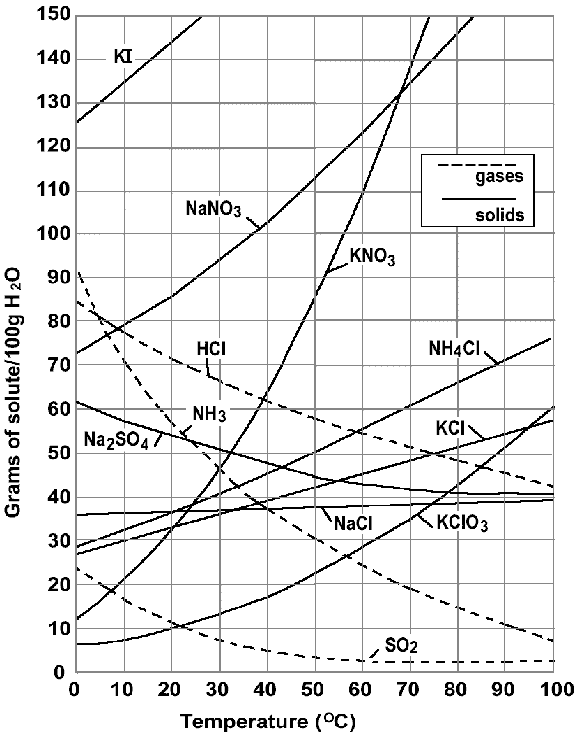
How much NaNO3 can be dissolved in 100 grams of water at 25 degrees Celsius?
90 grams
300
K2SO4 + 2 HBr -> H2SO4 + 2 KBr
If you have 15 g of HBr, what mass of KBr will be produced? Round to the nearest 0.01 and include the unit and substance formula.
22.06 g KBr
g to g (or mass to mass) is 3 steps

300
What volume, in liters, of a 1.2 M solution of BeF2 would contain 175 g of BeF2? Round the nearest 0.1 and include the right unit, no substance.
3.1 L
400
Milk and coffee are two liquids that mix seamlessly. This means they are...
a) Soluble
b) Insoluble
c) Miscible
d) Immiscible
c) Miscible = mixable
400
What is the percent by mass of a solution of salt water that is made from 4.5 grams of salt to create a 91 g solution? Round to the nearest 0.1 and include the correct unit only (no substance).
4.9%
mass of solute/mass of solution x 100
400
What happens to freezing point when more solute is added?
What happens to boiling point when more solute is added?
Freezing point depression
Boiling point elevation
400
When 90 g of NH4Cl are dissolved in 100 g of water at 80 degrees Celsius, what kind of solution do you have?
Supersaturated
400
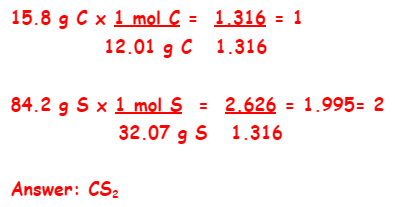
Jennifer has an unknown compound. In the lab, she determined that the unknown compound was 15.8% carbon and 84.2% sulfur. Calculate the empirical formula.
Molar Mass C = 12.01 g/mol
Molar Mass S = 32.07 g/mol
CS2
Percent to grams, grams to mol, divide by small, multiply till whole (if your numbers end in .0, .1, or .9 you don't have to multiply till whole, just round)
400
What is the percent composition of a solution made of 29 g NaCl and 130 g of WATER?
a) 4.48 %
b) 44.8 %
c) 22.3 %
d) 18.2 %
d) 18.2 %
Mass of solute divided by mass of solution times 100
130 is NOT the mass of the solution, it is the mass of WATER that is going to put into the solution. Solution = solute + solvent = 29 + 130.
500
2 K + Cl2 -> 2 KCl
If a student performs an experiment using 2.5 grams of chlorine, how many moles of potassium chloride will be formed?
0.07 mol KCl
