Previous units
Heat
Energy
Rate and Equilibrium
100
A scientist reacts sodium and chlorine together to make sodium chloride. After the reaction is complete, there is some sodium metal left over in the beaker.
Sodium metal is the _______________ reactant and chlorine is the _________________ reactant.
Sodium metal is the EXCESS reactant and chlorine is the LIMITING reactant
(excess=extra)
100
1) Which substance would require the most energy to raise its temperature?
2) Which substance would require the least?
Specific Heat:
Lead 0.449
Granite 0.803
Water 4.184
1) Water (highest specific heat 4.184)
2) Lead (lowest specific heat 0.449)
100
Substance A is 90 degrees celsius and substance B is 20 degres celsius. Which substance has a higher kinetic energy?
Substance A (Higher temp = higher kinetic energy)
100
1)How do catalysts/enzymes speed up reactions?
2)How to inhibitors slow down reactions?
1) Catalysts/enzymes LOWER the activation energy barrier to make reactions go faster
2) Inhibitors RAISE the activation energy barrier to make reactions go faster
200
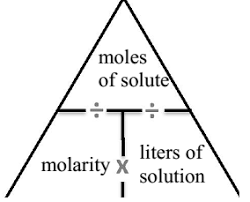
How many moles of solute are present in 2 L of a 5 M solution?
(Hint: turn molarity formula into molarity triangle)
10 moles
(moles is on top of the triangle because moles is on top of the fraction in the molarity formula)
200
Do the following scenarios require heat to be transferred INTO the substance or OUT of the substance?
1) Substance changing from liquid to solid
2) Substance changing from solid to liquid
3) Substance changing from liquid to gas
1) Liquid to solid is FREEZING so heat needs to go OUT
2) Solid to liquid is MELTING so heat needs to go IN
3) Liquid to gas is BOILING so heat needs to go IN to boil the liquid
200
Which graph is endothermic which one is exothermic?
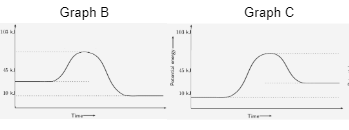
Graph B is EXOTHERMIC (products have less energy, energy was released)
Graph C is ENDOTHERMIC (products have more energy, energy was absorbed)
200
What are 5 ways that you can INCREASE the rate of reaction? (be specific, "temperature" is not an answer, does decreasing temperature or increasing temperature speed up a reaction?)
1) Increasing Temperature
2) Increasing Concentration (increasing the number of particles)
3) Increasing Pressure
4) Adding an inhibitor/catalyst
5) Increasing surface area
300
How many times more acidic will a substance with a pH of 2 have compared to a substance with a pH of 5?
1000 times more
5-2=3, so put 3 zeros
300
Do the following scenarios describe an endothermic reaction or an exothermic reaction?
1) You dissolve a substance in water. When you hold the beaker it feels cold.
2) You dissolve a substance in water. When you hold the beaker it feels hot.
(Hint: Think about which substance is absorbing heat from your hand and which one is releasing heat onto your hand)
1) Endothermic (feels cold because it is absorbing heat away from your hand)
2) Exothermic (feels warm because it is releasing heat onto your hand)
300
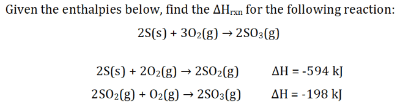
Answer: -792 kJ
-594 kJ + -198 kJ
300
What are the three things that must have for particles to react?
Hint: this theory is called the COLLISION theory
1) Particles must collide
2) They must collide with proper orientation
3) They must collide with enough energy
400
Which beaker shows the STRONGER acid? The first one or the second one?
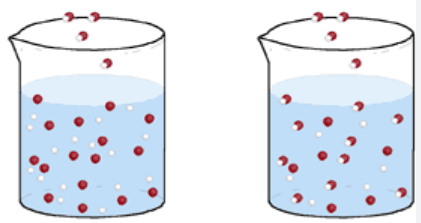
The first one because all the particles have dissociated/separated
(the second beaker some particles are still together, strong acids dissociate COMPLETELY)
400
You place a hot piece of metal into 7 g of water. The water increases in temperature by 12 degrees celsius. How many joules of heat does the water absorb? Specific heat of water is 4.184 j/gC
Answer: 351.46 j
Heat formula is q = m x c x T
m = 7
c = 4.184
T = 12
400
A student conducts a calorimetry experiment by burning a gummy bear underneath a can of water to figure out how much energy is stored in the gummy bear. How much heat (in Joules) is absorbed by the water if the student used 25 g of water and the temperature of the water changed from 25.00C to 48.00C? The specific heat of water is 4.184 J. Convert your answer to Calories.
1 cal = 4.184 j
1 Cal = 1000 cal
Final answer: 0.575 Cal
q = m x c x change in T
q = 2405. 8 J
Divide by 4.184 to get cal = 575 cal
Divide by 1000 to get Cal = 0.575 Cal
400
gas + gas ↔ solid + gas
1) If you INCREASE PRESSURE, will the reaction shift to the left or to the right?
2) If you DECREASE PRESSURE, will the reaction shift to the left or to the right?
1) RIGHT because that side has less gas (if your basketball has too much pressure, it's going to want less gas)
2) LEFT because that side has more gas (if your basketball has too litter pressure, it wants to move towards more gas)
500
How many grams is 2.9 x 10²³ molecules of F2 gas?
(Hint= convert molecules to moles... then convert moles to grams!)
1 mol = 6.022 x 10²³ molecules
18.30 g F2

500
What is the mass of a piece of metal that absorbs 120 j of energy resulting in a temperature change of 55 degrees celsius? The specific heat of the metal is 0.129 j/gC.
16.91 g
q = m x c x T
The question is asking for MASS so you are solving for M
q / (c x t) = m
500
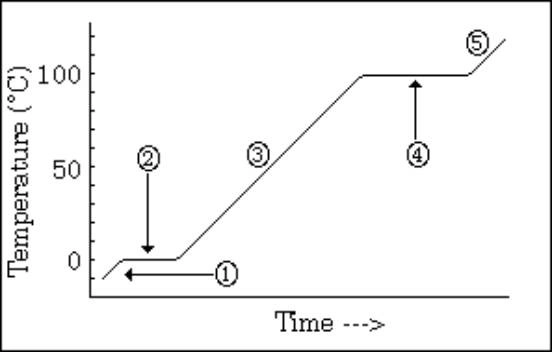
Describe what is going on at each number.
1) The substance is solid and heating up
2) The substance is melting
3) The substance is a liquid heating up
4) The substance is boiling
5) The substance is a gas heating up
500
Heat + NaCl (s) ↔ Na(s) + Cl2(g)
1) If I increase the temperature... will the reaction respond by making more reactants or by making more products?
2) What if I decrease the temperature?
1) Makes more PRODUCTS - (moves to the right) getting AWAY from heat
2) Makes more REACTANTS - (moves to the left) moving TOWARDS the heat