Timely Abbreviations
Muscles and Bones
This & That
Define this
Senses and Aging
Endocrine
Hormones, Hormones & more hormones
Aging Endocrine system
Diabetes
100
Range of motion is abbreviated in health care to.........
What is ROM
100
What connects muscles to bones.................
What is..............................
................tendons (Achilles Tendon)
100
What is the PSW Pain Framework...........
What is...............to assess and report pain
O nset
P rovoking/palliating (makes it better or worse)
Q uality (sharp, dull)
R egion/Radiating
S everity
T iming (when does it occur, what makes it worse)
U nderstanding (what does patient think is causing it)
V alues/goals (what want to do about the pain)
W hat else? (what else do I need to know)
100
What is Ostosclerosis................
What is...............
-progressive inherited condition causing bone growth (solidification) in the middle ear, usually affecting the stapes
-causes conductive hearing loss (often both ears0 and tinnitus or dizziness
-hearing aids
100
What are safety risks associated with aging of the senses............ ......
What are ............
Impaired vision = falls, unable to read labels
Impaired hearing- difficulty hearing warning alarms, following instructions
Impaired taste, smell, touch = eating spoiled food, risk of gas leaks, risk of not feeling hot and cold, pain and discomforts
100
What is the endocrine system?
What is.............
system of endocrine glands that secrete types of hormones (chemical substances) into the bloodstream to regulate body
ductless- hormones secreted directly into blood and not into ducts (eg Pancreas)
exert effect on target (specific) tissues-no direct contact between endocrine gland and target cells
Hormones transported by blood
100
What do the parathyroid glands secrete?
The Parathyroid Glands
•Secrete parathormone
•4 parathyroid glands (2 on each side of the
Thyroid Gland(posterior aspect)
Function of Parathormone
◦ Regulates body’s use of calcium
Calcium is needed for the proper functioning of nerves and muscles (stabilizes nerve and muscle membranes)
TETANY d/t insufficient amounts of calcium
state of severe muscle contraction and spasm-leads to death if not treated.
100
What factors are related to abnormal endocrine activity?
Acute or chronic illness
•Alteration in diet, activity, and lean body mass
•Disturbances in sleep patterns
•Decreased metabolic clearance rate of
hormones
•Increase use of drugs that affect hormone
function
100
What does insulin deficiency cause?
Diabetes: severe metabolic disturbance
If insulin is not available, where does the
body get its energy from?
In the absence of insulin
◦ The body makes glucose from protein
◦ The body will burn fatty acids for fuel
◦ This rapid incomplete breakdown of fatty
acids produces strong acids (H+) called
ketoacids
200
After racing to catch the bus, you are gasping for breath.............
What is SOB
200
What is a pivot joint..........
What is.....................
-a joint that moves in one direction
- neck allows head to rotate...shake your head "No"
200
All of your vaccines are up to date. What type of immunity do you have after a flu vaccine......
What is ..................
.....................artificially acquired immunity
200
What is Meniere's Disease.............
What is.................. a chronic inner ear disorder caused by excessive fluid buildup
-causes fluctuating hearing loss, unpredictable vertigo, tinnitus (ringing) and a feeling of fullness in the ear
-typically, only one ear is affected
200
Sensory overload causes..........
What is.................
racing thoughts
anxiety
restlessness
inability to focus attention
200
Name the 9 endocrine glands.......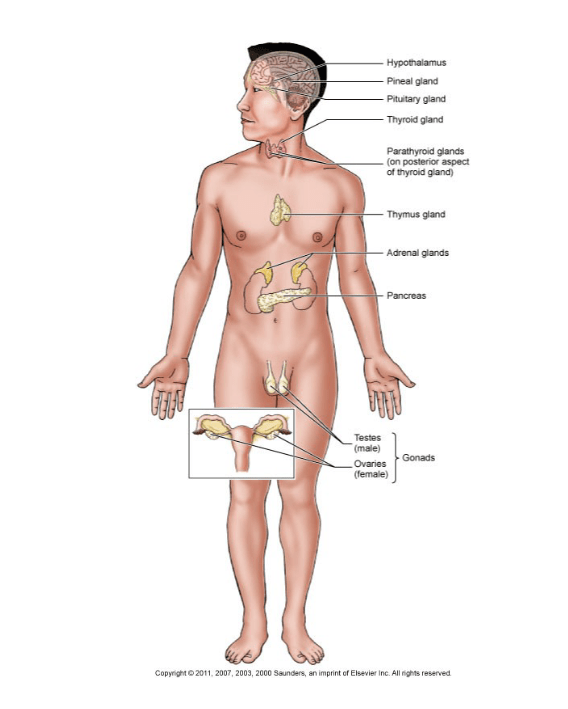
Nine endocrine glands:
Hypothalamus
Pituitary gland
Pineal gland
Thyroid gland
Parathyroid glands
Thymus gland
Adrenal Glands
Pancreas
Gonads
200
What does hypocalcemia cause?
Hypo secretion of parathormones =Hypocalcemia-unstable nerve and muscle membranes causing
continuous firing of electrical signals causing muscles to remain contracted
Can be life-threatening
200
The Posterior Pituitary Gland decreases the amount of which hormone related to aging?
Posterior Pituitary Gland
◦ Decrease ADH
Related Nursing Care
◦ Observe for urinary changes-polyuria, dilute
urine
◦ Follow care plan regarding sufficient hydration
◦ Monitor I&O
◦ Report findings
200
What is Hyperglycemia?
Hyperglycemia
Without enough insulin in the body, sugar
builds up
◦ Hyper – high
◦ Glyc – Sugar
◦ Emia - blood
Hyperglycemia
Without enough sugar, cells cannot
perform their functions.
Mild hyperglycemia- can lead to long-term problems
Severe hyperglycemia- can be life-threatening
300
What is the abbreviation used for vital signs
What is .........................VS
300
What is the function of muscle tissue........................
What is....................
-enables body movement
-maintains posture
-stabilizes joints
- generates body heat
-propels substances through hollow organs
300
What is the name of the receptor that responds to heat and cold sensations...........
What is ..........
- thermoreceptor
- quickly adjust to changes in heat and cold
300
What is 20/60 vision..................
What is.................
...... you must be 20 feet away to see something that a person with normal vision (20/20)sees at 60 feet
300
Sensory Deprivation risks and signs and symptoms.....
What are........
Risks- reduced sensory input (hearing/vision loss);elimination of order or meaning from input (strange environment, isolation, bedbound)
S&S- confusion, other illnesses depression, disorientation
300
Where are target tissues.........
Target tissues.....
hormones bind to specific tissue located close to or a distance from the endocrine gland
thyroid -has several target tissues
parathyroid - has fewer target tissues
300
What is Hypercalcemia?
Hypersecretion of parathormones = Hypercalcemia-calcium moves from bones to
the blood
S&S: Tumor in parathyroid gland
Bone pain results from persistent movement of calcium out of bones
Excess calcium filtered into the urine-
(may cause kidney stones)
300
What are the changes related to aging of Gonads?
Gonads (testes, ovaries) changes with aging:
1.Decrease ovarian function, size
2.Decrease in size of testes, production of testosterone
Related Nursing Care
◦ Observe for changes related to reduction in hormones-physical strength, health of bones
◦ Encourage diet rich in calcium
◦ Promote activity/exercise
◦ Psychological support related to sexual changes
◦ Report findings
300
Diabetes Statistics?
1 in 3 Canadians has diabetes* or prediabetes.
1/3 are unaware
estimated 80% of diabetics will die from heart disease or stroke
children and adults affected
2 Million + Canadians have diabetes
rates of diabetes and prediabetes continue to rise (2019 Diabetes Canada Cost Model).
1/3 are unaware
An estimated 80% of diabetics will die from heart disease or stroke
Diabetes can develop in children and adults
Risk factors;
◦ Obesity
◦ Family history of DM
◦ Risk increases after 40 years of age
◦ Aboriginal descent at increased risk-20%
Risk factors
Obesity
Family history of DM
Risk increases after 40 years of age
Aboriginal descent at increased risk-20%
400
Convert 1:15 PM to a 24 hour clock reading...
What is ..................
....................13:15 hours
400
Give examples of two types of muscles......
What are......
3 types:
skeletal muscles attach to bones for voluntary movement, cardiac muscle form the heart for involuntary rhythmic pumping and smooth muscle lines hollow organs for involuntary autonomic functions like digestion
400
What becomes cloudy and results in a cataract......
What is.......
-the lens of the eye
400
What is presbycusis......................
What is.................
-age- related hearing loss
-gradual, progressive loss
-typically affects both ears
1 in 3 adults between 65 -74 and nearly half of adults over 75
400
The primary goal in treating pain is......
What is........
-reduce pain to a level that allows the client to continue normal daily activities
- manage the pain- chronic conditions in elderly
400
What are hormone receptors......
Hormone receptors are-
...interact with receptor sites of cells of target tissues
... receptors may be on the outer surface of cell /within the cell
-hormones fit like key & lock -Must be Perfect
400
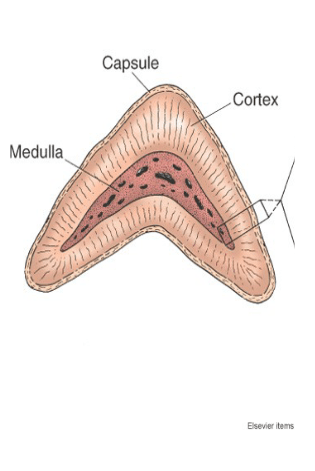
What do the adrenal glands secrete?
There are 2 Adrenal Glands, one on top of each
kidney
Each has 2 parts
◦ Adrenal Medulla (inner)
Secretes epinephrine and norepinephrine
Stimulates the body to quickly produce energy during emergencies- heart rate, blood pressure, muscle power, energy all increase
Adrenal Cortex (outer part of gland)
Secretes 3 groups of hormones essential for life
1. Glucocorticoids-sugar= ◦
Regulates metabolism of CHO, control body’s response to stress and inflammation
2. Mineralocorticoids-salt
Regulates amount of salt and water that is absorbed
and lost in the kidneys
3. Sex hormones
400
What Pancreatic changes occurs related to aging occurs?
Pancreas aging results in decreased glucose tolerance
Related Nursing Care
Observe for signs of High(elevated) Blood Glucose-
increased thirst, increased urination, N&V, fatigue, aching, weak, ketones in urine
Observe appetite
Report findings
400
What are 4 types of Diabetes?
1. Type 1
2. Type 2
3. Gestational Diabetes
4. Pre-diabetes
Also:Type 1.5 Latent Autoimmune Diabetes in Adults (LADA)
500
What is 12:05 AM in a 24 hour clock...............
What is.........
............00:05 hours
500
What is osteoporosis.......
What is.........a common "silent" bone disease characterized by decreased bone mass and density, making bones weak and susceptible to fractures from minor falls or daily activities.
- often diagnosed after a fracture occurs, commonly in the hip, spine or wrist
Early physical signs = loss of height, stooped posture and back pain
Certain diseases (rheumatoid arthritis, celiac disease) and certain medications can accelerate bone loss
Women are at higher risk, especially after menopause
Treatment and prevention= calcium and vitamin D supplements, medication and weight-bearing exercises
Bone scans women over 65 and men over 70
500
A client is in a very cold environment, as a healthy response, the body would thermoregulate by........
What is........
constricting blood vessels
500
What is glaucoma......
What is.....
- develops slowly without pain and may not know you have it until you have significant irreversible vision loss
-optic nerve damage caused by abnormally high pressure inside the eye (INTRACOCCULAR PRESSURE) crushes the optic nerve fibers
-eye drops, surgery to relieve pressure
500
What to do to care for a patient with pain.......
What is...
....check tubes, linens
.....warm blankets
....distraction (soft music)
....relaxation (massage clam environment
...guided imagery
'''' Medication as ordered... assess effectiveness after 30 minutes; concern regarding safety related to drowsinesswiat 30 minutes
500
What are functions of hormones?
What are:
1. regulate metabolic processes (fats, proteins, carbohydrates (CHOs) and water and electrolyte balance
2. important for growth and reproduction
3. Help regulate water balance
500
What does the pancreas secrete and what is its function?
The Pancreas secretes insulin= from the Islets of
Langerhans
Insulin regulates the amount of sugar in the blood
available for use by cells
Too little insulin- sugar cannot enter the cells ...high blood sugar
Excess amounts of sugar
build up in the blood =Diabetes
500
What is Type 1 Diabetes?
Type 1 Diabetes
•Occurs most often in children and young adults
•Cause unknown- genetic-environmental interaction
•Peaks at 12 years
•Pancreas does not produce insulin-leads to severe
hyperglycemia
•Develop symptoms early and require treatment daily with insulin injections
•Treatment: Close monitoring of blood glucose
• Insulin injections vary 1-4 times daily (more in times of stress), pumps
Signs and Symptoms
•Polyuria
•Polydipsia
•Polyphagia
•Unusual weight loss
•Fatigue
•Dry itchy skin
•Blurred eyesight
•Can have multisystem findings
Clients with Type 1 Diabetes Require
- insulin injection based on glucometer result
◦ Usually, 1-4 times daily
◦ Most monitor and self-inject
◦ Requires order by physician
◦ Too much insulin- Hyperglycemia
◦ Too little insulin-Hypoglycemia
600
Your class is on Thursdays from ........ to ........
What is ..................
.....................12:00- 14:00 hours
600
Types of hot and cold applications.......
What are.....
Heat- increases blood flow by dilating blood vessels
Cold -slows blood flow by constricting vessels
Moist heat- Warm compresses, Warm soak body part in heated water promoting circulation and muscle relaxation REMOVE EVERY 15 Minutes
Do not use cold on old injuries- cause tissue damage (frost bite)
600
Who are at high risk for complications from heat and cold applications
Who are........
thin, delicate or fragile skin
decreased sensation
dementia or confusion
mental implants
600
What produces 60% of the sperm volume..............
What is........
- seminal vesicles
600
What is R.I.C.E.
What is........
...for recent injuries =
Rest
Ice
Compressions
Elevate
600
What mechanisms control hormone secretion.....
3 mechanisms
◦1. Negative feedback loop “Enough is Enough”
Normal function depends on normal plasma hormone levels
Serious problems:Hyper secretion and Hypo secretion ◦ ex: if too little or too much
hormone is secreted by the adrenal cortex, signals the pituitary gland to respond
◦2. Biorhythms-rhythmic alteration in a hormone’s rate of secretion.
Some hormones are secreted in a circadian
rhythm (24 hr rhythm)
◦ Cortisol- highest in am, lowest at midnight
◦ Female reproductive hormones-monthly
pattern
Biorhythms can be disturbed by travel and
alterations in sleep patterns (shift workers)
◦3. CNS- central nervous system controls the secretion of hormones by;
◦ Activating hypothalamus
◦ Stimulating sympathetic nervous system (SNS)-
center for our emotions (affect the endocrine system)
◦ stressed= endocrine glands secrete
stress hormones, alerting every cell to the threat.
women under stress experience changes in menstrual cycles
600
What hormone is produced by the Pineal Gland?
Pineal Gland :Endocrine gland (Like a tiny pinecone located near the center of the brain)
•Produces melatonin- hormone that affects the
modulation of wake/sleep patterns and seasonal
functions
600
Where are insulin injection sites?
700
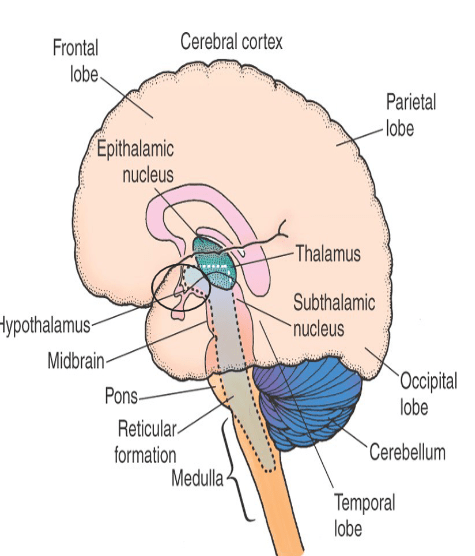
What does hypothalamus do.......
Hypothalamus -Secretes hormones that control/inhibit release other hormones
700
What does the thymus gland do?
Thymus Gland- lies underneath the top of the breast bone.
Processes a type of WBC known as a T-
lymphocyte = govern cellular immunity
which means they help cells recognize and
destroy invading microorganisms
700
What Technology is associated with Diabetes?
Technology:
•Diabetic Pumps
•Diabetic Pens
•Insulin-long, intermediate and short
acting
•Glucometers
•Blood sugar monitoring devices-
sensor
http://www.diabetescaregroup.info/images/pump2.jpg
http://www.diabetes.co.uk/images/article_images/insulin-pen-and-lid.j
pg
http://anthonycolpo.com/wp-content/uploads/2010/09/insulin.jpg
800
Tell me about the Pituitary Gland.....
Master gland -Small/size of a cherry
Located at the base of the brain behind the
eyes
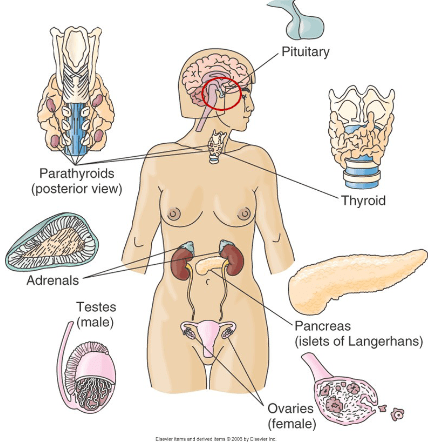
1. Anterior Pituitary lobe- secretes Growth Hormone (GH) growth of muscles, bones
organs needed to maintain normal size (bones/muscles)
stunted d/t deficient amounts of GH
excess growth d/t too much GH
Thyroid-stimulating Hormone (TSH) for thyroid gland function (Herlihy, 2014)
Adrenocorticotropic Hormone (ACTH) stimulates adrenal gland
Reproductive Hormones-Regulate growth,
development, & function of the
reproductive systems
Thyroid-stimulating hormone (TSH)
Adrenocorticotropic hormone (ACTH)
Reproductive hormones
FSH-development of ova and sperm
LH- secretion of testosterone & progesterone
Prolactin-milk production
2. Posterior Pituitary Lobe
Each part secretes its own specific hormones
800
What is the function of the gonads?
The Gonads (testes and ovaries) have two
functions:
1. to produce hormones (testosterone, estradiol, progesterone)
2. to produce gametes (eggs or sperm)
800
What is Type 2 Diabetes?
Type 2 Diabetes
•Usually develops in adulthood
•No cure
•Can occur in children as well
•Most common type of diabetes
•Pancreas does not produce enough insulin,
or body does not use insulin that is produced
•Gradual onset, may go undetected for years
Treatment for Type 2 Diabetes
◦ May require oral agents
◦ May require insulin at times
◦ Check careplan for special considerations for: special diabetic diet, snacks, activity
◦ Always ensure meals and snacks are on
time!
Risk Factor: obesity, inactivity
•Hyperglycemia is mild- may not notice S&S
•same as type 1: Polyuria, Polydipsia, Polyphagia
•Unusual weight loss
•Fatigue
•Dry itchy skin
•Blurred eyesight
Gradual onset, no ketones, excess weight (modifiable)
Treatment for Type 2 Diabetes
May require oral agents
May require insulin at times
Check care plan for special considerations for: special diabetic diet, snacks, activity
Ensure meals and snacks are on time!
900
What does the Posterior Pituitary secrete?
Posterior Pituitary Secretes hormones (produced in hypothalamus);
1.Antidiuretic hormone (ADH) -Prevents kidneys
excreting excessive amounts of water
2.Oxytocin-causes uterine muscles to contract
during childbirth
900
What is Gestational Diabetes?
Gestational Diabetes
•Develops during pregnancy
•Usually during 3rd trimester
•Occurs in 1-14% of all pregnancies
•Usually disappears after baby is born
•Women at risk for type 2 DM later in life
(40-60% within 15 years after gestation)
1000
Where is the thyroid gland located and what hormones does it secrete?
Shaped like a butterfly in neck in front of larynx
SecretesT3 & T4
Regulates metabolism- burning of food for heat & energy by the cells.
Required for: 1. Proper functioning of all other
hormones
2. Maturation of the nervous system
3. Normal growth and development
Too little TH- HYPOTHYROID
◦ Slowed body processes-HR, peristalsis
◦ Slowed movements
◦ Weight gain
◦ Condition called Myxedema (mucus)
Too much TH- HYPERTHYROID
◦ Increased metabolism-HR, diarrhea
◦ Excess energy
◦ Weight loss
◦ Condition type called Grave’s Disease
29
Shaped like a butterfly- Situated in the neck in
front of the larynx
Secretes thyroid hormones-T3 and T4 Regulates metabolism- burning of food
for heat and energy by the cells.
Necessary:
Proper functioning of all other
hormones
◦Maturation of the nervous system
◦Normal growth and development
28
Too little TH- HYPOTHYROID
◦ Slowed body processes-HR, peristalsis
◦ Slowed movements
◦ Weight gain
◦ Condition called Myxedema (mucus)
Too much TH- HYPERTHYROID
◦ Increased metabolism-HR, diarrhea
◦ Excess energy
◦ Weight loss
◦ Condition type called Grave’s Disease
29
Too little TH- HYPOTHYROID
◦ Slowed body processes-HR, peristalsis
◦ Slowed movements
◦ Weight gain
◦ Condition called Myxedema (mucus)
Too much TH- HYPERTHYROID
◦ Increased metabolism-HR, diarrhea
◦ Excess energy
◦ Weight loss
◦ Condition type called Grave’s Disease
29
1000
What is Pre-Diabetes?
Pre-Diabetes
•Higher than normal blood glucose levels
•Many develop type 2 diabetes