Environmental Hazards
Disease
Toxicology
Dose response
Accumulation and Risk
100
What are the four types of environmental hazards?
What are physical, chemical, biological, and cultural hazards?
100
What type of disease kills most of us?
What are infectious diseases?
100
What is typically present in water in levels not high enough to affect human health, but high enough to affect aquatic life?
What are pesticides?
100
Analysis quantifies the toxicity of a substance by measuring its effects on animals at different doses
What is dose-response?
100
Process of toxicants building up in animal tissues to greater concentration than in the environment
What is bioaccumulation?
200
Synthetic or natural chemicals such as pharmaceuticals, disinfectants, or pesticides
What are chemical hazards?
200
What insect is the vector for Lyme disease?
What are ticks?
200
This type of toxic substance causes cancer: __________
This type of toxic substance causes DNA mutations: __________
What are carcinogens?
What are mutagens?
200
The amount of substance needed to kill half the population of study animals
What is LD50?
200
Process that occurs when concentration of toxicants becomes magnified in higher levels of the food chain
What is biomagnification?
300
Result from ecological interactions such as viruses, bacteria, and other pathogens
What are biological hazards?
300
What is the most dangerous animal or insect in the world, based on the number of deaths associated with it?
What are mosquitos?
300
This type of toxic substance causes birth defects in embryos: __________
This type of toxic substance assaults the nervous system: __________
What are teratogens?
What are neurotoxins?
300
For a nonlethal toxicant, what is measured?
What is an effective dose-50% (ED50)?
300
The probability that some harmful outcome will result from a given action, event, or substance?
What is risk?
400
Result from where we live, our socioeconomic status, our occupation, or our behavior
What are cultural hazards?
400
To reduce disease, we can improve the basic living conditions of poor, developing countries. What are some of the basic living conditions that could be improved?
What is food security, sanitation, and clean drinking water?
400
High exposure to a hazard for short periods of time
-easy to recognize
-stems from discrete events: ingestion, oil spills, nuclear accidents
What is acute exposure?
400
Responses to some toxicants occur only above a certain dose (when the body's organs can metabolize or excrete a toxicant at low doses but get overwhelmed at high doses)
What is a threshold/threshold dose?
400
Assumes that substances are harmless until shown to be harmful
What is the innocent-until-proven-guilty approach?
500
Hazards that occur naturally in our environment
What are physical hazards?
500
A way to reduce disease in developing countries is to provide expanded access to healthcare. What type of places or access can be provided?
What are health clinics, immunizations, and pre- & postnatal care?
500
Low exposure for long periods of time
-common but harder to detect and diagnose
-cause and effect are not easily apparent due to time between onset of exposure and symptoms
What is chronic exposure?
500
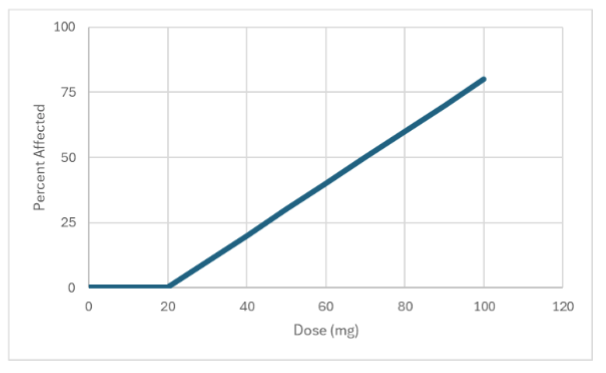 What is the threshold dose for this toxicant? The LD50 occurs at what dose?
Threshold- What is 20%?
LD50- What is 70%
500
Assumes substances are harmful until proven harmless
What is the precautionary principle?