GPCR
TRK
Apoptosis
Consequences / Integration
100
This receptor family has 7 transmembrane helices and activates a heterotrimeric G protein after ligand binding.
G protein-coupled receptor
100
This receptor family usually has one transmembrane segment and is activated by dimerization and autophosphorylation
receptor tyrosine kinase
100
This form of cell death is programmed, enzyme-driven, and important in development and tissue maintenance.
apoptosis
100
One pathway mainly uses G proteins and second messengers, while the other mainly uses phosphorylation cascades. Name both pathways.
GPCR signaling and RTK signalingways.
200
In this pathway, Gα exchanges GDP for GTP, then activates an effector such as adenylyl cyclase or phospholipase C. What turns Gα off?
GTP hydrolysis to GDP by Gα
200
After ligand binding, these receptors phosphorylate tyrosine residues on neighboring receptors, creating docking sites for proteins like GRB2. What is this process called?
autophosphorylation
200
These proteins are synthesized as inactive precursors and, once activated, cleave cellular proteins to execute cell death.
caspases
200
What are two mechanisms by which a cell can down-regulate its response to a ligand
Decrease receptor density on the cell surface
- the cell removes receptors from the membrane, often by endocytosis
- fewer receptors means less ligand binding and less signaling
Desensitization by lowering receptor affinity or responsiveness
- the receptor is still present, but it binds ligand less well or activates downstream signaling less effectively
300
A GPCR activates phospholipase C, which cleaves PIP₂ into two second messengers. Name them and state the main function of each.
IP₃ → releases Ca²⁺ from the ER
DAG → activates PKC
 (File:PIP2 Cleavage to IP3 and DAG.jpg - Wikimedia Commons, n.d.)
300
In the TRK Signaling , GRB2 and Sos help activate a small G protein by promoting exchange of GDP for GTP. Name this small G protein and the kinase cascade it activates.
G protein: Ras
Pathway: Raf → MEK → MAPK cascade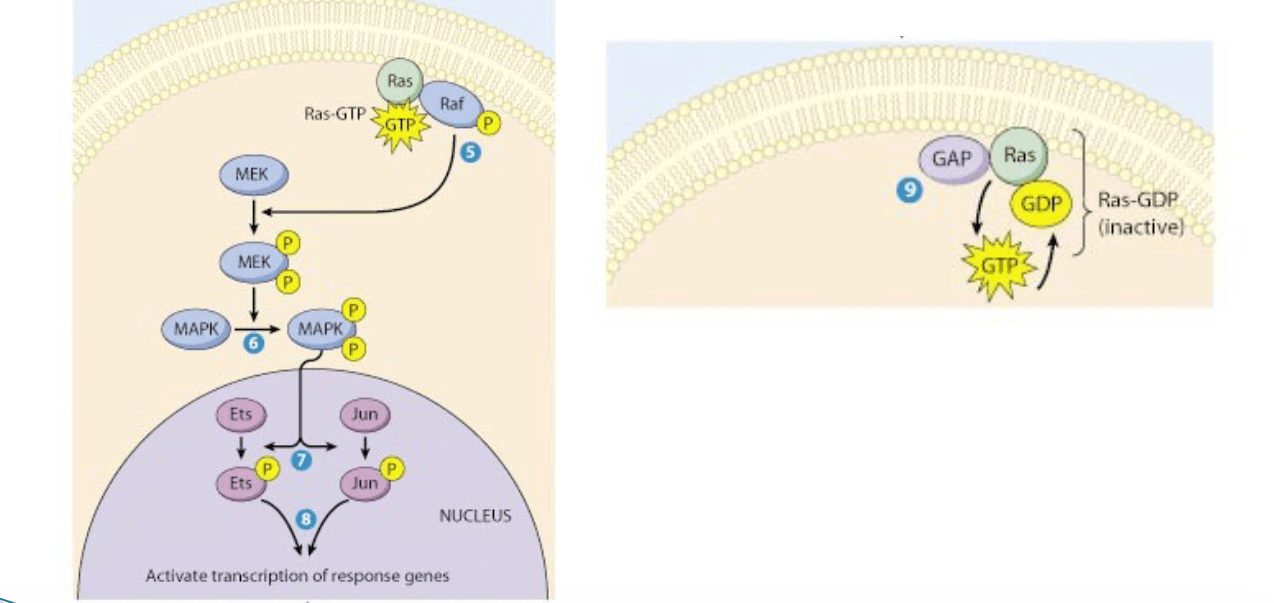
(Henley, n.d.)
300
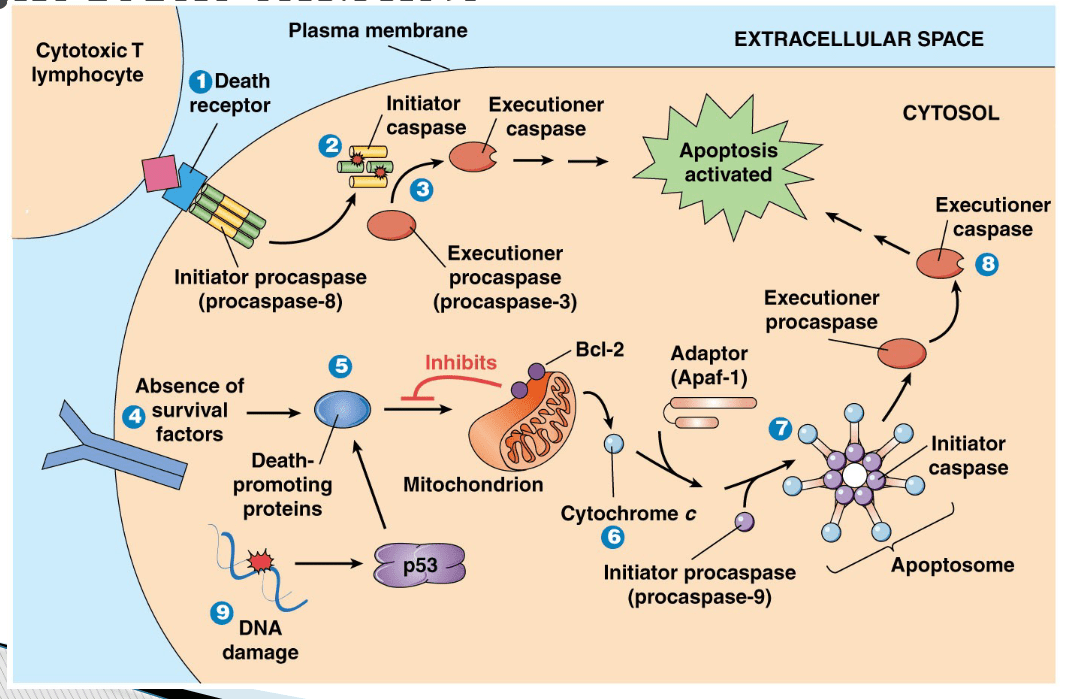
A cell receives a death signal through Fas/CD95 or TNF-related signaling. What enzyme cascade is activated, and what is the final cellular outcome?
Fas/CD95 or TNF receptor activation → procaspase-8 activation (intiating procaspase) → caspase-8 (intiating Capases) activates caspase-3 and other executioner caspases → cellular proteins are cleaved → apoptosis
(Henley, n.d.)
300
Compare GPCRs and RTKs in terms of: receptor structure, immediate downstream switch (changes to structure after ligand-receptor interaction) , and one major downstream output.
GPCR
structure: 7-pass transmembrane receptor
immediate downstream switch: heterotrimeric G protein
output: cAMP/PKA or IP₃-DAG/Ca²⁺-PKC
RTK
structure: single-pass receptor
immediate downstream switch: dimerization + autophosphorylation
output: Ras/MAPK signaling or other phosphorylation cascades
 (Cattaneo et al., 2014)
400
A mutation prevents phosphodiesterase from degrading cAMP. Predict the effect on PKA activity and downstream cellular response.
If phosphodiesterase cannot degrade cAMP:
- cAMP stays elevated
- PKA remains active longer
- signaling is prolonged/exaggerated
400
A mutation prevents an RTK from forming phosphotyrosine docking sites. Predict what happens to SH2-domain protein recruitment and downstream signaling.
If phosphotyrosine docking sites do not form
- SH2-domain proteins cannot bind
- adaptor protein (Gbr2 and SoS) recruitment fails
- Ras/MAPK or related pathways are impaired
400
This anti-apoptotic protein helps prevent apoptosis when survival factors are present.
High Bcl2:
- inhibits apoptosis
- promotes survival
- can allow cells that should die to persist
400
Mini-case: A tumor cell has constitutively active Ras, high Bcl2, and reduced response to death receptor signaling. Explain how these three abnormalities together promote tumor survival and growth.
- Constitutively active Ras drives persistent growth signaling through MAPK.
- High Bcl2 blocks apoptosis.
- Reduced death receptor response weakens extrinsic apoptotic signaling.
Together, these changes allow abnormal cells to keep dividing and avoid elimination.
500
Mini-case:
A hormone binds a cell-surface receptor. Gα is activated normally, but the cell fails to generate cAMP. Another experiment shows ATP levels are normal. Give two likely molecular defects and predict the downstream effect on PKA and gene regulation.
Possible defects:
- defective adenylyl cyclase
- defective Gsα interaction with adenylyl cyclase
- receptor coupled to wrong G protein subtype
- severe defect in cAMP synthesis machinery
Overall effects :
- low cAMP
- PKA not activated properly
- reduced phosphorylation of targets proteins
- reduced gene regulation response
500
Mini-case: A growth factor binds its receptor. The receptor dimerizes normally, but Ras remains GDP-bound and MAPK is never activated. Identify two likely defects upstream of Ras activation and explain the consequence for proliferation-related gene expression.
Possible defects upstream of Ras activation
- phosphotyrosine docking sites not formed
- GRB2 cannot bind receptor
- Sos is absent or defective
- receptor kinase activity is impaired despite dimerization
Consequence
- Ras stays inactive as Ras-GDP
- Raf/MEK/MAPK cascade stays off
- reduced activation of transcription factors
- reduced proliferation-related gene expression
500
Mini-case: A damaged cell should undergo apoptosis, but it survives. Testing shows procaspases are present, yet caspase activity never rises. Give two possible explanations involving death signaling or survival signaling, and predict the biological consequence.
Possible explanations
- death receptor signaling failed, so procaspases are never activated
- very strong survival signaling / Bcl2 activity blocks apoptosis
- defect in initiator caspase activation
- death signal absent or receptor nonfunctional
Biological consequence
- damaged cells survive when they should be removed
- can disrupt tissue homeostasis by allowing growth of abnormal cells (cancer)
500
Three cell different are tested. Cell A has a defective GPCR that cannot activate G proteins. Cell B has an RTK that binds ligand but cannot autophosphorylate. Cell C overexpresses Bcl2. For each line, predict the signaling failure, the immediate downstream defect, and the likely long-term cellular consequence.
Cell A: defective GPCR
- failure: ligand binding may occur, but no G protein activation
- immediate downstream defect: no activation of adenylyl cyclase or PLC
- long-term consequence: weak second messenger signaling, reduced response to hormones/mediators
Cell B: RTK cannot autophosphorylate
- failure: receptor binds ligand but cannot create phosphotyrosine docking sites
- immediate downstream defect: no recruitment of SH2-domain proteins, poor Ras/MAPK activation
- long-term consequence: impaired growth, proliferation, or differentiation signaling
Cell C: overexpresses Bcl2
- failure: apoptosis is suppressed
- immediate downstream defect: caspase pathway is blocked or resisted
- long-term consequence: prolonged survival of cells that may be damaged or unnecessary