CRISPR Gene Editing
DNA Replication
DNA Repair
Mission Bay &
Microbial Communities
Microbial Communities
Miscellaneous
100
This protein acts as an RNA-guided endonuclease that can cut DNA at specific sites.
Cas9
100
This enzyme synthesizes short RNA primers required to initiate DNA synthesis on both leading and lagging strands.
DNA primase
100
Msh3 is involved in this DNA repair process
Mismatch repair
100
The goal of the microbial communities lab module in BIOL 351
To investigate how the composition of microorganisms changes across time and place in Mission Bay
100
When DNA replication initiates at a single origin, it results in this # of replication forks
2
200
This short DNA sequence adjacent to the target site is required for Cas9 binding and cleavage.
PAM (protospacer adjacent motif)
200
During DNA synthesis, these two chemical groups are linked together in a covalent bond.
5' phosphate and 3' hydroxyl
200
This process involves the loss of adenine and guanine base from DNA, which can result in mis-pairing during DNA replication
Depurination
200
This instrument uses fluorescent dyes to determine DNA concentration very accurately
Qubit fluorometer
200
This DNA repair process fixes double strand breaks and nucleotide sequences are exchanged between similar or identical DNA molecules
Homologous recombination
300
Cas9 requires this co-factor to cleave DNA
Magnesium ion
300
These short DNA fragments are later joined together by ligase during replication. Spell the answer.
Okazaki fragments
300
Pyrimidine dimers (i.e. thymine dimers) can be induced by this source of DNA damage
UV light
300
The gene that will be amplified and sequenced to determine the microorganism's taxonomic classification
16s rRNA gene
300
This describes a set of rules used by living cells to translate information encoded within genetic material into proteins.
Genetic code
400
The molecule that is separated via agarose gel electrophoresis in the cleavage assays (Figure 1 of the journal club paper)
Cut/uncut plasmid DNA
400
The experiment by Meselson–Stahl showed that DNA replication demonstrates this property
Semi-conservative
400
In this DNA repair process, a double stranded DNA end is ligated to the nearest available double-stranded DNA end.
Non-homologous end joining
400
This is one reason why it is important to study the microbial communities of Mission Bay
To see how urban runoff might change the composition of microbial communities.
Because different biotic/abiotic conditions might increase the levels of microorganisms that are harmful to human health...
400
This structural problem arises at the ends of linear chromosomes and is solved by telomerase enzyme in eukaryotes.
End-replication problem
500
This experiment demonstrated that the CRISPR-Cas9 system could be repurposed for programmable gene editing.
A single engineered RNA targeting the GFP gene sequence was shown to cut GFP specifically
500
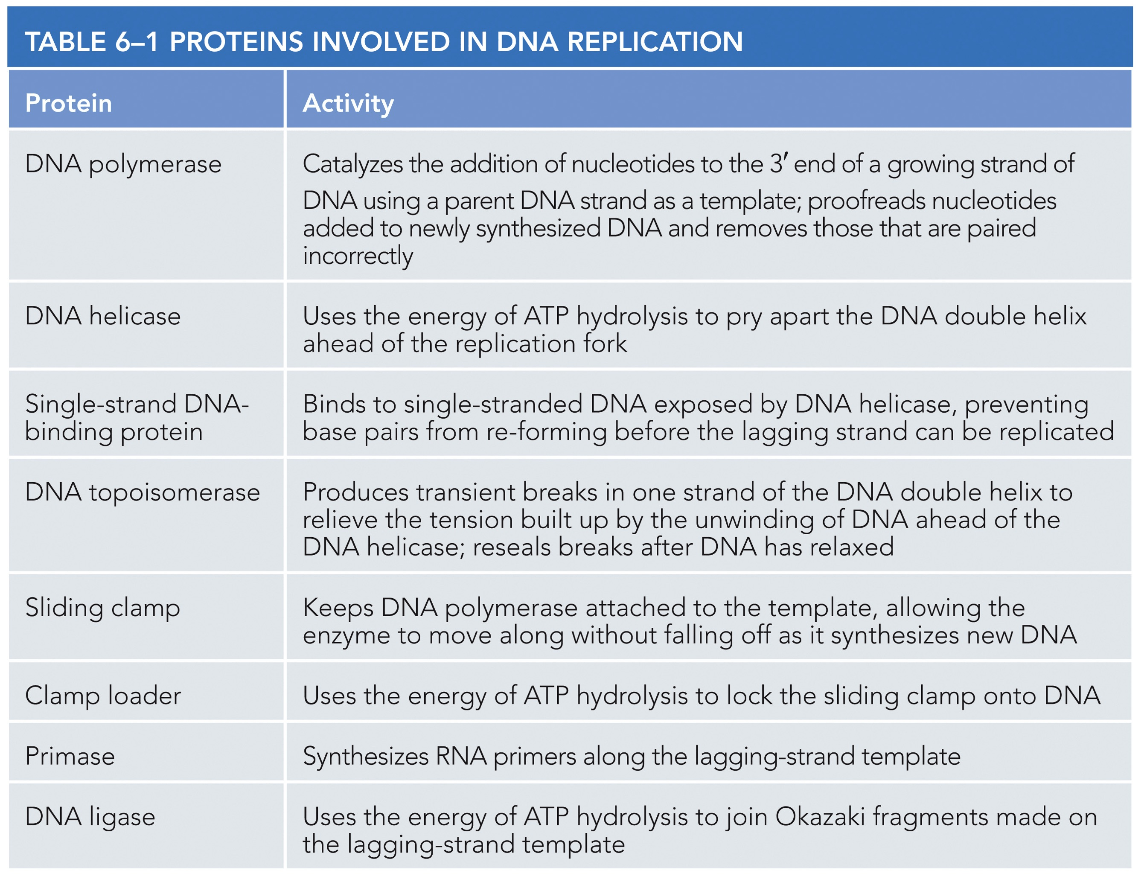
These are 5 proteins involved in DNA replication
500
This describes the sequential steps of DNA mismatch repair
DNA damage is recognized, the newly synthesized strand is identified by an existing nick in the backbone, a segment of the new strand is removed by repair proteins, the gap is filled by DNA polymerase, and the strand is sealed by DNA ligase.
500
This sequencing platform/technology will be used to determine the taxonomic groups of the microorganisms found in Mission Bay
Illumina sequencing
500
This is one application of how PCR has been used in BIOL 351 lab
To amplify MSH3 gene and determine if correct mutation has been made during CRISPR gene editing.
To amplify the 16s rRNA gene from microbial community DNA.