Fossils
Rock Layers & Dating
Plate Tectonics
Earth's History
Vocabulary
100
What is a fossil?
Preserved remains or traces of living things
100
Where are the oldest rock layers found in looking at strata?
Bottom
100
What are large pieces of Earth's crust called?
Plates
100
About how old is the Earth?

4.6 billion years
100
What is magma?
Melted rock inside the mantle of Earth.
100
Where are most fossils found (Type of Rock)?
Sedimentary Rock
100
How are rock layers usually deposited (Horizontal or uneven layers)?
Horizontal
100
Do tectonics plates move fast or slow?
Slow
100
What is the geologic time scale?
A timeline of Earth's History
100
What is a plate?
A large piece of Earth's crust.
200
How do fossils form?
Buried in sediment that hardens.
200
What is relative dating?
Putting rocks in order by age.
200
What type of boundary moves apart?
Divergent boundary
200
What is Pangea?
A supercontinent
200
What is subduction?
One plate goes under the other or into the mantle.
200
What is a mold fossil?
Hollow shape of an organism
200
What does original horizontality mean?
Layers form flat.
200
What type of boundary slides past each other?
Transform boundary
200
What were the first life forms like?
Single celled organisms, bacteria
200
What is a trace fossil?
Evidence of activity (footprints)
300
Name one type of fossil?
Mold, cast, petrified.
300
What does the Law of Superposition state?
Oldest layers are on the bottom and news layer on top.
300
What forms at convergent boundaries?
Mountains, Mid-ocean ridge, volcanoes
300
What is a mass extinction?
Many species die quickly
300
What is a mid-ocean ridge?
Underwater mountain or volcano where crust forms
300
What is a cast fossil?
A sold copy of an organism (not hollow)
300
What are rock layers called?
Strata
300
What forms at divergent boundaries?
Trench, rift valley, mid ocean ridge
300
What era is known as the Age of the Reptiles?
Mesozoic Era
300
What is a convergent boundary?
Plates coming together
400
Why are fossils important?
Show how life has changed over time.
400
What happens at a mid-ocean ridge?
New rock forms and pushes the continents.
400
What caused the dinosaur extinction?
Meteor
400
What is strata?
Rock layers
400
What is petrified fossil?
Mineral replace the organism
400
What type of dating uses radioactive elements?
Absolute Dating
400
The sliding past at transform boundaries results in?
Earthquakes
400
What happened during the Paleozoic Era
Life expanded rapidly
400
What is erosion?
Wearing away of Rock/layers
500
How do fossils support evolution?
Show change over time
500
Name two rock dating methods?
Absolute & Relative dating
500
Explain sea-floor spreading.
Magma rises up the mid-ocean ridge, cools, pushes crust that moves the continents. The old rock gets subducted into the mantle and the process starts again.
500
Give 3 pieces of evidence for Pangea.
1. Fossils
2. Fit together like puzzle pieces
3. Mountain ranges lined up
4. Same type of rock
500
Explain 3 plate boundaries
1. Divergent boundary pull apart from one another
2. Convergent boundary smash into one another or come towards one another
3. Transform boundary the plates slide past each other.
500
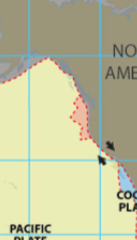 What type of boundary is this where the North American plate and the Pacific plate move past one another?
Transform Boundary
500
Put the these in order from longest to shortest periods of time. Era, Period, Epoch, and Eon.
Eon
Era
Period
Epoch