Environmental Chemistry
Environmental Regulations
Risk Assessment
Drinking and Wastewater
Hazardous Waste and Remediation
100
The value of the soil-water partitioning coefficient is driven by?
A compound's hydrophobicity
log(Kow)
Kd=focKoc
100
This law regulates the production of new chemicals. It's key provision is to require chemical companies to test the environmental fate and toxicity of new compounds and self-report results.
Toxic Substances Control Act
100
What is IRIS?
IRIS is the Integrated Risk Information System. It is a database of toxicity information housed by the EPA.
100
What is the main acute health risk in drinking water that is mitigated via disinfection?
Microbial pathogens!
100
What are the three basic categories of remediation technologies? There are specific names but you can just describe the categories.
Destruction - breaks down covalent bonds (e.g., UV-advanced oxidation)
Separation - phase transfer processes (e.g., air stripping)
Immobilization - stops contaminant from moving in groundwater (e.g., changing ox state of metal; in situ GAC)
200
A 55-gallon drum is filled half with air and half with an aqueous solution of carbontetrachloride (H = 21.8) and chloroform (H=3.7), each at the same concentration. Which compound will have the highest air phase concentration?
Carbon tetrachloride!
200
The National Pollutant Discharge Elimination System regulates point source discharges based on environmental load. NPDES permits are the result of which Act?
Clean Water Act
200
What is point B in the below graph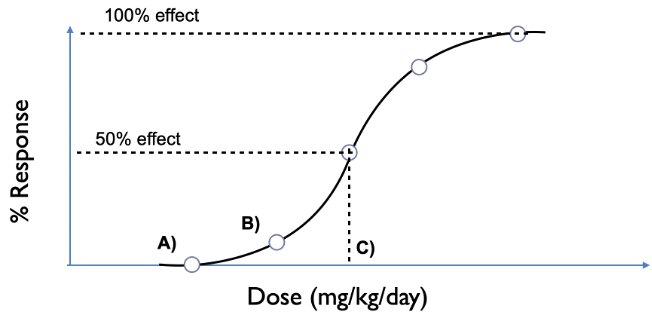
LOAEL (Lowest Observed Adverse Effect Level)
200
Construction of sewer systems in the 18th century didn't solve the public health problems associated with urbanization but instead contributed to...
The Sewer Pipe-Water Pipe Death Spiral!
200
Describe monitored natural attenuation
MNR relies on natural processes to decrease the concentration of contaminants in soil and groundwater; it relies heavily on monitoring; important mechanisms of attenuation include..biotic and abiotic reactions, sorption to soil, biodegradation.
300
Which of the polycyclic aromatic hydrocarbons below do you expect to have the lowest Koc?
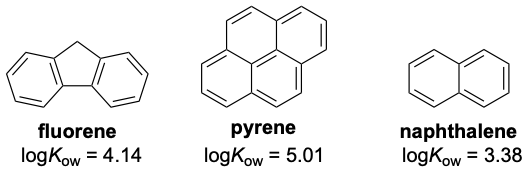
Napthalene
K_{ow} \propto K_{oc}
300
This Act provides definitions of hazardous waste, deals with minimization of all types of soldi waste, and utilizes the "cradle to grave" approach for hazardous waste management.
RCRA
300
What is the level of risk deemed acceptable by the EPA?
10-6 to 10-4
Risk = CDI * SF where
CDI = chronic daily intake
SF = slope factor
300
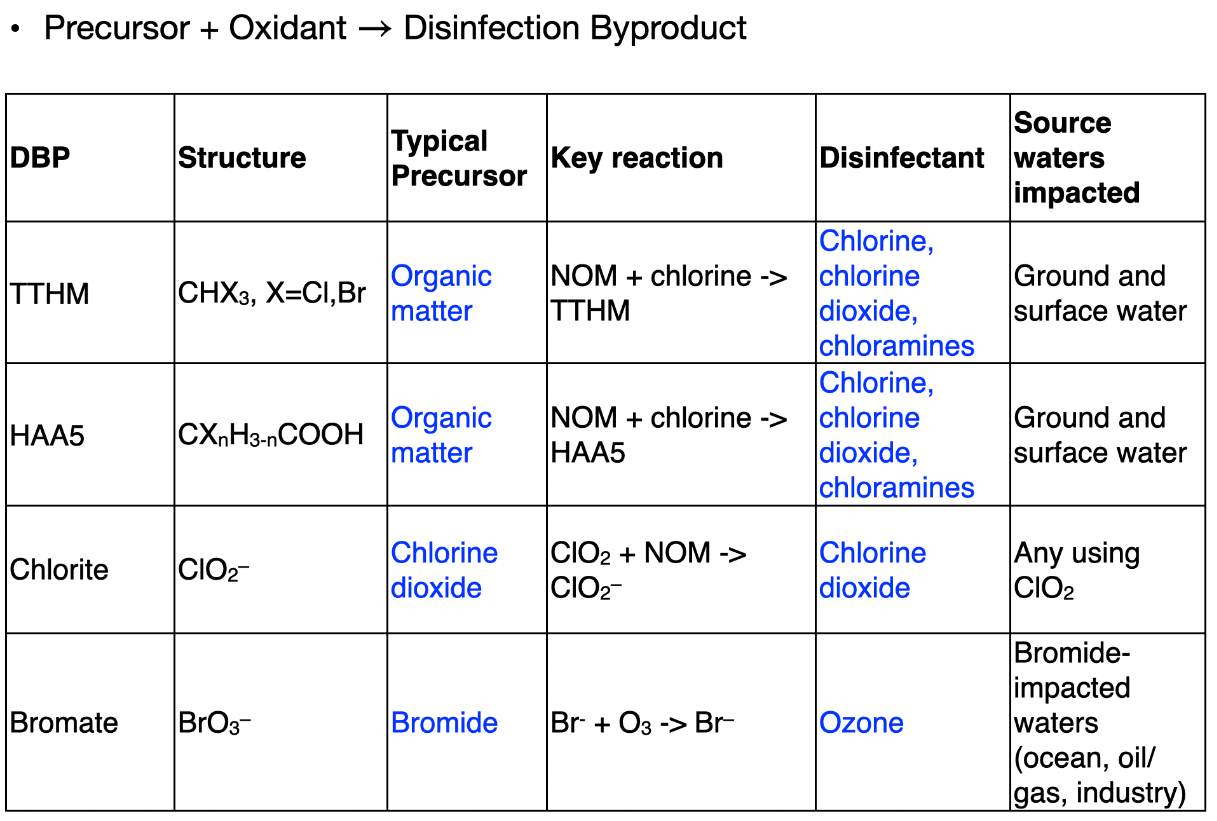
This is the main precursor to disinfection byproducts in chlorinated water systems
Natural organic matter!
300
What is the purpose of the landfill design component labeled with a red asterisk *
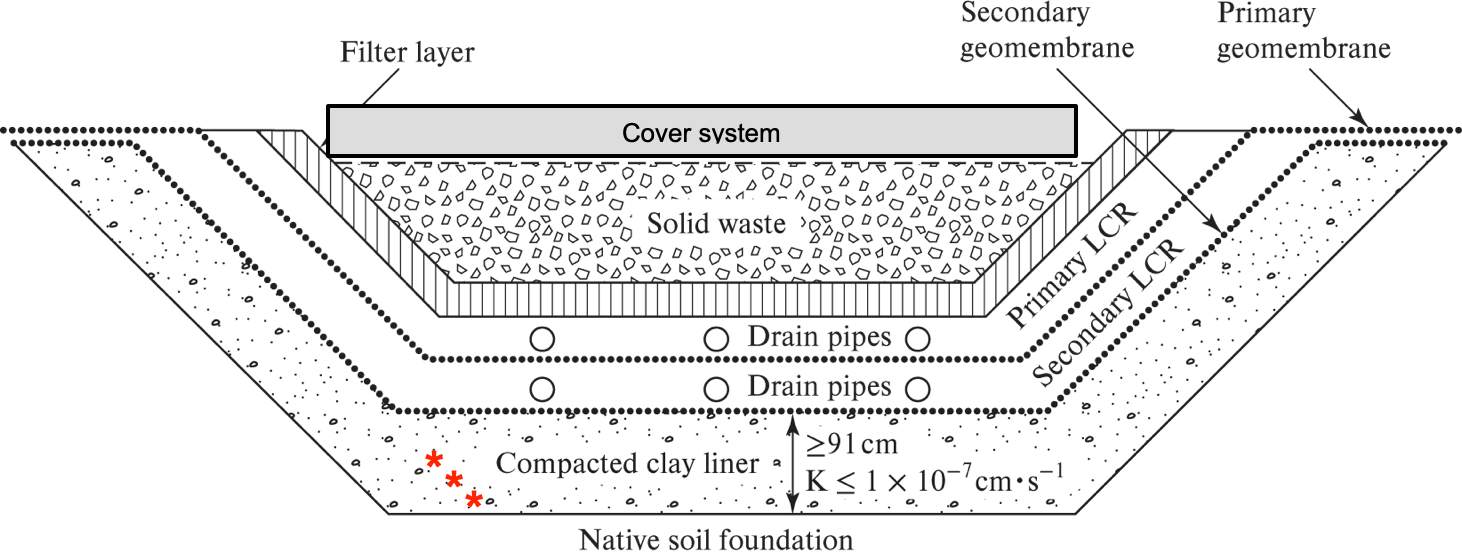
Stop landfill leachate from getting into groundwater
400
The Kow of neutral 2,4,5-trichlorophenol is 103.72, and you find a unitless Henry’s law constant of 6.63x10⁻⁵ and pKa of 6.91. You have 1 L of pH 5 water, 1 L of octanol, and 1 L of air in a sealed container. What phase has the largest fractional mass of 2,4,5-trichlorophenol?
Octanol! Why? This is a three-phase system with equal volumes of each phase. The octanol-water partition coefficient is much larger than H'. Further, Kow>>1 thus 2,4,5-trichlorophenol prefers octanol over water. A quick fo calculation can verify.
f_o=(C_oV_o)/(C_oV_o + C_wV_w+C_aV_a)
400
CERCLA or "The Superfund Act" has what type of liability for parties potentially responsible for environmental contamination?
Strict - applies even if actions were permissible at the time
Retroactive - can go back in time to pre-CERCLA
Joint - any PRP can be held responsible
400
How is a Conceptual Site Model (CSM) used in risk assessment?
A CSM hypothesizes pathways between sources and receptors. It implements scientific and engineering tools to predict contaminant movement and potential attenuation at contaminated sites. It can inform sampling locations for site investigations.
400
Name one non-organic disinfection byproduct
Chlorite (ClO2-)
Bromate (BrO3-)
400
This remediation technology works by forcing water through organic polymers with small pore sizes. Larger molecules and ions are "rejected" while water molecules pass through.
Membranes
500
The concentration of a chemical degrades in water according to first order kinetics. The degradation rate constant is 0.2 per day. If the initial concentration is 100 mg/L, how many days are required (approximately) for the concentration to reach 0.14 mg/L?
Two ways to solve this:
#1: Desert island: The t1/2 = 3.465 days
100->25->12.5->6.25->3.125->1.56->.78->.39->.19 (8 half-lives*3.465 = 27.72)
#2: With calculator:
C(t)=C_0e^{-kt}
0.14/100=e^{-0.2*t} \Rightarrow t=32.9
500
Which Act includes the Unregulated Contaminant Monitoring Rule?
Safe Drinking Water Act (SDWA)
UCMR authorizes EPA to collect data from participating utilities on a list (the UCMR list) of chemical and/or biological contaminants present in drinking water sources. The occurrence data informs future potential regulations.
500
What is the difference between HQ and SF?
The hazard quotient (HQ) characterizes risk from non-carcinogens. It is the ratio of CDI to reference dose (RfD). HQ>1 generally deemed an unacceptable level of risk. This risk is not directly calculable in terms of # of more incidents / population.
The slope factors is proportional to the likelihood to cause cancer. SF*CDI = increased risk of developing cancer due to a certain level of exposure.
500
Turbidity is most commonly associated with exposure to what type of contaminant in drinking water?
Microbial pathogens
500
This remediation technology works by increasing the opportunities for air-water exchange
Air stripping
600
Name the intermolecular force responsible for the high boiling point of ethanol? (CH3CH2OH)
Hydrogen bonding!
H-bonding and ion-water interactions are very important in determining a compound's preference for the aqueous phase.
600
Which Act lists design specifications for hazardous waste landfills?
RCRA
600
Calculate the risk for an adult exposed to 10 ppb arsenic in their drinking water for a 20 year period. Use the following standard parameters: 75 year lifetime, 2.5 L water/day, 70 kg body mass, exposed for 50/52 weeks of the year
Steps: Calculate CDI. Remember that exposure duration is 20 years and frequency is 50/52 weeks/year. Denominator averaging time is 75 years. Then lookup SF or RfD (IRIS or data table). If a RfD is given then calculate HQ. If SF is given then calculate risk (CDI*HQ). If both are given you can calculate both HQ and risk.
600
During water disinfection, what are the two parameters that determine the number of surviving microorganisms (i.e., inactivation).
ln(N_t/N_0)=-kCt
Disinfectant concentration (C) and exposure time (t) are the biggest contributors. This is the basis of the CT concept used to design disinfection systems.
600
This remediation technology works by injecting oxidants underground where they react with and destroy chemical contaminants
In situ chemical oxidation