Division of the Nervous System
Synapses and Neurons
Brain
Spinal Cord & Reflexes
100
What parts of the body are included in the central nervous system (CNS)?
Brain & spinal cord
100
Which part of the neuron is the receptor and receives the signal?
Dendrites
100
The meninges are best described as:
Protective membranes covering the brain and spinal cord - cerebrospinal fluid (CSF) in the spaces to bathe them, absorb shock, and exchange nutrients/wastes between blood and nervous tissue
100
Explain what a "knee jerk reaction" is?
An involuntary reaction to a stimulus
200
The sympathetic nervous system controls all _________ responses of the body.
The parasympathetic nervous system ___________ the body.
fight or flight (emergency situations)
calms
200
What is the space between two neurons at a synapse called?
Synaptic cleft
200
What is the green portion and what is its function?
Cerebellum - responsible for balance and coordination
200
What are the neurons called in the gray matter of the spinal cord that connects and translates from sensory neurons to motor neurons?
Interneurons
300
Describe function the central nervous system (CNS) and the peripheral nervous system (PNS)
Central nervous system (CNS) - control center of the body (interprets information from the PNS)
Peripheral nervous system (PNS) - receives information from the environment and relays commands from the CNS to organs and glands
300
________________ are structural and functional units of the nervous system , whereas _______________ are accessory cells in nerve tissue.
Neurons & neuroglial cells
300
What is the blue portion of the brain and what is its function?
Cerebrum - largest part of the brain that controls senses, thoughts, emotions, and imagination
300
What are the afferent neurons?
They are nerve cells that carry sensory signals from the body's receptors (skin, organs, eyes, ears) toward the central nervous system (brain and spinal cord). They are responsible for relaying information about touch, pain, temperature, and special senses to be processed.
400
Describe the function of the sensory division and the motor division within the peripheral nervous system.
Sensory division - transmit impulses from sense organ to the CNS
Motor division - transmits impulses from the CNS to the muscles or glands
400
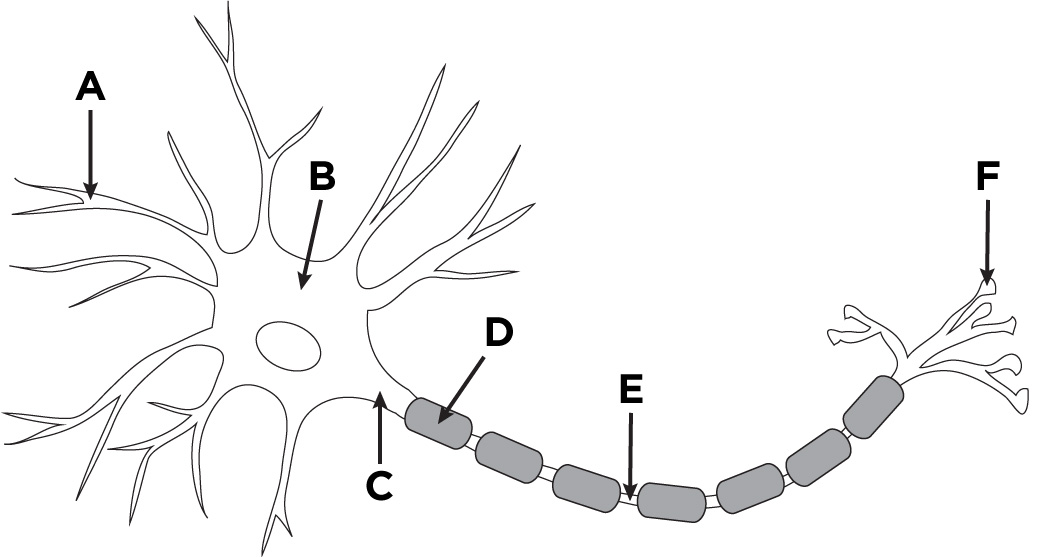 Identify A, B, C, D
A - dendrite
B - cell body
C - axon
D - myelin sheath
E - node
F - axon terminal
400
The medulla oblongata is colored orange at the inferior portion of the brain stem. What is the function of the medulla oblongata?
Regulates breathing & heart rate
400
What are efferent neurons?
Efferent neurons, commonly known as motor neurons, are nerve cells that carry signals away from the central nervous system (CNS) to peripheral targets like muscles and glands. They are responsible for executing both voluntary movements and involuntary bodily functions
500
Describe the function of the autonomic nervous system and the somatic nervous system.
Autonomic nervous system - regulates activities that are involuntary (heart rate, glands, digestion)
Somatic nervous system - regulates activities under voluntary control (skeletal muscle movement, reflexes)
500
What are neurotransmitters ?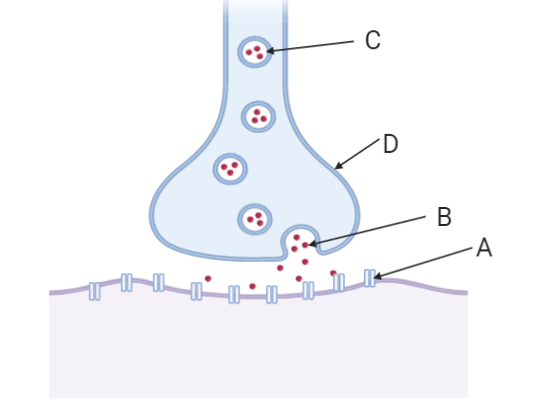
Neurotransmitters are the body’s chemical messengers. They carry signals between nerve cells (neurons) or from neurons to target cells like muscles and glands. This biochemical communication system drives everything we do, from basic involuntary functions like breathing to complex processes like thinking, feeling, and moving
500
What is the primary function of the hypothalamus?
Temperature regulation and hunger
500
Afferent nerves are called____________
Efferent nerves are called____________
ensory nerves
motor nerves