Data Types
Numbers
Samples & Populations
Ethics
Designs
100
Identify the data type:
A student says, “I felt nervous before the test because I did not study enough.”
Qualitative data.
100
Look at the table below. Which amount of sleep had the highest average concentration score?
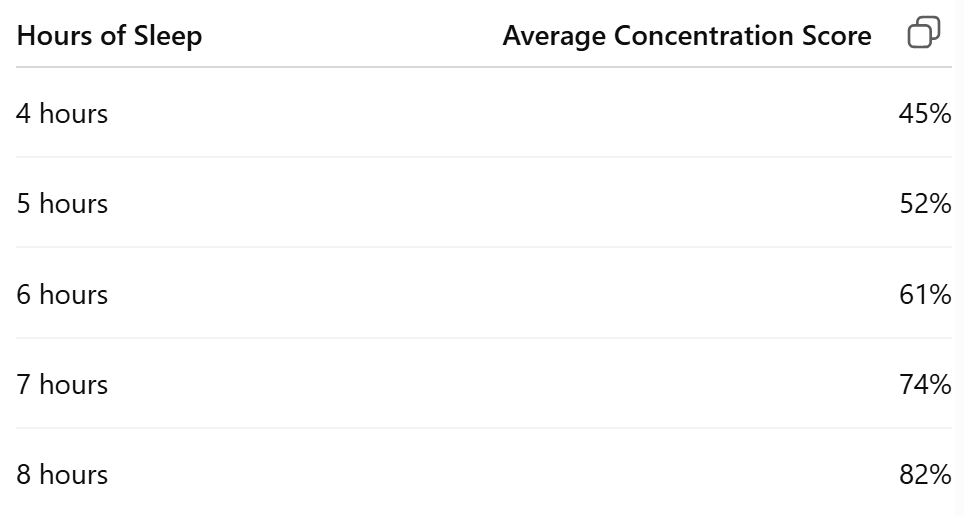
8 hours.
100
Define sample.
A sample is the smaller group of participants selected from the population to take part in a study.
100
Identify one ethical consideration researchers must follow when conducting a psychology study.
Any one of the following: informed consent, confidentiality, voluntary participation, right to withdraw, protection from harm, or debriefing.
100
State one feature of a focus group.
A focus group involves a small group of people discussing their opinions, experiences, or ideas about a topic.
200
Identify each data type:
a. A student rates their stress level as 8/10.
b. A researcher records that a student’s heart rate is 92 beats per minute.
a. Subjective quantitative
b. Objective quantitative
200
Calculate the mean of the following data set:
4, 6, 8, 10, 12
Answer:
Mean = 8
Working:
4 + 6 + 8 + 10 + 12 = 40
40 ÷ 5 = 8
200
Define the term population in psychological research.
A population is the whole group of people the researcher wants to study or make conclusions about.
200
Describe what informed consent means in psychological research.
Informed consent means participants are told what the study involves before they agree to take part. They should understand what they are being asked to do and any possible risks.
200
Identify the most suitable design type for each example: experimental, observational, or qualitative.
a. Researchers interview students in a focus group about how phone use affects their sleep.
b. Researchers give one group caffeine and another group no caffeine, then compare concentration test scores.
c. Researchers watch and record how often students check their phones during study time without changing anything.
a. Qualitative
b. Experimental
c. Observational
300
State one difference between objective quantitative data and subjective quantitative data.
Objective quantitative data is numerical data measured directly, such as heart rate or test score. Subjective quantitative data is numerical data based on someone’s opinion or personal rating, such as stress rated 8/10.
300
Calculate the median of the following data set:
3, 9, 4, 7, 10, 6, 8
Answer:
Median = 7
Working:
Order the numbers: 3, 4, 6, 7, 8, 9, 10
The middle number is 7.
300
A researcher wants to investigate whether sleep affects concentration in Australian teenagers. They collect data from only one Year 11 Psychology class.
Explain why using only Year 11 Psychology students may affect the results.
Using only Year 11 Psychology students may make the sample less representative of all Australian teenagers. These students may have similar ages, school routines, stress levels, or knowledge of psychology. This means the results may not apply to teenagers from other year levels, schools, or backgrounds. Therefore, the findings may have low generalisability.
300
Explain why ethical guidelines are important in psychological research. Include one example.
Ethical guidelines are important because they protect participants and make sure research is conducted responsibly. For example, informed consent ensures participants understand the study before agreeing to take part. Confidentiality also protects participants’ personal information, which is important because psychology studies can involve personal thoughts, feelings, and behaviours.
300
Discuss one strength and one weakness of using a focus group to collect data.
One strength of a focus group is that it allows researchers to collect detailed opinions and experiences from participants. Participants can explain their answers in their own words. One weakness is that some people may not answer honestly in front of others, or their answers may be influenced by what other people in the group say.
400
Explain the difference between qualitative data and quantitative data. Include one example of each.
Qualitative data is descriptive data that uses words, opinions, or explanations. For example, “I felt tired and distracted” is qualitative data. Quantitative data is numerical data that can be counted or measured, such as a concentration score of 75% or a stress rating of 6/10.
400
Look at the table below. Identify the general trend shown in the data.
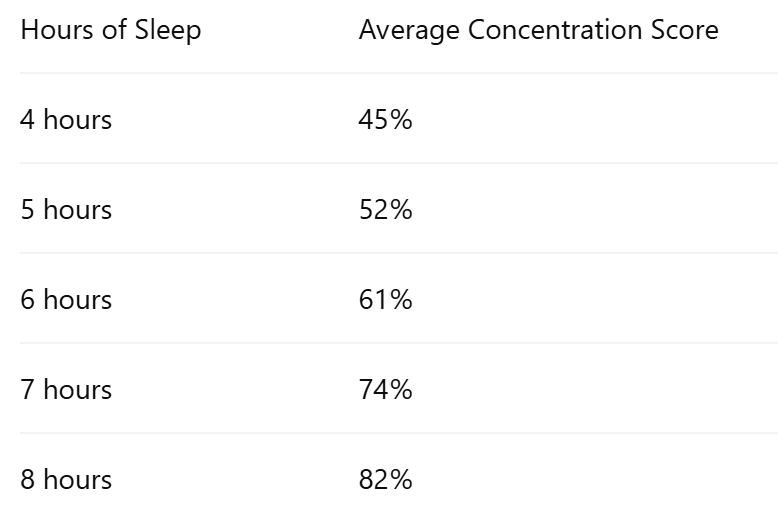
As hours of sleep increase, the average concentration score also increases.
400
A Year 11 Psychology class investigates whether sleep affects concentration. The teacher asks 20 Year 11 students from one Psychology class to take part.
Explain one strength and one limitation of this sample.
One strength of the sample is that it is relevant because the study is about teenagers and the participants are Year 11 students. It is also convenient because the teacher can easily access students from their own Psychology class. However, one limitation is that the sample only includes 20 students from one class. This means the sample may not represent all teenagers, so the results may not generalise well to other year levels, schools, or teenagers.
400
A teacher is conducting a psychology study about student stress. Students are asked to write their names on their responses and describe how stressed they feel before exams.
Identify one ethical issue in this study and explain how the teacher could fix it.
One ethical issue is confidentiality because students are sharing personal information about stress and their names are attached to their responses. The teacher could fix this by removing names from the data or using anonymous codes instead. This would help protect students’ privacy and make them feel safer when answering honestly.
400
Compare an experimental design and an observational design.
An experimental design involves manipulating or changing an independent variable to see its effect on a dependent variable. An observational design involves watching and recording behaviour without changing any variables. Experimental designs are better for testing cause and effect, while observational designs are better for seeing how behaviour naturally occurs.
500
A Year 11 Psychology class wants to investigate whether sleep affects concentration in teenagers.
Students record how many hours of sleep they had, complete a concentration test, and then take part in a focus group about sleep, mood, focus, and motivation.
Identify two different types of data collected in the sleep and concentration study and explain why each fits that data type.
The concentration test scores are objective quantitative data because they are numerical scores collected from a test. The hours of sleep are quantitative data because they are recorded as numbers, although they may be self-reported. The focus group responses are qualitative data because students discuss their opinions and experiences using words.
500
A Year 11 Psychology class investigates whether sleep affects concentration. The results are shown below.
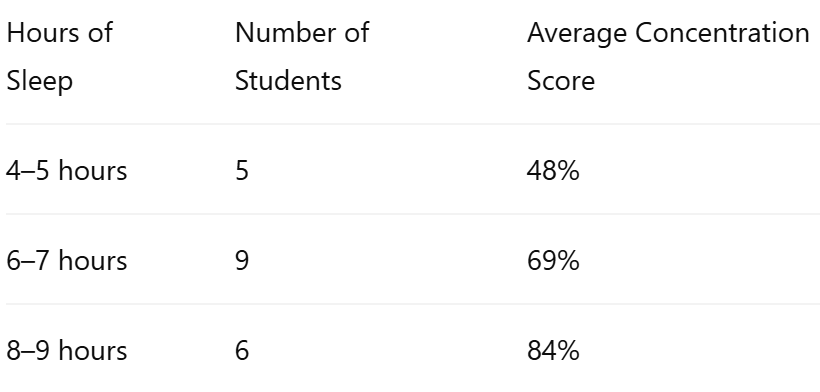
Explain what the results suggest about the relationship between sleep and concentration. Does this prove that sleep definitely causes better concentration?
The results suggest that students who had more sleep had higher average concentration scores. Students who slept 4–5 hours had an average score of 48%, while students who slept 8–9 hours had an average score of 84%. This shows a positive relationship between sleep and concentration. However, it does not prove that sleep definitely causes better concentration because other factors, such as stress, breakfast, phone use, motivation, or prior knowledge, may have influenced the results.
500
A researcher wants to investigate whether sleep affects concentration in Australian teenagers. They use a sample of 20 Year 11 Psychology students from one school.
Explain how this sample could affect the generalisability of the study.
Using only 20 Year 11 Psychology students from one school may reduce the generalisability of the study because the sample is small and specific. These students may have similar routines, school expectations, stress levels, and psychology knowledge. Teenagers from other schools, year levels, or backgrounds may have different sleep patterns and concentration levels. Therefore, the results may not accurately represent the wider teenage population.
500
A Year 11 Psychology teacher asks their own class to take part in a study about sleep, mood, focus, and motivation. Students record their sleep hours, complete a concentration test, and discuss their experiences in a focus group.
Explain two ethical considerations the teacher should follow and connect them to the scenario.
The teacher should gain informed consent so students understand what the study involves before agreeing to take part. Students should also know that participation is voluntary and that they have the right to withdraw, especially because they may feel pressured if their teacher is running the study. Confidentiality is also important because students are sharing personal information about their sleep, mood, focus, and motivation. The teacher should avoid using names when recording results so students feel safe and respected.
500
A researcher wants to find out whether caffeine causes better concentration in teenagers.
Would a focus group be the best design for this research aim? Explain your answer and suggest a better design.
A focus group would not be the best design because it collects opinions and experiences rather than testing cause and effect. To test whether caffeine causes better concentration, researchers would need an experimental design. For example, they could give one group caffeine and another group no caffeine, then compare their concentration test scores. This would be better because the researcher is manipulating the caffeine variable and measuring its effect on concentration.