Wegener and Continental Drift
Seafloor Spreading
Earth's Layers
True/False
Terms
100
Wegener believed all continents were once a single supercontinent (which looks like a jigsaw puzzle) called...
Pangea
100
This scientist discovered that the ocean floor moves like conveyor belts, known as seafloor spreading
Harry Hess
100
This is the name given to the outermost surface layer of the Earth.
Crust
100
True or False: The Earth's outer core is liquid.
True
100
The hypothesis that the continents slowly move across the Earth's surface.
Continental Drift
200
In this year, Alfred Wegener proposed his theory of continental drift.
1912
200
Seafloor spreading occurs because of this process.
Magma rises to the surface at mid-ocean ridges, forming new rock.
200
Tectonic plates move due to heat released from inside Earth creating these currents in the mantle
Convection currents
200
True or False: Hot material sinks while cool material rises.
False (hot material rises while cool material sinks)?
200
The name of the single landmass that began to break apart 200 million years ago.
Pangea
300
What is the definition of the continental drift theory.
Continents were once a single landmass and drifted apart.
300
Did Harry Hess’s discovery disprove Wegener's idea of moving continents. Explain why or why not.
No, because seafloor spreading provided the missing mechanism explaining how continents move as the ocean floor carries them.
300
This statement correctly compares continental crust and oceanic crust.
A. Continental crust is thinner and made mostly of basalt.
B. Oceanic crust is denser than continental crust and composed mostly of basalt.
C. Continental crust is denser and sinks under oceanic crust.
D. Oceanic crust is thicker and composed mostly of granite.
B. Oceanic crust is denser than continental crust and composed mostly of basalt.
300
True or False: The center (inner core) of the Earth is made of liquid rock.
False (it is solid iron/nickel due to immense pressure)?
300
Finding identical matching layers of these two things on different continents supports continental drift
Fossils and Rocks
400
Name 3 pieces of evidence that supported Alfred Wegener’s theory of continental drift.
Fossils, Rocks, and Mountains
400
Suppose a drill ship takes core samples at three locations:
Location A: 10 km from the Mid-Atlantic Ridge
Location B: 500 km from the Mid-Atlantic Ridge
Location C: 1,200 km from the Mid-Atlantic Ridge, near the continental coast
Based on seafloor spreading evidence, how will the ages and thermal properties of the rock samples compare?
A. Location A will have the oldest, coolest rocks; Location C will have the youngest, hottest rocks.
B. Location A will have the youngest, hottest rocks; Location C will have the oldest, coolest rocks.
C. Location B will have the hottest rocks, while Locations A and C will have identical ages.
D. All three locations will yield rocks of identical age, but Location A will be significantly colder.
B. Location A will have the youngest, hottest rocks; Location C will have the oldest, coolest rocks.
400
List the layers in order from the outer surface to the inside of the Earth.
Crust, Mantle, Outer Core, Inner Core
400
True or False: The mantle is the hottest layer of the Earth.
False (the inner core is the hottest layer)?
400
An undersea mountain chain where new ocean floor is produced
Mid-Ocean Ridge
500
This was the major flaw in Wegener’s hypothesis that caused it to be initially rejected by scientists.
He couldn't explain what was causing the continents to move.
500
Fossils of the reptile Cynognathus, reptile Lystrosaurus, and fern Glossopteris on separate continents are used by scientists to prove this.
Continental Drift- the theory that these continents were once joined together but moved apart over time?
500
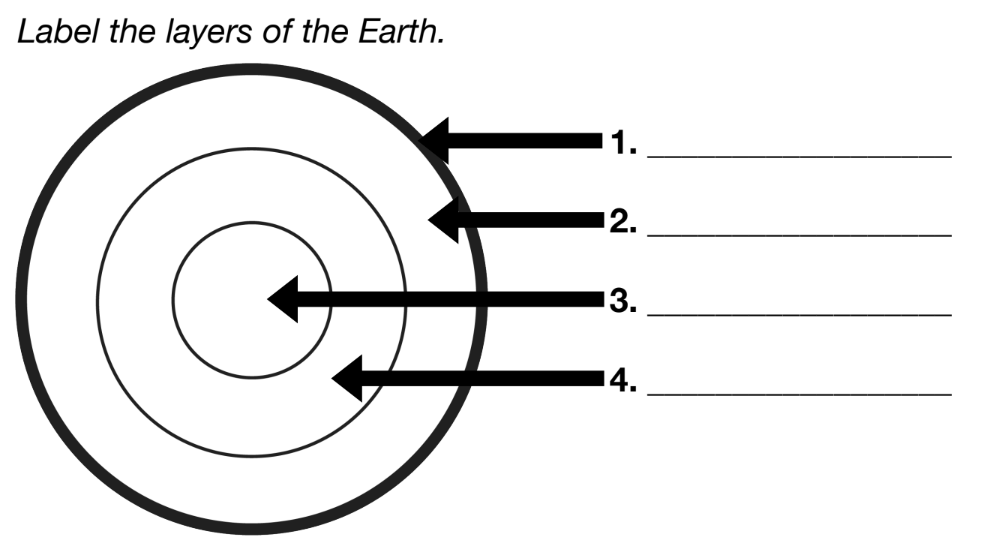
1. Crust
2. Mantle
3. Inner Core
4.Outer Core
500
True or False: Alfred Wegener's theory was rejected until Harry Hess discovered seafloor spreading.
True
500
The process by which oceanic crust sinks beneath a deep-ocean trench and back into the mantle at a convergent plate boundary.
Subduction