Graphs
Tables
Algebra
Continuity
Misc.
100
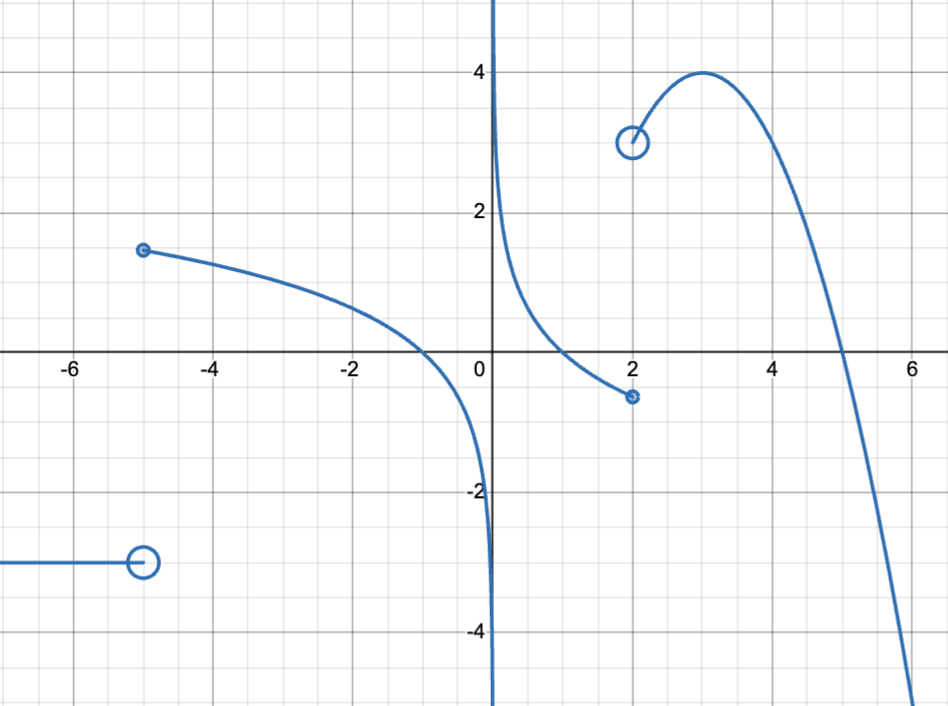
Find:
\lim_{x\rightarrow\ 0} f(x)
Does not exist
100
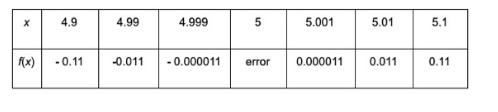
Find:
\lim_{x\rightarrow\ 5} f(x)
0
100
Evaluate the following limit:
\lim_{x\rightarrow\ 0} 3\sqrt{x}+x^\frac{2}{3}+x^5
0
100
Is this function continuous over all real numbers?
y=tan(x^2+x+1)
No, tangent composed with a non-constant polynomial will always have asymptotes
100
Which theorem is depicted in the diagram below?
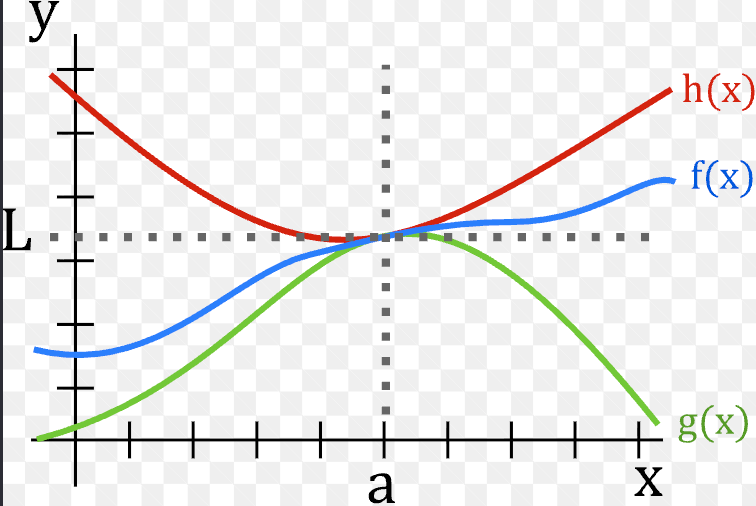
Squeeze Theorem
200
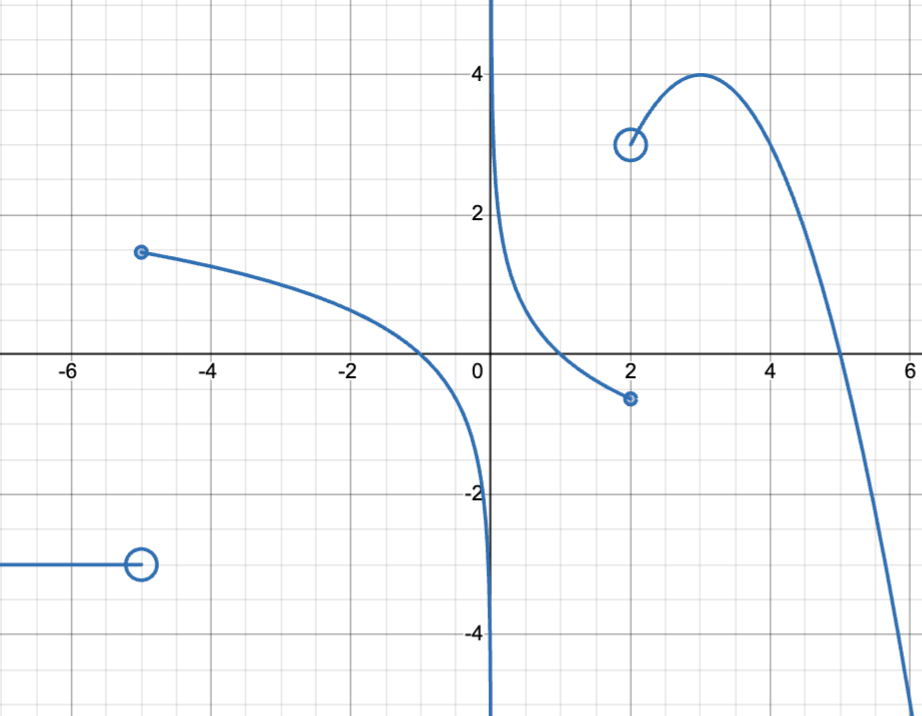
Find:
\lim_{x\rightarrow 2^+} f(x)
3
200
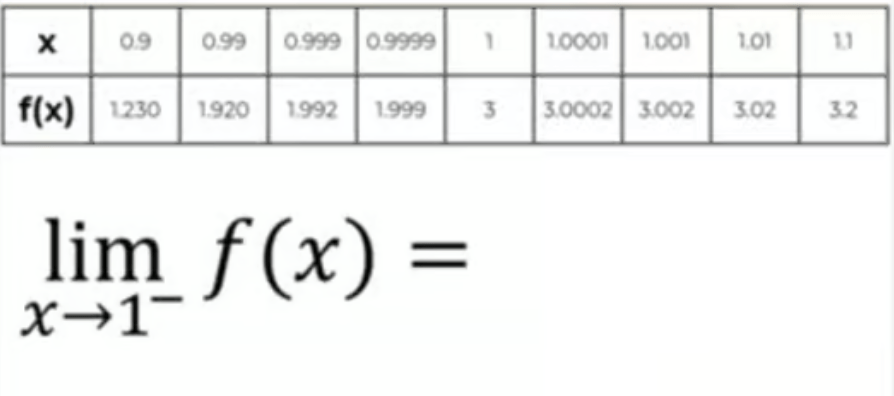
2
200
Evaluate:
\lim_{x\rightarrow -3^+} \frac{x^2-9}{x^2+5x+6}
6
200
Which condition causes the failure of continuity of the function below at x=4?
f(x)=\frac{x^3-4x}{x-4}
I (and III as well, as it also fails because I does not exist)
200
Which theorem is depicted in the diagram below?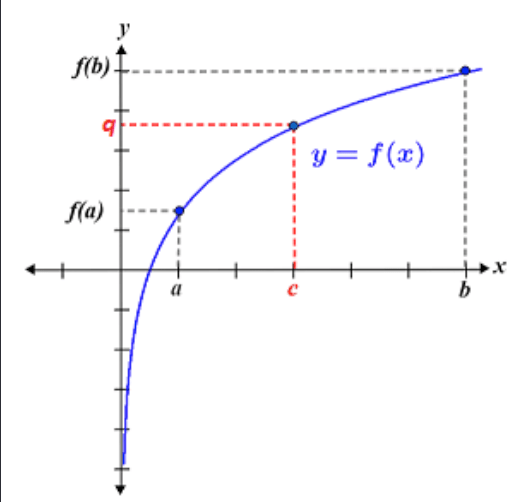
Intermediate Value Theorem
300
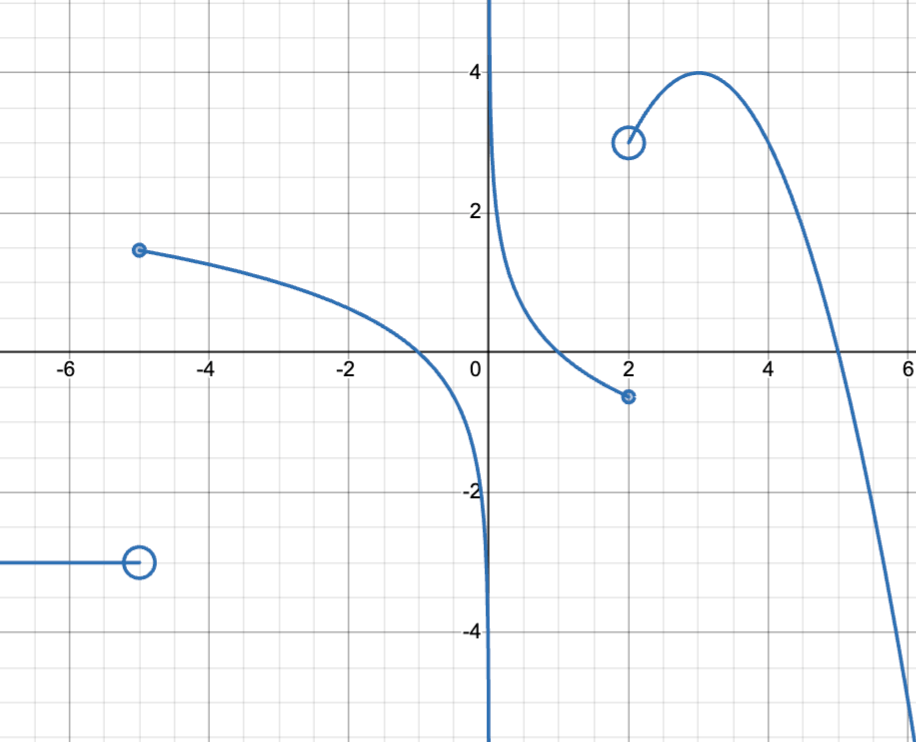
Find:
\lim_{x\rightarrow-\infty} f(x)
-3
300
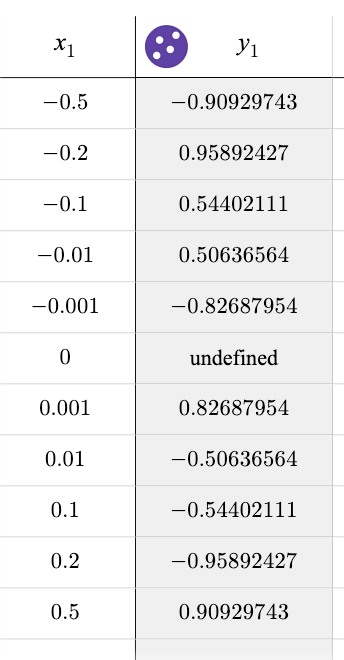
Find:
\lim_{x\rightarrow\ 0^-} f(x)
Undefined
300
Evaluate:
\lim_{x\rightarrow\ 0} \frac{\sqrt{x+2}-\sqrt{2}}{x}
\frac{1}{2\sqrt{2}}
\frac{\sqrt{2}}{4}
300
Is this function continuous at x=4?
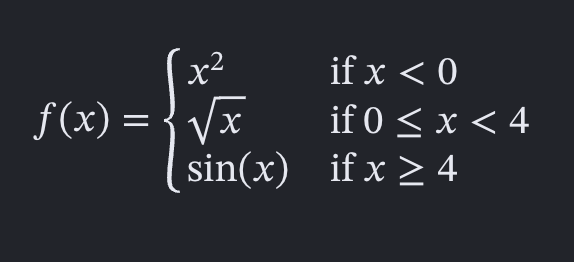
No, there is a jump discontinuity as
\sqrt{4}\ne sin(4)
300
List the four types of discontinuities.
Jump discontinuity, removable discontinuity (or hole), vertical asymptote (or infinite discontinuity), oscillating discontinuity