HEG
Ectopic Pregnancy
Gestational
Trophoblastic
Disease
Trophoblastic
Disease
Abruptio
Placentae
Placentae
Placenta Previa
PreE
Severe PreE
Eclampsia
Mag Tox
& ABO
incompatibilities
& ABO
incompatibilities
Complication
misc.
misc.
Introduction to maternal Child
Nursing Care During Pregnancy
100
Hyperemesis gravidarium is another name for “morning sickness?”
1. True
2. False
What is false?
100
The incidence of ectopic pregnancy is increasing in the United States as a result of:
1. Cesarean sections
2. Hyperemesis
3. Sexually transmitted diseases
4. Teen pregnancy
What is STDS?
100
After suction and evacuation of a complete hydatididform mole, the 28-year-old multigravid client asks the nurse when she can become pregnant again. The nurse would advise the client not to become pregnant again for at least which of the following time spans?
1. 6 months
2. 12 months
3. 18 months
4. 24 months
What is 12 mos?
100
Nursing considerations for a woman who presents with abruptio placenta include:
1. Monitoring the woman for signs of hypovolemic shock
2. Performing vaginal exam to see if she is dilated
3. Providing emotional support
4. All of the above
5. 1 & 3
What is 1 and 3.
100
A client who is 36 weeks’ gestation presents to the OB triage unit with complaints of mild contractions. Which of the following complications should the nurse be watching for if the client tells her that she has placenta previa?
1. Fever
2. Emesis
3. Vaginal bleeding
4. Sudden rupture of membranes
What is vaginal bleeding?
100
The hallmark sign(s) of pre-eclampsia include(s):
1. Blood pressure > 140 systolic and > 90 diastolic
2. Blood pressure > 150 systolic and > 100 diastolic
3. Proteinuria present
4. Proteinuria not present
5. 1 & 3
6. 2 & 4
What is 1 & 3?
100
When preparing the room for admission of a multigravid client at 36 weeks’ gestation diagnosed with severe preeclampsia, which of the following should the nurse obtain?
Oxytocin (Pitocin) infusion solution
Disposable tongue blades
Portable ultrasound machine
Padding for the side rails
What is padding for the side rails?
100
A 16-year-old unmarried primigravid client at 37 weeks’ gestation with severe preeclampsia is in early active labor. The client’s blood pressure is 164/110 mm Hg. Which of the following would alert the nurse that the client may be about to experience a seizure?
1. Decreased contraction intensity
2. Decreased temperature
3. Epigastric pain
4. Hyporeflexia
What is epigastric pain?
100
The antidote for magnesium toxicity is:
1. Betamethasone
2. Calcium gluconate
3. Hydralazine
4. Labetalol
What is calcium gluconate.
100
Early signs and symptoms of hypovolemic shock include:
1. Maternal tachycardia
2. Falling B/P
3. Pallor, Cold, clammy skin
4. Agitation, restlessness, and decreased mental ability
5. All of the above
What is maternal tachycardia?
100
List what not to eat during pregnancy?
What is raw/undercooked foods, soft cheese, pate, excessive caffeine, alcohol, raw milk, smoked seafood.
100
A patient had a non reactive NST and is now scheduled for a BPP. What 5 parameters are assessed in this test?
What is fetal breathing movements, gross body movements, fetal tone, amniotic fluid, non-stress test
200
A 21-year-old client at 6 weeks’ gestation is diagnosed with hyperemesis gravidarum. This excessive vomiting during pregnancy will often result in which of the following?
1. Bowel perforation
2. Electrolyte imbalance
3. Miscarriage
4. Preeclampsia
What is electrolyte imbalance?
200
Before surgery to remove an ectopic pregnancy and the fallopian tube, which of the following would alert the nurse to the possibility of tubal rupture?
1. Amount of vaginal bleeding and discharge
2. Falling hematocrit and hemoglobin levels
3. Slow, bounding pulse rate of 80 bpm
4. Marked abdominal edema
What is falling hematocrit and hemoglobin levels?
200
A 38-year-old client at about 14 weeks’ gestation is admitted to the hospital with a diagnosis of complete hydatidiform mole. Soon after admission, the nurse would assess the client for signs and symptoms of which of the following?
1. Pregnancy-induced hypertension
2. Gestational diabetes
3. Hypothyroidism
4. Polycythemia
What is pregnancy induced hypertension?
200
Following a cesarean delivery for abruptio placentae, a multigravid client tells the nurse, “I feel like such a failure. None of my other deliveries were like this.” The nurse’s response to the client is based on the understanding of which of the following?
1. The client will most likely have postpartum blues
2. Maternal-infant bonding is likely to be difficult
3. The client’s feeling of grief is a normal reaction
4. This type of delivery was necessary to save the client’s life
What is 3. The client’s feeling of grief is a normal reaction ?
200
A client presents to the OB triage unit with no prenatal care and painless bright red vaginal bleeding. Which interventions are most indicated?
1. Applying external fetal monitor and complete physical assessment
2. Applying external fetal monitor and perform sterile vaginal exam
3. Obtaining a fundal height physical assessment on the patient
4. Obtaining a fundal height and sterile vaginal exam
What is Applying external fetal monitor and complete physical assessment ?
200
The cure for pre-eclampsia is:
1. Bedrest
2. Delivery
3. Magnesium sulfate
4. Steroid injections to accelerate fetal lung maturity
What is delivery?
200
The primary health care provider prescribes intravenous magnesium sulfate for a primigravid client at 38 weeks’ gestation diagnosed with severe preeclampsia. Which of the following medications should the nurse have readily available at the bedside?
1. Diazepam (Valium)
2. Hydralazine (Apresoline)
3. Calcium gluconate
4. Phenytoin (Dilantin)
What is calcium gluconate?
200
A client at 36 weeks’ gestation begins to exhibit signs of labor after an eclamptic seizure. The nurse should assess the client for:
Abruptio placentae
Transverse lie
Placenta accreta
Uterine atony
What is abruptio placentae?
200
A therapeutic level for a pre-eclamptic woman on Magnesium Sulfate is:
1. 0.5-3.0 mg/ dL
2. 1.5-2.5 mg/ dL
3. 4.0-8.0 mg/ dL
4. 6.5-9.0 mg/ dL
What is 4 to 8 mg/dL.
200
Spontaneous abortion is the leading cause of pregnancy loss. Treatment is aimed at preventing complications such as:
1. Hypertension
2. Hypovolemic shock
3. Infection
4. All of the above
5. 2 & 3
What is 2 & 3?
200
What are calorie intake recommendations for:
1st trimester?
2nd trimester?
3rd trimester?
what is:
prepregnancy
+340 kcal/day
+452 kcal/day
200
What test screens for neural tube defects and is done between 15 and 22 weeks of gestation?
What is MSAFP (maternal serum alpha fetal protein).
300
A multigravid client is admitted at 16 weeks’ gestation with a diagnosis of hyperemesis gravidarum. The nurse should explain to the client that hyperemesis gravidarum is thought to be related to high levels of which of the following hormones?
1. Progesterone
2. Estrogen
3. Somatotropin
4. Aldosterone
What is estrogen?
300
A multigravid client diagnosed with a probable ruptured ectopic pregnancy is scheduled for emergency surgery. In addition to monitoring the client’s blood pressure before surgery, which of the following would the nurse assess?
1. Uterine cramping
2. Abdominal distension
3. Hemoglobin and hematocrit
4. Pulse rate
What is pulse rate?
300
After a dilatation and curettage (D&C) to evacuate a molar pregnancy, assessing the client for signs and symptoms of which of the following would be most important?
Urinary tract infection
Hemorrhage
Abdominal distention
Chorioamnionitis
What is hemorrhage?
300
The primary health care provider prescribes whole blood replacement for a multigravid client with abruptio placentae. Before administering the intravenous blood product, the nurse should first:
1. Validate client information and the blood product with another nurse
2. Check the vital signs before transfusing over 5 to 6 hours
3. Ask the client if she has ever had any allergies
4. Administer 100 mL of 5% dextrose solution intravenously
What is 1. Validate client information and the blood product with another nurse ?
300
A client presents to the OB triage unite with a report of bright red vaginal bleeding that has saturated a peripad over the last hour. The nurse observes the fetal heart rate with a baseline of 130 decreasing to 100 for 60 seconds and then returning to 130. There are no contractions present. Which are the priority nursing interventions?
1. Ask client time of last oral intake and prepare to start an IV
2. Continue to observe monitor and perform Leopold’s maneuver
3. Apply oxygen by face mask and perform sterile vaginal exam
4. Place client in hands and knees position and call primary health care provider
What is Ask client time of last oral intake and prepare to start an IV ?
300
For the client who is receiving intravenous magnesium sulfate for severe preeclampsia, which of the following assessment findings would alert the nurse to suspect hypermagnesemia?
1. Decreased deep tendon reflexes
2. Cool skin temperature
3. Rapid pulse rate
4. Tingling in the toes
1. Decreased deep tendon reflexes
300
Soon after admission of a primigravid client at 38 weeks’ gestation with severe preeclampsia, the primary health care provider prescribes a continuous intravenous infusion of 5% dextrose in Ringers solution and 4 g of magnesium sulfate. While the medication is being administered, which of the following assessment findings should the nurse report immediately?
1. Respiratory rate of 12 breaths/ min
2. Patellar reflex of +2
3. Blood pressure of 160-88 mm Hg
4. Urinary output exceeding intake
What is respiratory rate?
300
Signs of CNS depression related to magnesium toxicity include:
1. +3 DTRs
2. Confusion
3. Respiratory rate >18
4. Urine output > 30 mL/ hr
5. All of the above
What is confusion?
300
On arrival at the emergency department, a client tells the nurse that she suspects that she may be pregnant but has been having a small amount of bleeding and has severe pain in the lower abdomen. The client’s blood pressure is 70/50 mm Hg and her pulse rate is 120 bpm. The nurse notifies the primary health care provider immediately because of the possibility of:
1. Ectopic pregnancy
2. Abruptio placentae
3. Gestational trophoblastic disease
4. Complete abortion
What is ectopic pregnancy?
300
Lifestyle choices such as alcohol, smoking, and drug use can lead to what complications?
What is SIDS, preterm labor, fetal alcohol disorders, miscarriage, birth defects
300
Which of the following strips would be categorized as a reactive Non-Stress test?
A.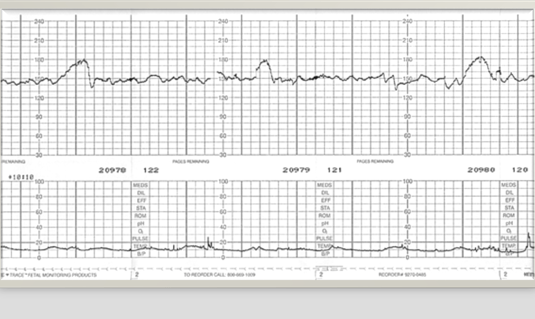
B.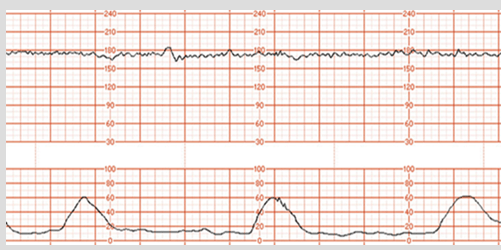
What is strip A. At least 15bpm by 15 secs.
400
A multigravid client thought to be at 14 weeks’ gestation reports that she is experiencing such severe morning sickness that she “has not been able to keep anything down for a week.” The nurse should assess for signs and symptoms of which of the following?
1. Hypercalcemia
2. Hypobilirubinemia
3. Hypokalemia
4. Hyperglycemia
What is hypokalemia?
400
A 36-year-old multigravid client is admitted to the hospital with possible ruptured ectopic pregnancy. When obtaining the client’s history, which of the following would be most important to identify as a predisposing factor?
1. Urinary tract infection
2. Marijuana use during pregnancy
3. Episodes of pelvic inflammatory disease
4. Use of estrogen-progestin contraceptives
What is episodes of pelvic inflammatory disease.
400
A client at 15 weeks’ gestation is admitted with dark brown vaginal bleeding and continuous nausea and vomiting. Her blood pressure is 142/98 and fundal height is 19 cm. The nurse should prepare to do which of the following?
1. Transfer the client to the antenatal unit
2. Keep the client NPO for 24 hours
3. Administer magnesium sulfate
4. Obtain an ultrasound
What is obtain an ultrasound?
400
When caring for a multigravid client admitted to the hospital with vaginal bleeding at 38 weeks’ gestation, which of the following would the nurse anticipate administering intravenously if the client develops disseminated intravascular coagulation (DIC)?
1. Ringer’s lactate solution
2. Fresh frozen platelets
3. 5% dextrose solution
4. Warfarin sodium (Coumadin)
What is fresh frozen platelets?
400
When assessing a 34-year-old multigravid client at 34 weeks’ gestation experiencing moderate vaginal bleeding, which of the following would most likely alert the nurse that placenta previa is present?
1. Painless vaginal bleeding
2. Uterine atony
3. Intermittent pain with spotting
4. Dull lower back pain
What is painless vaginal bleeding?
400
A 32-year-old multigravida returns to the clinic for a routine prenatal visit at 36 weeks’ gestation. The assessments during this visit include B/P 140/90, P 80, and +2 edema of the ankles and feet. What further information should the nurse obtain to determine if this client is becoming preeclamptic?
1. Headaches
2. Blood glucose level
3. Proteinuria
4. Edema in the lower extremities
What is proteinuria.
400
As the nurse enters the room of a newly admitted primigravid client diagnosed with severe preeclampsia, the client begins to experience a seizure. The nurse should do which in order of priority from first to last?
1. Call for immediate assistance
2. Turn the client to her side
3. Assess for ruptured membranes
4. Maintain airway
What is 1,2,4, 3.
1. Call for immediate assistance
2. Turn the client to her side
4. Maintain airway
3. Assess for ruptured membranes
400
A 29-year-old multigravida at 37 weeks’ gestation is being treated for severe preeclampsia and has magnesium sulfate infusing at 3 g/ hr. To maintain safety for this client, the priority intervention is to:
1. Maintain continuous fetal monitoring
2. Encourage family members to remain at bedside
3. Assess reflexes, clonus, visual disturbances, and headache
4. Monitor maternal liver studies every 4 hours
What is 3. Assess reflexes, clonus, visual disturbances, and headache ?
400
The nurse knows that some women will need to have RhoGAM after delivery. Which woman needs the RhoGAM injection?
1. The Rh-negative woman who has an Rh-negative baby
2. The Rh-negative woman who has an Rh-positive baby
3. The Rh-positive woman who has an Rh-negative baby
4. The Rh-positive woman who has an Rh-positive baby
What is The Rh-negative woman who has an Rh-positive baby?
400
Disseminated intravascular coagulation (DIC) is a life-threatening complication that may or may not be related to pregnancy. Some of the pregnancy-related conditions in which DIC may occur include:
1. Abruptio placenta
2. Diabetes
3. Hyperemesis
4. Multiple gestation
5. All of the above
What is abruptio placenta?
400
What core measures do nurses help support in obstetrical nursing care?
What is reduce rate of elective deliveries, decrease c/s rates, preterm labor, infection, increase breastfeeding rates.
400
What are complications of an amniocentesis?
What is hemorrhage, labor/loss, infection, bladder damage, fetal demise/damage, amniotic fluid embolism, leakage of amniotic fluid.
500
After instruction of a primigravid at 8 weeks’ gestation about measures to overcome early morning nausea and vomiting, which of the following client statements indicates the need for additional teaching?
1. “I’ll eat dry crackers or toast before arising in the morning.”
2. “I’ll drink adequate fluids separate from my meals or snacks.”
3. “I’ll eat two large meals daily with frequent protein snacks.”
4. “I’ll snack on a small amount of carbohydrates throughout the day.”
What is 3. “I’ll eat two large meals daily with frequent protein snacks.”
500
A multigravid client is admitted to the hospital with a diagnosis of ectopic pregnancy. The nurse anticipates that, because the client’s fallopian tube has not yet ruptured, which of the following may be prescribed?
1. Progestin contraceptives (Hylutin)
2. Medroxyprogesterone (Depo-Provera)
3. Methotrexate (Trexall)
4. Dyphylline (Dilor)
What is methotrexate?
500
When preparing a multigravid client who has undergone evacuation of a hydatidiform mole for discharge, the nurse explains the need for follow-up care. The nurse determines that the client understands the instructions when she says that she is at risk for developing which of the following?
Ectopic pregnancy
Choriocarcinoma
Multifetal pregnancies
Infertility
What is choriocarcinoma?
500
A 24-year-old client, G3P1, at 32 weeks’ gestation is admitted to the hospital because of vaginal bleeding. After reviewing the client’s history, which of the following factors might lead the nurse to suspect abruptio placentae?
Several hypotensive episodes
Previous low transverse cesarean delivery
One induced abortion
History of cocaine use
What is history of cocaine use?
500
Placenta previa is when implantation of the placenta occurs where?
The fundus
The upper uterine segment
The lower uterine segment
The cervix
What is the lower uterine segment?
500
At 32 weeks’ gestation, a 15-year-old primigravid client who is 5 feet 2 inches tall has gained a total of 20 lbs, with a 1 lb. weight gain in the last 2 weeks. Urinalysis reveals negative glucose and a trace of protein. The nurse should advise the client that which of the following factors increases her risk for pre-eclampsia?
1. Total weight gain
2. Short stature
3. Adolescent age group
4. Proteinuria
What is adolescent age group?
500
Following an eclamptic seizure, the nurse should assess the client for which of the following?
1. Polyuria
2. Facial flushing
3. Hypotension
4. Uterine contractions
What is uterine contractions?
500
A woman who is Rh-negative had delivered an Rh-positive infant. The nurse explains to the client that she will receive Rho (D) Immune Globulin (RhoGAM). The nurse determines that the client understands the purpose of the RhoGAM when she states:
1. “RhoGAM will protect my next baby if it is Rh-negative.”
2. “RhoGAM will prevent antibody formation in my blood.”
3. “RhoGAM will be given to prevent German measles.”
4. “RhoGAM will be used to prevent bleeding in my newborn.”
What is “RhoGAM will prevent antibody formation in my blood.”
500
Several pregnant clients are waiting to be seen in the triage area of the obstetrical unit. Which client should the nurse see first?
1. A client at 13 weeks’ gestation experiencing nausea and vomiting three times a day with +1 ketones in her urine
2. A client at 37 weeks’ gestation who is an insulin-dependent diabetic and experiencing 3 to 4 fetal movements per day
3. A client at 32 weeks’ gestation who has preeclampsia and +3 proteinuria who is returning for evaluation of epigastric pain
4. A client at 17 weeks’ gestation who is not feeling fetal movement at this point in her pregnancy
A client at 32 weeks’ gestation who has preeclampsia and +3 proteinuria who is returning for evaluation of epigastric pain
500
List the five social determinants that can impact maternal outcomes?
What is education access and quality, healthcare access and quality, economic stability, neighborhood and built environment, and social and community context?
500
Why is Chorionic Villus Sampling performed?
metabolic and chromosomal disorders (genetic)