Atomic Models
Light & Energy
Electron Configurations
Orbital Rules
Valence & Ions
Periodic Trends
Final Jeopardy
100
This term describes an atom’s lowest-energy electron arrangement.
Ground state.
100
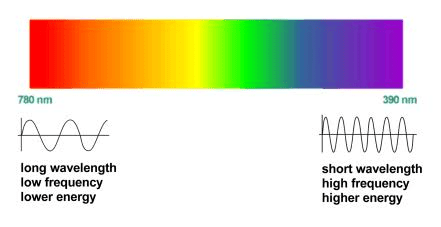
Which has the higher energy: red light or violet light?
Violet light.
100
Write the full ground-state electron configuration of neutral boron.
1s² 2s² 2p¹
Boron has 5 electrons.
100
What is the maximum number of electrons in one orbital?
Two electrons.
When an orbital contains two electrons, their spins must be opposite.
100
How many valence electrons does a neutral selenium atom have?
Six.
Selenium belongs to Group 16. Its outer shell is 4s² 4p⁴.
100
Name the property that measures an atom’s ability to attract shared electrons in a bond.
Electronegativity.
Higher electronegativity means a stronger attraction for bonding electrons.
100
A neutral molybdenum atom (Mo) has atomic number 42.
Write its full ground-state electron configuration.
Write its abbreviated noble gas configuration.
A molybdenum atom loses four electrons to form Mo⁴⁺. Predict whether this ion has a larger or smaller radius than the neutral atom. Explain your reasoning.
1) 1s² 2s² 2p⁶ 3s² 3p⁶ 4s² 3d¹⁰ 4p⁶ 5s¹ 4d⁵
2) [Kr] 5s¹ 4d⁵
3) Mo⁴⁺ has a smaller radius than neutral Mo. Losing electrons reduces electron–electron repulsion while the number of protons stays the same, so the nucleus pulls the remaining electrons closer.
200
An electron absorbs just enough energy to move from the second energy lever 2 to the fourth energy level. What state do we call this and say whether the atom gained or lost energy.
Excited state. The atom gained energy.
Absorption raises an electron to a higher allowed energy level.
200
A wave’s wavelength doubles in a vacuum. What happens to its frequency?
Its frequency is cut in half.
Wavelength and frequency have an indirect relationship. As frequency gets larger, the wavelength gets shorter (smaller number).
200
Name the neutral element with configuration 1s² 2s² 2p⁶ 3s² 3p⁶ 4s¹.
Potassium (K).
The configuration contains 19 electrons, so a neutral atom has atomic number 19.
200
A student fills 3p before 3s in a ground-state atom. Which principle does this break or describe why this rule is being broken?
The Aufbau principle.
Electrons occupy the lowest energy available orbitals of lower energy first.
200
Draw the Lewis dot symbol for a neutral nitrogen atom.
200
Rank Be, Mg, and Ca from smallest to largest atomic radius.
Be < Mg < Ca.
Radius increases down Group 2 as occupied energy levels and shielding increase.
300
Different Question?
A student says an orbital is a circular path. Explain what an orbital represents in the quantum mechanical model.
A region where there is a high probability of finding an electron.
The quantum model describes probability distributions rather than fixed circular paths.
300
Calculate the energy of a photon with frequency 6.20 × 10¹⁴ Hz.
4.11 × 10⁻¹⁹ J
E = hν
E= (6.626 × 10⁻³⁴ J·s)(6.20 × 10¹⁴ s⁻¹)
300
Write the noble gas configuration of neutral scandium.
[Ar] 4s² 3d¹
300
A student writes the following orbital notation for neutral nitrogen.
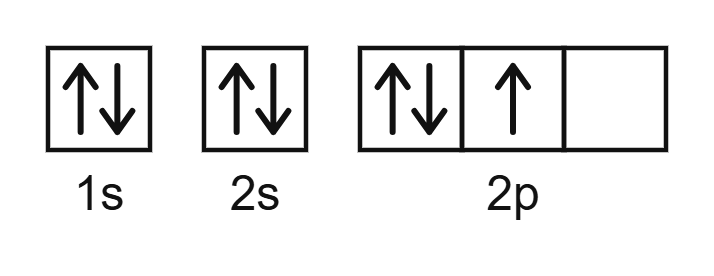
Is this the correct orbital diagram? If not, how would you fix it? Also, either name the rule that is being broken or explain what the rule says.
Correct diagram for neutral nitrogen.
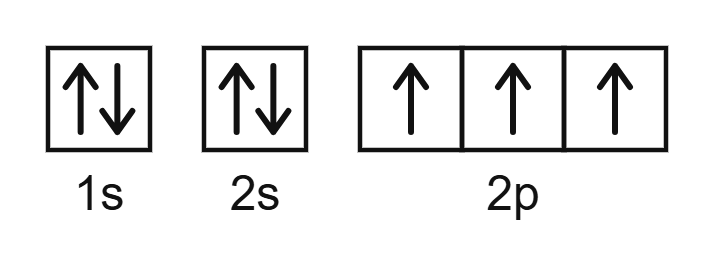
Hund's rule was being broken which states that one electron in each orbital all with the same spin.
300
A neutral aluminum atom reaches a noble gas electron arrangement. How many electrons does it gain or lose, and what ion forms?
It loses 3 electrons and forms Al³⁺.
Al has 13 electrons. Losing 3 leaves the neon arrangement with 10 electrons.
300
Which has the higher first ionization energy, Rb or Sr? Explain using their positions in Period 5.
Sr.
Across a period, increasing nuclear charge generally holds outer electrons more tightly. Sr is to the right of Rb.
400
After absorbing energy, an electron drops from the 5th energy level to the 3rd energy level. Is a photon created? If so, does the atom absorb or emit a photon? Must this electron now be in its ground state or is it still in the excited state? How do we see this photon?
A photon is created and is emitted from the atom. As it goes back down into the ground state, that is when the photon is release. When the photon is release, it travels at different wavelength that we see as color.
400
A spectral line has wavelength 510 nm. Calculate its frequency. Show the conversion to meters (1nm = 1.00 x 10⁻⁹ m).
5.88 × 10¹⁴ Hz
510 nm = 5.10 × 10⁻⁷ m.
ν = c/λ = (3.00 × 10⁸)/(5.10 × 10⁻⁷)
400
Write the full electron configuration of O²⁻ and explain how you determined its electron count.
1s² 2s² 2p⁶. It has 10 electrons.
Oxygen has 8 protons. A 2− charge means it has gained 2 electrons. 8 + 2 = 10
400
A student writes the following orbital notation for neutral flourine.
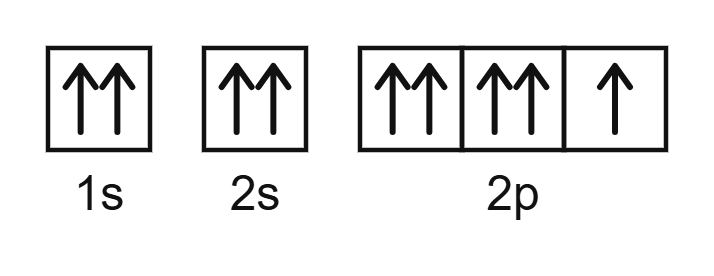
Is this the correct orbital diagram? If not, how would you fix it? Also, either name the rule that is being broken or explain what the rule says.
Correct diagram for neutral flourine.
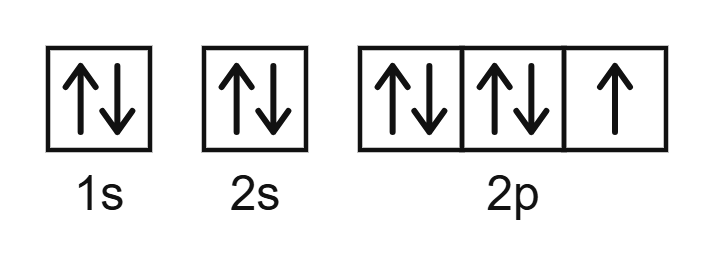
Pauli exclusion principle is being broken. It states that when 2 electrons occupy an orbital, they must have opposite spins.
400
Draw a Bohr-style shell arrangement for Li⁺. State its proton, neutron and electron count.
Li⁺
Protons - 3
Neutrons - 4
Electrons - 2
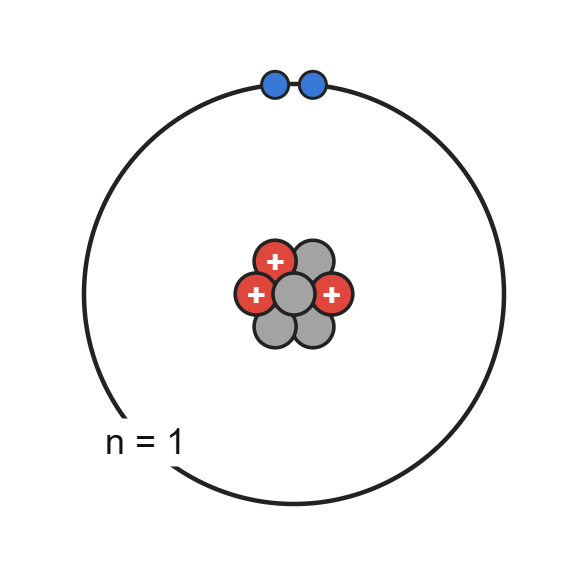
Li⁺ has 1 less electron. 3-1 = 2 electrons
400
Compare the radius of neutral calcium with Ca²⁺. Which is smaller, and why?
Ca²⁺ is smaller.
Calcium loses its two 4s electrons, removing the occupied outer shell. The same nucleus attracts fewer electrons.
500
Two atoms emit photons after different energy drops. Atom A releases twice as much energy as atom B. Compare their photons’ frequencies and wavelengths. (Does A doubles or halves B's frequency? Does A doubles or halves B's wavelength?)
A has twice B’s frequency and half B’s wavelength.
Energy and Frequency have a direct relationship. As energy increases, so does frequency.
Energy and Wavelength have a indirect relationship. As wavelength gets shorter (smaller number), then energy increases.
500
Show work.
A photon has energy 3.60 × 10⁻¹⁹ J. Calculate its wavelength in meters.
m = 5.5217 x 10⁻⁷ m or 5.52 x 10⁻⁷ m
λ = hc/E = 5.5217 × 10⁻⁷ m. Multiply meters by 10⁹ to obtain nanometers.
500
Write the noble gas configurations of K⁺ and S²⁻. Explain why different elements can share this configuration and what do we call this phenomenon.
Both are [Ne] 3s² 3p⁶.
K⁺ has 19 − 1 = 18 electrons. S²⁻ has 16 + 2 = 18. They are isoelectronic.
500
For the third energy level, name every allowed sublevel and give the number of orbitals and maximum electrons in each. Also, state the maximum number or electrons that can occupy the third energy level.
3s: 1 orbital, 2 electrons. 3p: 3 orbitals, 6 electrons. 3d: 5 orbitals, 10 electrons.
Total capacity of the third energy level: 18 electrons.
500
A student draws the following for neutral He.

The student's reason is because He is a noble gas. Correct the drawing and explain helium’s stability.

The student should have two dots. Its first energy level is full with 1s². The first shell holds only 2 electrons. Helium has a filled valence shell without an octet.
500
Rank P, S, and Cl from lowest to highest electronegativity. Explain why atomic radius generally changes in the opposite direction across this period.
P < S < Cl. Atomic radius generally decreases from P to Cl.
Nuclear charge increases while electrons enter the same main energy level. The greater effective attraction pulls electrons closer and strengthens attraction for shared electrons.