ROCKS
LANDFORMS
MAPS & HEIGHTS
ESTONIA
VARIA
100
Name one rock.
Granite, limestone, sandstone, etc.
100
What is a landform?
A natural shape or feature of Earth's surface.
100
What do different colours show on a physical map?
Elevation and depth.
100
Is Estonia mostly flat or mountainous?
Mostly flat.
100
What planet do we live on?
Earth
200
Name one sedimentary rock found in Estonia.
Limestone or sandstone.
200
Name three landforms.
Hill, mountain, valley, plain, etc.
200
What is absolute height?
Height above sea level.
200
Name one upland in Estonia.
Haanja, Otepää, Pandivere, etc.
200
Name three wild animals that live in Estonia.
Moose, roe deer, fox, wolf, brown bear, wild boar, etc.
300
What is a fossil?
The remains or traces of an ancient living organism.
300
What is the difference between a hill and a valley?
A hill rises above the surrounding land; a valley is a low area between higher land.
300
What is a contour line?
A line connecting places at the same elevation.
300
What is the highest point in Estonia?
Suur Munamägi (318 m).
300
Which organ pumps blood around the human body?
The heart
400
What is the difference between an igneous rock and a sedimentary rock?
Igneous rocks form when magma or lava cools and hardens. Sedimentary rocks form from sediments.
400
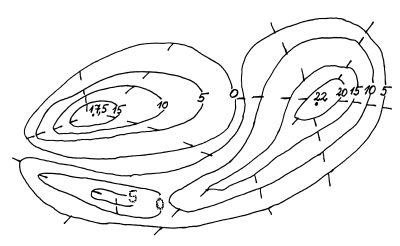 How can you recognise a steep slope using contour lines?
The contour lines are close together.
400
What is the difference between absolute and relative height?
Absolute height is measured from sea level; relative height is the height difference between two places.
400
Name one lowland in Estonia.
Pärnu Lowland, Peipsi Lowland, etc.
400
What is the largest animal in the world?
The blue whale
500
How did large granite boulders get to Estonia?
Glaciers carried them from Scandinavia during the Ice Age.
500
What is the difference between a landform and relief?
A landform is one natural shape of Earth's surface, such as a hill or valley. Relief describes all the landforms in an area.
500
Point A is at 40 m and the hilltop is at 110 m. What is the relative height?
70 m (110 − 40).
500
Which part of Estonia generally has higher land – northern, southern, eastern or western Estonia?
Southern Estonia.
500
Name all eight planets in our Solar System in the correct order, starting from the Sun.
Mercury, Venus, Earth, Mars, Jupiter, Saturn, Uranus, Neptune