SCIENCE SKILLS 1
SCIENCE SKILLS 2
EARTH, SUN & MOON
THE SOLAR SYSTEM
SEASONAL CHANGE
SCIENTIFIC EQUIPMENT & MEASUREMENTS
100
D-Tails is an acronym we use to ensure we have included everything we need in a graph. What does the “T” in D-TAILS stand for?
Title
100
What does the “A” in D-TAILS stand for?
Axes labelled
100
What movement of Earth causes day and night?
Rotation
100
Which planet is closest to the Sun?
Mercury
100
What is the equator?
An invisibvle line eeparating the northern and southern hemisphere.
100
Which tool measures liquid volume accurately?
Measuring cylinder
200
What type of graph should be used for each of the following data:
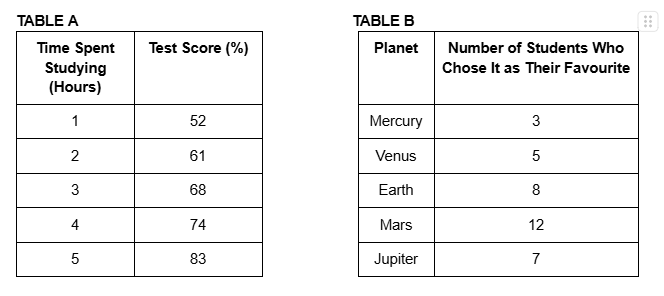
Table A - Libne graph as both independent and dependent variables are quantitative (numerical)
Table B - Column graph as the independent variable is categorical
200
What is the average of:
8, 10, 12, 14
What formula would you use to calculate the average
the sum of each number, then divide by how mamny numbers there are. e.g.
(8+10+12+14) / 4 = 11
200
Approximately how long does Earth take to rotate once?
24 hours
200
Which planet do humans live on?
Earth
200
What season occurs in Australia when the Southern Hemisphere is tilted toward the Sun?
Summer
200
Which tool measures temperature?
Thermometer
300
A student changes the amount of sunlight a plant receives.
What is the independent variable?
Amount of sunlight
300
A student recorded temperatures:
18°C, 21°C, 24°C, 25°C, 22°C
Calculate the average.
22°C
300
Why does one side of Earth experience nighttime?
It is facing away from the Sun
300
Place these planets in order from the Sun:
Venus, Mars, Mercury, Earth
Mercury, Venus, Earth, Mars
300
What causes seasons on Earth?
Earth’s tilted axis as it revolves around the Sun. The tilt remains the same throughout the year, and depending on the position of the Earth relative to the sun, the directy sun rays hitting the Earth changes.
When it is summer, the southern hemisphere is pointed towards the sun, and therefore, more direct sunlight is hitting the souythern hemisphere, and less is hitting the northern hemisphere
300
Which tool measures mass?

Electronic balance
400
State the difference between an observation and an inference.
Observation = something directly seen/measured
Inference = explanation based on observations
400
A student investigates how the amount of water affects plant growth.
The student changes the amount of water each plant receives and measures the height of the plants after two weeks.
Identify the:
- Independent variable
- Dependent variable
- ONE control variable
- Independent variable: amount of water
- Dependent variable: plant height/growth
- Control variable: any one of:
- type of plant
- amount of sunlight
- type of soil
- pot size
- temperature
400
What causes tides on Earth?
The Moon’s gravitational pull
400
What is the name of the star at the centre of our solar system?
The Sun
400
Why are seasons opposite in Australia and Europe?
The hemispheres experience opposite seasons because of Earth’s tilt. When the Southern Hemisphere is tilted toward the Sun, areas near the equator and the Southern Hemisphere receive more direct sunlight, causing warmer temperatures and summer. At the same time, the Northern Hemisphere is tilted away from the Sun and receives less direct sunlight, causing winter.
400
Is “The water is blue” qualitative or quantitative?
Qualitative
500
Why do scientists repeat investigations multiple times?
To improve reliability and reduce random errors
500
Identify five things that are incorrect about this graph
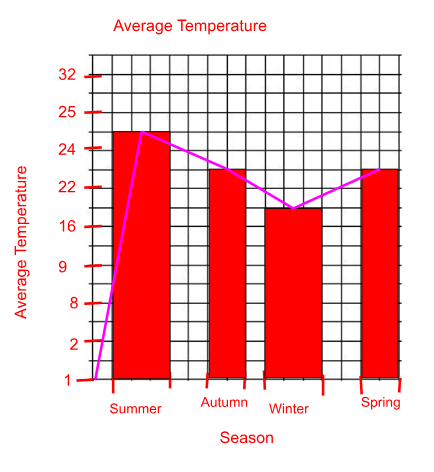
Title does not include both variables
No units on Average temperature (OC)
Scale is uneven and doesn't start from 0
There is a line in the data and there shouldn't be as it is a column graph
The columns are uneven in width and distance
500
Explain why tides change during the day.
The Moon’s gravity pulls on Earth’s oceans as Earth rotates, and the Sun's gravity also influences this. This causes water levels to rise and fall.
500
Why is Mars colder than Earth?
It is further away from the Sun
500
Explain why daylight hours are longer during summer.
The hemisphere tilted toward the Sun receives sunlight for a longer period each day.
500
Is “The liquid temperature is 32°C” qualitative or quantitative?
Quantitative